
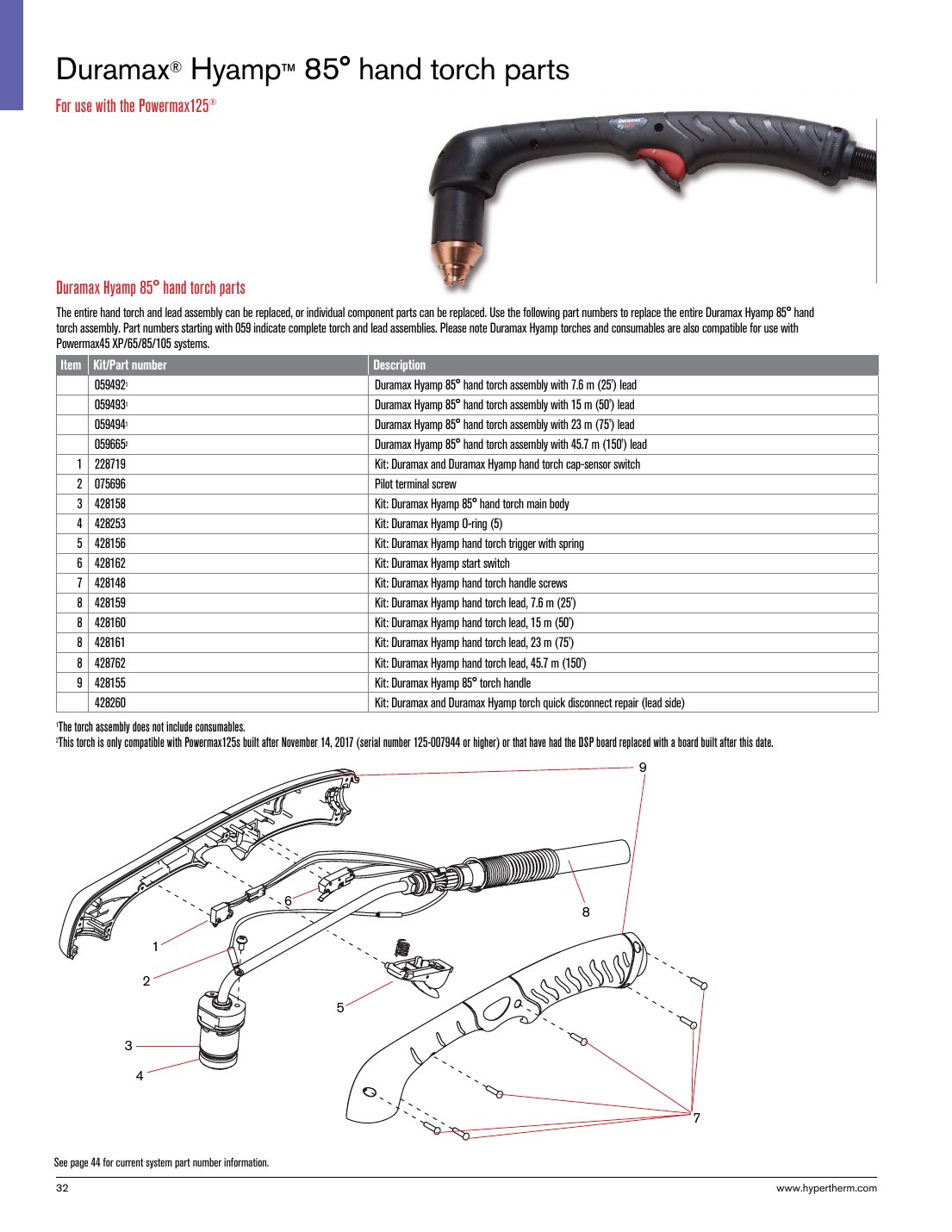
If you service plasma cutters in the field or on the shop floor, the Hypertherm Duramax Hyamp hand torch is a parts-and-wear-item system, not a single replace-all assembly. This guide gives you a practical way to identify the common replacement decision points, verify the torch condition before ordering, and use the Weld Support Parts lookup page as the catalog reference for the hand torch page tied to this model.
Key Takeaways
- Start with the torch body, electrode, shield, retaining components, and swirl-ring area when diagnosing arc-start or cut-quality issues.
- Do not assume a worn consumable is the only fault. Check the torch leads, connector condition, and visible heat damage first.
- Use the WSP lookup page as the source reference for the Duramax Hyamp hand torch page, then confirm the exact part numbers against your machine and torch setup before ordering.
- If fit, torch family, or cut current context is uncertain, treat it as Unknown (Verify) until confirmed by the machine manual or manufacturer support.
What this parts breakdown is for
The Duramax Hyamp hand torch parts breakdown is useful when a torch still powers up but starts showing weak arc transfer, rough starts, excess spatter, or shortened consumable life. In plasma service, those symptoms can come from damaged consumables, poor assembly contact, contamination, or heat damage in the torch head. A parts breakdown helps you map the visible wear point to the replacement candidate instead of swapping parts blindly.
Initial troubleshoot: check, inspect, verify
Before you order anything, use a simple sequence. This reduces wrong-part replacement and avoids masking a torch or power-source problem.
Check
- Check whether the symptom is intermittent or constant.
- Check for start-up failure, weak pilot arc, arc dropout, or poor cut face quality.
- Check the torch body for scorch marks, melted insulation, cracked front-end parts, or loose retaining hardware.
Inspect
- Inspect the electrode for deep pit wear, crater damage, or abnormal erosion.
- Inspect the nozzle/orifice for ovaling, spatter buildup, or edge damage.
- Inspect the shield and retaining components for heat distortion or thread damage.
- Inspect the swirl-ring or gas-distribution parts, if present in your setup, for cracking or contamination. Exact part relationship is Unknown (Verify) without the full manufacturer assembly data.
- Inspect the lead, trigger area, and connector interface for cuts, looseness, or overheating.
Verify
- Verify the torch model designation matches the Duramax Hyamp hand torch page you are using.
- Verify whether the issue is on the torch side or the power-source side by testing with known-good consumables, if available and approved by your maintenance process.
- Verify that the installed consumables match the torch family and operating setup. Do not assume cross-compatibility.
How to decide what to replace first
In most shop cases, the electrode and nozzle are the first wear items to evaluate. If both show normal wear but the torch still misbehaves, move outward into the shield, retaining hardware, and torch body inspection. If the front-end parts continue to fail early, look for air quality problems, incorrect assembly torque, or a torch issue upstream of the consumables.
Replace the front-end consumables when wear is obvious and the torch is otherwise intact. Replace the torch parts or assembly components when you find heat damage, thread damage, internal contamination, or repeated failure after a correct consumable change. If you cannot identify the failed element confidently, stop and verify with the catalog record and the machine documentation.
WSP lookup reference
Use the Weld Support Parts lookup page for the Hypertherm Duramax Hyamp hand torch here:
Hypertherm Duramax Hyamp Hand Torch Parts Breakdown
This page should be treated as the catalog-backed reference point for the torch family and its replacement decision path. It is a starting point for identification, not a substitute for confirming the exact torch configuration in service.
Practical replacement workflow
- Power down the plasma system and isolate energy sources before touching torch components.
- Remove the consumables and lay them out in order so wear patterns can be compared.
- Document abnormal wear: pitting, blackening, arc damage, cracking, or melted plastic.
- Check the front of the torch for debris, gas-path blockage, or physical distortion.
- Compare the torch model and consumable family to the WSP lookup page.
- Replace the worn item first, then test on a known workpiece before escalating to larger parts.
- If failure repeats immediately, stop and verify air supply quality, trigger function, lead condition, and torch head integrity.
Replacement signals that should not be ignored
- Repeated misfires after a fresh consumable install.
- Visible arc tracking, charring, or carbonization on the torch front end.
- Loose fit or unusual movement in the retaining stack.
- Consumables that wear much faster than expected compared with the job pattern. Exact life is Unknown (Verify) because duty cycle and setup vary.
- Cut quality loss that does not improve after standard cleaning and reassembly.
Filler metal page note
No filler metal finder page is provided for this topic. For plasma torch support, keep the focus on torch-family identification, wear-item inspection, and verified replacement sourcing rather than weld filler selection.
Safety notes
- Lock out and de-energize the system before removing torch parts.
- Allow hot parts to cool before inspection; plasma front-end components can retain heat longer than expected.
- Do not reuse parts that show cracking, melting, or severe erosion.
- Do not force threaded parts if they resist installation. Cross-threading can damage the torch head.
- Use only parts verified for the torch family and application. If fit is uncertain, stop and verify.
FAQ
What usually wears out first on a Duramax Hyamp hand torch?
In normal service, the front-end consumables are the first items to inspect. The electrode and nozzle are common wear points, but you should confirm the entire retaining stack and torch head condition before replacing only one part.
Can I identify the replacement part by symptom alone?
No. Symptoms narrow the search, but they do not prove the exact failed part. Use the check, inspect, verify sequence and compare the torch against the WSP lookup page before ordering.
What if the torch still misfires after I replace the consumables?
Then move upstream. Inspect air quality, connector condition, trigger circuit, lead damage, and the torch body for heat-related damage. If the cause remains unclear, treat the fit or internal configuration as Unknown (Verify) until confirmed.
Is the WSP lookup page a substitute for the manufacturer manual?
No. It is a catalog reference and ordering starting point. Safety-critical fit and procedure details still need manufacturer review or your internal maintenance standard.
Sources Checked
- Weld Support Parts: Hypertherm Duramax Hyamp Hand Torch Parts Breakdown
- Internal reference: Plasma Consumable Compatibility: How to Verify Torch Parts Before Ordering
- Internal reference: Plasma Cutter Pilot Arc Failure Troubleshooting: No Start, Weak Spark, Arc Dropout, and Torch Consumable Checks
Keep this page as a replacement decision aid, not a substitute for machine-specific documentation. When in doubt, verify the torch family, inspect the wear pattern, and confirm the part before purchase.
Disclosure: As an Amazon Associate, Weld Support Parts may earn from qualifying purchases.

Leave a Reply