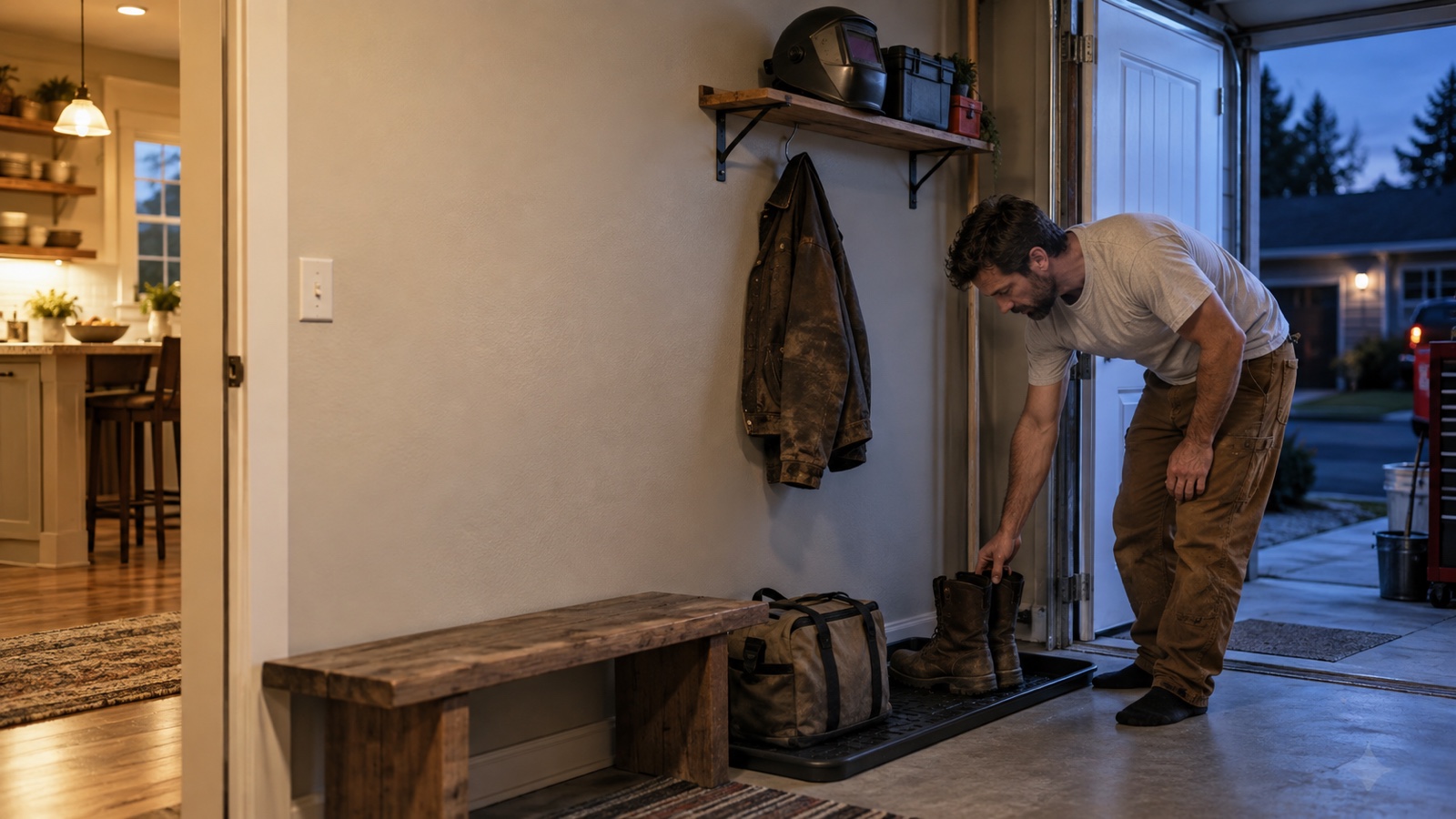
The shop does not always end at the time clock. Sometimes it rides home in the truck: dust in the floor mat, a jacket behind the seat, the smell of hot steel still caught in the fabric. The last task of the day happens at a different threshold, where work boots meet the doormat and a welder decides what crosses into the house.
That small routine rarely appears in a job description. It may be a hook in the garage, a separate laundry bag, a change of shoes at work or a pause at the back door. The details depend on the job, the employer’s controls and the hazards involved. The idea underneath them is steady: the shop has a place, and home deserves a boundary.
For welding families, that boundary is both practical and personal. It protects clean space from dirty gear. It also marks the moment a shift stops asking for a worker’s full attention.
Work has a way of traveling
Metalwork leaves evidence. A cuff can catch grinding dust. Boot treads find every corner of a cab. A marker, tape measure or pair of gloves can migrate from the bench to the center console without anyone making a plan for it.
Not every welding job presents the same exposure. OSHA’s welding, cutting and brazing chemical overview notes that the metals present depend on the material being worked, welding rods, fluxes and related factors; coatings and residues can change the picture, too. That is why the safety data sheet, the employer’s hazard assessment and the site’s procedures matter more than a universal shop-floor rule.
The larger principle is well established. The National Institute for Occupational Safety and Health explains on its current take-home exposure page that workplace chemicals can travel on skin, hair, clothes and shoes and reach vehicles or living spaces. NIOSH’s first recommendation is to keep contaminants from leaving the workplace, using measures such as protective clothing, changing before departure and keeping dirty workwear separate from clean items.
That guidance is not a reason to panic over every dusty knee. It is a reason to know what the work involves and treat the boundary deliberately. A home routine cannot replace ventilation, exposure control, training, laundering arrangements or other employer responsibilities. It is the last handoff, not the whole safety program.
The entryway becomes a tiny piece of shop design
Welders tend to notice systems that either work or create friction. A fixture is useful because it gives every part a home. A shadow board makes a missing tool obvious. The best mudroom routines follow the same logic.
The dirty side and the clean side are easy to understand. There is a reliable place for boots, a place for outerwear and a place for whatever should go back to work. Clean clothes do not have to share a pile with the day’s gear. The arrangement is simple enough to follow after a long shift, not only on the day somebody reorganizes the garage.
That last point matters. A complicated ritual will eventually lose to fatigue, groceries or a doorbell. A useful boundary depends less on a perfect-looking room than on good placement: the boot tray where a person naturally stops, the hook that can take the weight of a jacket, the container that closes, the clean change that is already in the truck or locker.
Specific controls should come from the hazards and the workplace plan. NIOSH publishes separate, stricter instructions for workers dealing with lead, including guidance to leave contaminated tools, scrap and packaging at work and to keep work clothes apart from household laundry. Those details are for lead exposure, not a slogan to paste onto every welding job. The broader lesson is to avoid improvising once a known contaminant is involved.
A boundary also helps the person inside the gear
Workwear has a way of carrying identity. A broken-in jacket fits like a record of the jobs it survived. Boots reveal the floor conditions. A helmet can feel more personal than almost anything else in the truck.
Taking those things off is not rejecting the trade. It is changing roles.
At the shop, awareness reaches outward: the arc, the grinder, the forklift lane, the person entering the booth. At home, attention has somewhere else to go. The dog needs out. Dinner is getting cold. Somebody wants to explain what happened at school. A short, familiar transition helps the mind catch up with the body.
Some people use the drive. Some sit in the truck for one quiet song. Some wash up, change shirts and become available the moment the work clothes come off. None of those habits proves toughness or balance. They simply acknowledge that a person can be proud of the job without asking the whole household to live on shop time.
There is respect in that separation. The family does not get the leftover version of the welder by default. The welder does not have to perform the shift all evening. Home can be where the shoulders drop.
The best routine belongs to the real household
There is no prize for the most elaborate mudroom. A one-bedroom apartment, a farmhouse, a shared rental and a house with three children will not use the same setup. The right questions are more useful than a staged answer: What hazards are actually present? What does the employer provide? Where can gear be stored without mixing it into living space? What routine can the household sustain every day?
If the answers are unclear, the employer’s safety professional, union representative or a qualified occupational-health resource is the place to start. The point is not to shift a workplace problem onto a worker’s washing machine. It is to make the line between work and home visible enough that nobody has to guess.
So here is the community question: what is the one end-of-shift habit that tells your household—and your own head—that the shop is staying on the other side of the door?
Arc Life follows the trade beyond the booth, into the ordinary rituals that make a working life sustainable. Find more welding culture and shop-built perspective at The Welder’s Life.

Leave a Reply