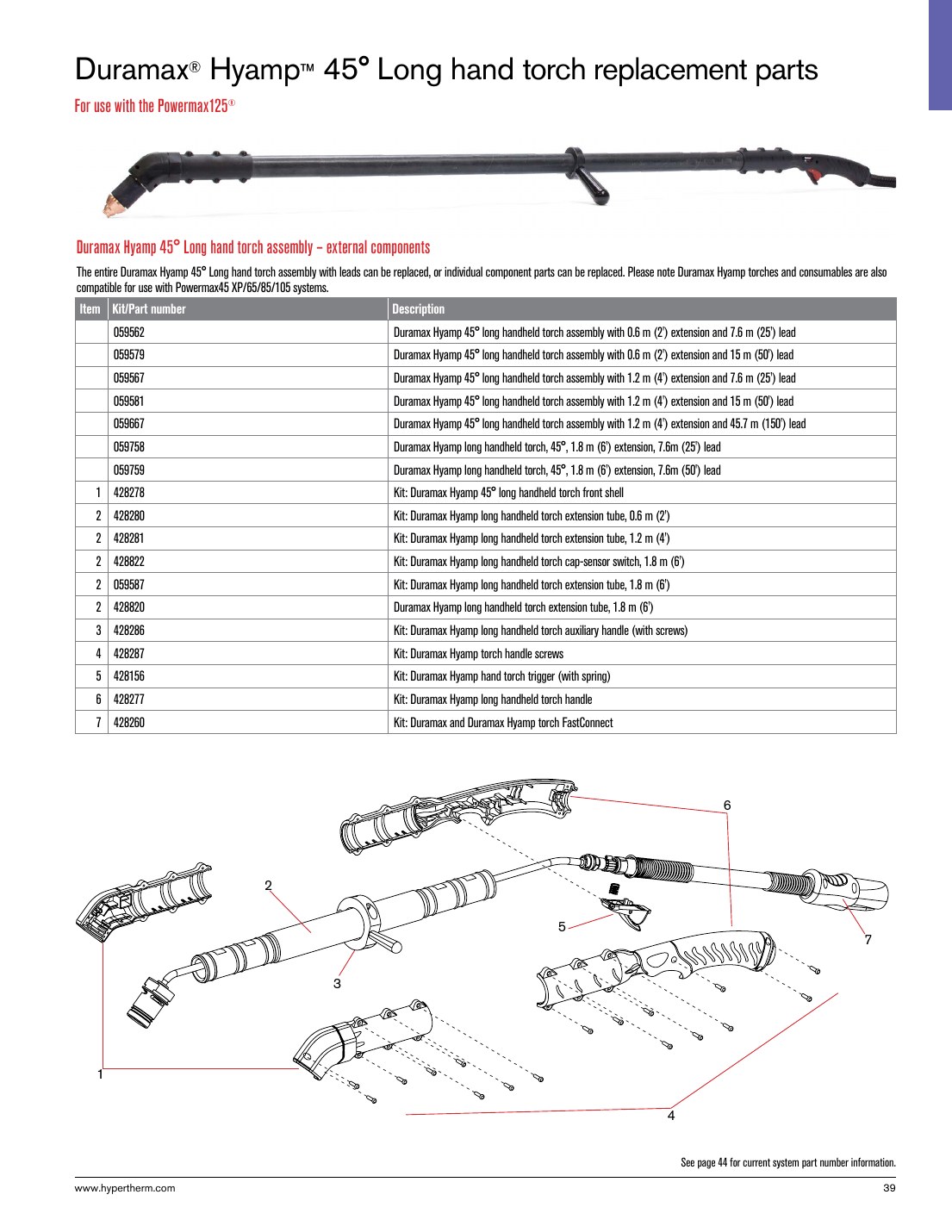
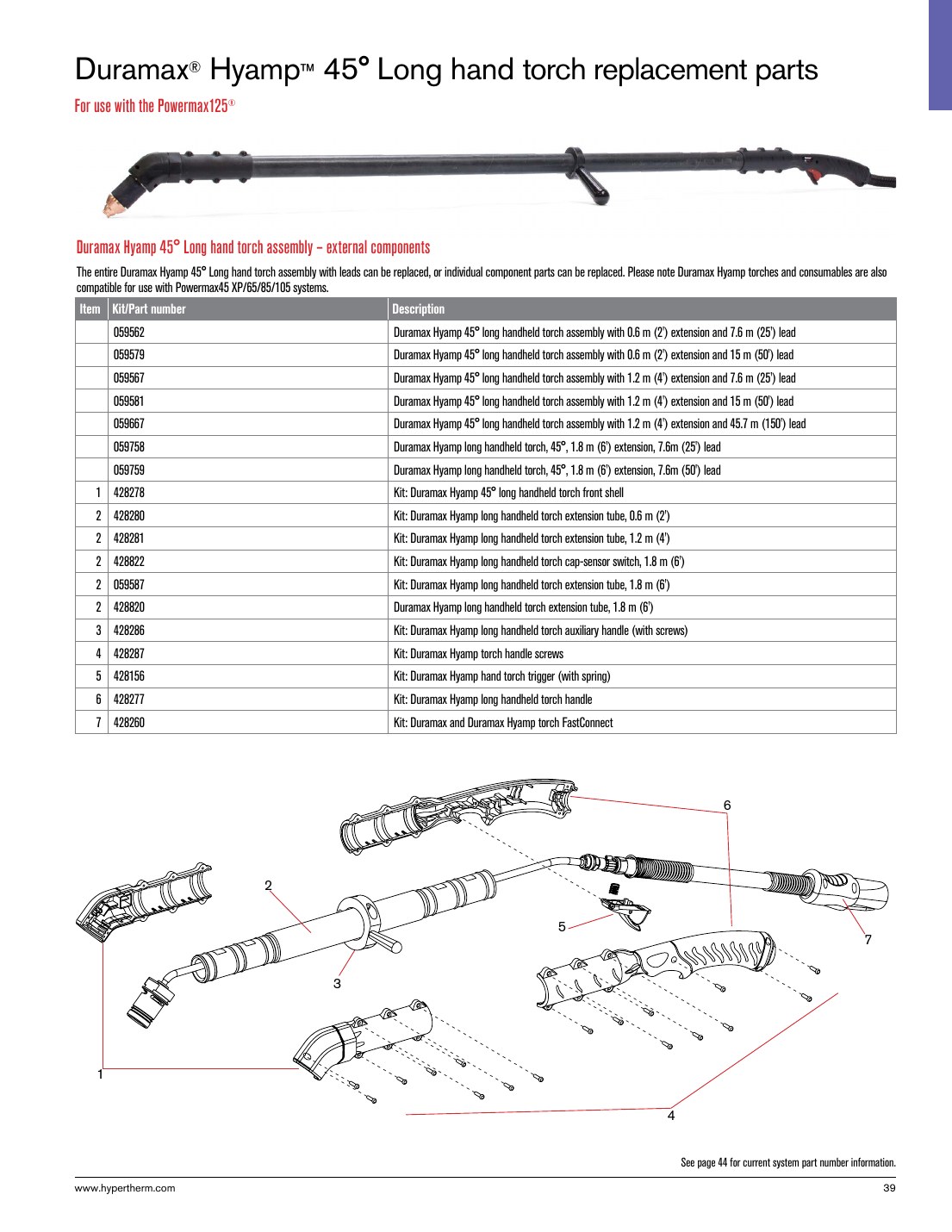
When a Hypertherm Duramax Hyamp long hand torch starts cutting poorly, the first question is usually whether the problem is a worn consumable, a torch-body issue, or a machine-side fault. The right replacement decision depends on inspection, not guesswork. This guide gives a practical breakdown approach for field use: check the visible wear points, verify the torch setup against the parts lookup, and confirm the fault before ordering parts.
Key Takeaways
- Start with the consumables before replacing torch-body parts.
- Inspect, clean, and verify the torch parts path from power source to nozzle.
- Use the Weld Support Parts lookup page as the source reference for this torch family: Hypertherm Duramax Hyamp Long Hand Torch Parts Breakdown.
- If a fit, rating, or part number is not clearly confirmed, treat it as Unknown (Verify).
- Do not replace parts only because of arc instability; verify air supply, torch condition, and machine fault indicators first.
Replacement decision workflow
For a torch that is cutting poorly, follow this sequence before ordering anything:
- Check the consumables. Remove the torch parts and inspect for heat damage, erosion, ovalized or enlarged openings, cracked ceramics, or heavy spatter build-up.
- Inspect the torch body. Look for burn marks, damaged threads, loose retaining parts, cut insulation, or evidence of overheating near the head.
- Verify the fit. Match the torch model and consumable family to the parts breakdown page before selecting a replacement.
- Confirm the machine condition. If the torch fault repeats with fresh consumables, check air quality, power source output, and torch lead damage.
- Document the failure pattern. Note whether the issue is no-start, intermittent arc, rapid nozzle wear, excessive dross, or unstable arc transfer.
What to inspect first
Check the nozzle. A worn nozzle usually shows enlarged or distorted orifice shape, heat discoloration, and poor arc focus. If the nozzle has visible damage, replace it as a set with the matching consumables required by the system.
Inspect the electrode. Look for deep crater wear, severe pitting, or an end-of-life condition that exceeds normal use. If the electrode is heavily worn, do not assume the shield or swirl ring is still serviceable.
Inspect the shield and swirl ring area. Debris, spatter, or carbon tracking can affect arc initiation and cut quality. Clean only with methods appropriate for plasma parts; do not scrape precision surfaces aggressively.
Verify torch assembly condition. If the retaining parts do not tighten correctly or the torch head shows heat damage, the issue may be beyond consumables. That is a torch-body replacement decision, not just a parts swap.
How to verify before you buy
Use this practical checklist:
- Check model identification: confirm the torch is the Duramax Hyamp long hand torch, not another Hypertherm torch family.
- Inspect the part path: confirm which item is worn by comparing the old part to the breakdown reference.
- Verify machine context: make sure the torch is being used on the intended plasma system. If the machine context is unclear, mark it Unknown (Verify).
- Inspect for system faults: repeated consumable failure can point to air contamination, incorrect installation, or lead damage.
- Document the result: keep a simple note of which part failed and after how many starts or cutting hours.
WSP lookup section
The Weld Support Parts lookup page for this torch family is the starting point for catalog-backed identification and replacement decisions: Hypertherm Duramax Hyamp Long Hand Torch Parts Breakdown.
Use that page to confirm the torch family, compare the visible parts against the breakdown, and narrow the replacement list. If a part number or subassembly is not clearly confirmed from the available record, do not assume it matches. Use Unknown (Verify) until the fit is confirmed by the manufacturer or an authorized source.
Common support issues and what they usually mean
No start: Check the consumables first, then verify torch lead connections, work lead condition, and machine-side error codes if available.
Weak spark or arc dropout: Inspect the electrode and nozzle wear, then verify correct assembly order and clean contact surfaces.
Poor cut edge quality: Check for nozzle wear, swirl ring contamination, incorrect standoff, or an air quality problem.
Frequent consumable failure: Verify whether the torch is being run within the intended setup. Repeated failure can indicate a torch-body fault, not just normal wear.
Safety notes
- De-energize the machine before opening the torch or removing consumables.
- Allow hot parts to cool before handling.
- Do not touch plasma parts with bare hands if contamination control is required for your process.
- Replace damaged torch parts immediately; do not keep using parts with visible heat damage or cracked insulation.
- If the failure involves overheating, burning, or repeated arc instability, stop and inspect the full torch circuit before resuming work.
FAQ
How do I know whether to replace a consumable or the whole torch?
Start with the consumables. If the failure repeats after a correct consumable replacement and the torch body shows heat damage, loose threads, or insulation damage, the torch itself may need service or replacement.
Can I identify the correct part by visual inspection alone?
Visual inspection is the first step, but not enough by itself. Verify the torch family and the part path against the lookup page before ordering.
What if the torch cuts poorly even with new parts?
Check air supply quality, torch lead condition, installation order, and machine-side faults. Poor cut quality is not always a consumable problem.
Is the lookup page enough to approve a replacement?
It is a starting point for identification and comparison. If compatibility or fit is not clearly confirmed, treat it as Unknown (Verify) and confirm with the manufacturer or an authorized source.
Sources Checked
- Weld Support Parts: Hypertherm Duramax Hyamp Long Hand Torch Parts Breakdown
- Plasma Consumable Compatibility: How to Verify Torch Parts Before Ordering
- Plasma Cutter Pilot Arc Failure Troubleshooting: No Start, Weak Spark, Arc Dropout, and Torch Consumable Checks
Use the lookup page, inspect the worn parts, and verify the torch setup before ordering replacements. That approach reduces wrong-part buys and helps isolate whether the fault is in the consumables, the torch body, or the machine.
Disclosure: As an Amazon Associate, Weld Support Parts may earn from qualifying purchases.

Leave a Reply