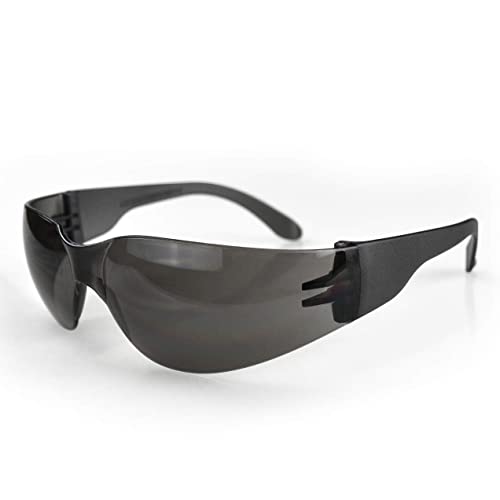

Shop safety eyewear fails for simple reasons: wrong fit, poor lens condition, and buying by appearance instead of job use. The Radians Safety Glasses Mirage USA Smoke Frame and Lens MR0120ID, Order of 12 is a jobsite purchase that should be checked the same way you would inspect any other personal protective equipment. Start with the task, then verify the frame, lens condition, and user fit before putting it into service.
For welding support teams, maintenance buyers, and fabricators, the buying decision is less about the label and more about whether the glasses will be worn consistently, stay positioned during work, and hold up to the environment. The listed source information identifies a smoke-frame and smoke-lens style in an order of 12. Beyond that, technical details such as exact lens rating, coating, or certification status are Unknown (Verify) unless confirmed by the manufacturer or the current product record.
Key Takeaways
- Match eye protection to the actual task and nearby hazards, not just to the work area.
- Inspect each pair on arrival for lens scratches, frame damage, and poor hinge action.
- Verify fit on multiple users if the purchase is for shared stock or issue bins.
- Do not assume smoke lenses are suitable for all indoor work or all lighting conditions.
- Use the source listing as a starting point; confirm safety-critical details with the manufacturer or approved documentation.
Application Checks Before You Buy
Before ordering by the dozen, check where the glasses will actually be used. In a fabrication shop, smoke lenses may be acceptable for bright environments, but they can reduce visibility in low-light spaces, inside enclosures, or on gray days near doors and dock areas. That makes task review important.
Check: the work area lighting, nearby arc flashes, grinding spark exposure, and whether users need general-purpose eye protection or a more specific task-based solution.
Inspect: existing stock for wear patterns. If most glasses are scratched, slipping, or uncomfortable, the issue may be fit rather than supply.
Verify: that the intended users can wear the frame style with other required PPE such as hard hats, face shields, hearing protection, or respirators. If that interaction is not confirmed, treat it as Unknown (Verify).
Buying Checks for Order-of-12 Purchases
Bulk buying is useful only if the inventory can be issued without returns. For this item, verify whether the order of 12 is meant for a single crew, a stocked spares cabinet, or rotation after loss and damage. That matters because eyewear wear-out is usually caused by scratches, dropped lenses, and rough storage rather than normal use alone.
Check: the receiving process. Each pair should be counted, visually inspected, and assigned to a bin or user before the box goes into general stock.
Inspect: the packaging for crushed corners, opened seals, or evidence of transit damage. If the outer box is damaged, inspect every pair before issue.
Verify: the expected replacement cycle with the site supervisor or safety lead. If the schedule is not established, use Unknown (Verify) and set a local re-order trigger based on breakage rate and loss rate.
Troubleshooting and Support Checks
If the glasses are not being worn, the problem is usually one of three things: poor comfort, poor visibility, or poor compatibility with other PPE.
Comfort issue: Have the user wear the frame for several minutes while moving, bending, and looking down at the work. If the temples pinch or the frame slides, record the issue and verify whether another frame size or style is needed.
Visibility issue: Test the lenses in the actual job lighting. Smoke lenses can be too dark for indoor service work or shaded areas. If the user has to remove the glasses to see detail, the lens choice is wrong for that task.
PPE compatibility issue: Fit the glasses with the other required items. Check ear cup clearance, hard-hat brim interference, and whether the frame lifts when a face shield is lowered. If that interaction is not documented, mark it Unknown (Verify).
Damage issue: Remove any pair with deep scratches, cracked lenses, warped frames, or loose hinges. Do not issue damaged eye protection for jobsite use.
Inspect, Verify, and Replace
Use a simple issue-bins checklist so the same failure does not repeat.
Inspect: lens clarity, frame symmetry, hinge movement, temple tension, and how the glasses sit on the bridge of the nose.
Verify: that each user can wear the glasses while looking up, down, and side to side without constant repositioning.
Replace: any pair that cannot pass a visual check, that causes pressure points, or that interferes with required PPE.
If your site requires a specific performance standard, treat the standard as Unknown (Verify) until confirmed by the manufacturer documentation or site safety program.
Related Buying Reference
For broader context on eye protection selection, see Welding Safety Glasses Guide 2025 | Shade Numbers, ANSI Z87.1 & UV Protection. That guide is useful as a starting point for understanding eye protection decisions, but task approval still depends on the actual job, environment, and current safety requirements.
If your site also tracks other PPE such as head protection, review Jackson Safety 14834 SC-6 Hard Hat Review: Basic Head Protection for Shop and Jobsite Use for another example of fit and task-based checking.
Safety Notes
- Do not use scratched or cracked eyewear for hazardous work.
- Do not assume smoke lenses are acceptable for all indoor tasks.
- Do not mix unverified PPE assumptions with safety-critical decisions.
- If a user needs prescription eyewear integration, verify the requirement separately; Unknown (Verify) unless documented.
- Eye protection should be selected with the site safety program, not guessed from a catalog image.
FAQ
Are these glasses suitable for all welding tasks?
No. The available source information identifies smoke-frame and smoke-lens safety glasses, but task suitability for welding-adjacent work is Unknown (Verify). Confirm against the specific hazard, lighting, and site safety rules before issue.
What should I check when receiving an order of 12?
Count every unit, inspect lenses for scratches or cracks, check the frame for warping, and verify hinge movement. If the box was damaged in transit, inspect every pair before stocking it.
Can I use smoke lenses indoors?
Sometimes, but not automatically. Smoke lenses can reduce visibility in low-light areas. Verify with the actual work area and the user’s task before deciding.
What if the glasses do not fit with a hard hat or face shield?
Do not force the issue. Verify compatibility with the full PPE set. If the interaction is not known, treat it as Unknown (Verify) and select a different eyewear style if needed.
Sources Checked
- ArcWeld product source: Radians Safety Glasses Mirage USA Smoke Frame and Lens MR0120ID, Order of 12
- Provided product summary for safety glasses Mirage smoke frame and lens, order of 12
- Provided internal links for related PPE guidance
Related Arc Weld Part
Radians Safety Glasses Mirage USA Smoke Frame and Lens MR0120ID, Order of 12
Safety Glasses Mirage Smoke Frame and Lens, Order of 12
View at Arc Weld Store
Leave a Reply