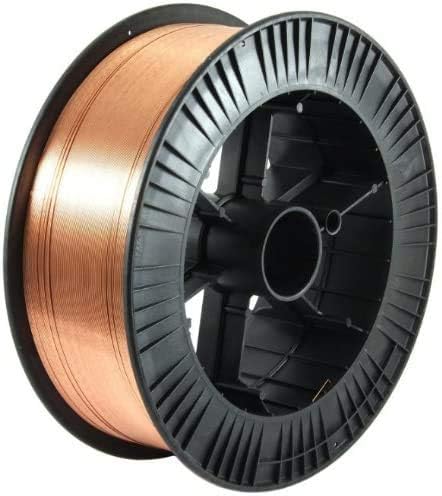

Washington Alloy 33 Lb. Spool Mig Welding Wire 80S-D2 Mild Steel (.045 X 33 lb.) is a solid MIG wire aimed at joining and buildup work on mild steel and some low alloy steels. The product description identifies it as 80S-D2 wire and notes use on problem steels, including material with higher sulfur content and certain carbon and low alloy Cr-Mo base metals. Treat that description as a starting point, not a procedure approval. Final suitability depends on the base metal, joint design, shielding gas, welding position, and code or customer requirements.
If you are buying wire for production, maintenance, or repair work, the first question is not spool size. It is whether the filler metal matches the job. Check the work order, the base metal identification, and the required weld properties before loading the gun.
Key Takeaways
- 80S-D2 is described as a low alloy solid MIG wire for mild steel and select low alloy steels.
- The product description points to higher strength output, stable arc, low spatter, and a flat bead profile.
- .045 in. wire is a common production diameter, but machine settings and feed system capacity must be verified.
- Do not assume this wire is approved for every carbon or Cr-Mo repair. Verify the procedure first.
- When the job is critical, confirm weld procedure, shielding gas, and mechanical property targets before welding.
What This Wire Is Intended For
Based on the supplied product information, this wire is meant for general welding on mild steel and low alloy steels where a stronger deposit is desired than a basic mild steel filler may provide. The description also mentions good arc stability and low spatter. That can help in production work, but only if the machine, drive rolls, liner, and gas coverage are set correctly.
Use the product page as the primary reference for the seller’s intended use:
[arcbox product=”washington-alloy-33-lb-spool-mig-welding-wire-80s-d2-mild-steel-045-x-33-lb”]
Where It May Fit in the Shop
Typical decision points for a shop buyer or lead welder include maintenance welds, fabrication on mild steel structures, repair work on unknown or mixed-condition carbon steel, and selected low alloy applications. That said, “problem steels” is a broad label. It does not replace material verification. If the base metal is unknown, suspect, or heat-treated, inspect the job requirements before choosing wire.
Troubleshooting and Support Checks
When a weld does not look right, work through the system in order.
1) Check the base metal
- Check: Is the base metal mild steel, low alloy steel, or something else?
- Inspect: Look for mill scale, rust, oil, galvanizing, coatings, or prior repairs.
- Verify: Confirm the material spec or job ticket before assuming 80S-D2 is appropriate.
2) Check the procedure
- Check: Is there a WPS or repair instruction for this joint?
- Inspect: Confirm joint type, thickness, position, and preheat requirements if any are listed.
- Verify: Do not use this article or the product description as procedure approval. Unknown (Verify).
3) Check the machine and feed path
- Check: Is the feeder sized and set up for .045 wire?
- Inspect: Look at drive roll type, liner condition, contact tip wear, and spool tension.
- Verify: Wire feed must be smooth and consistent before production welding starts.
4) Check shielding gas and coverage
- Check: Is the gas type set for the wire and procedure being used?
- Inspect: Leaks, flow restriction, loose fittings, damaged nozzles, and excessive stickout.
- Verify: Gas selection is not provided in the source data. Unknown (Verify).
5) Check weld appearance
- Check: Does the bead show excessive spatter, undercut, porosity, or poor tie-in?
- Inspect: Travel speed, voltage, wire feed speed, and gun angle.
- Verify: If defects continue, stop and correct the root cause before continuing.
Selection Notes for Buyers
For purchasing, the main value of a wire like this is its application range and the expected deposit behavior. The supplied description claims strong mechanical performance in the 100,000 psi range and good impact values, but those statements should be treated as manufacturer or seller claims unless your own procedure, test report, or spec sheet confirms them. Unknown (Verify).
Also verify spool handling details before ordering. The product title lists a 33 lb. spool and .045 diameter, but any other machine compatibility details are not provided here. Unknown (Verify).
How to Use Internal Guidance Pages
If you are still deciding between filler metals, use the Weld Support Parts blog library as a selection aid. These pages help compare wire families and identify likely candidates, but they are not guaranteed approvals for your job.
- Blue Demon ER70S-6 Mild Steel MIG Welding Wire (ER70S-6)
- E70S-6 Solid MIG Wire vs E71T-1 Flux Core Wire
- Best MIG Wire for Stainless Steel (ER308L vs ER309L)
Use these pages to compare wire families, then verify against the job spec. Selection aid only. Not procedure approval.
Safety Notes
- Ventilation matters. Fume control is required for MIG welding operations.
- Clean the work area before welding to reduce spatter ignition and contaminant-related porosity.
- Wear appropriate eye, hand, body, and hearing protection.
- Do not weld on unknown plated, coated, or contaminated material without verifying the hazard.
- Follow shop lockout, hot work, and fire watch rules where required.
FAQ
Is Washington Alloy 80S-D2 the same as a basic ER70S-6 wire?
No. The product is identified as 80S-D2, which is a different filler metal designation from ER70S-6. Compare the job requirements before choosing between them.
Can I use this wire on any mild steel repair?
No. Base metal condition, thickness, joint design, shielding gas, and procedure requirements all matter. Verify the repair specification first.
Does the product description guarantee high-strength welds?
No. The description claims high-strength performance, but actual results depend on procedure, machine setup, and base metal. Unknown (Verify).
Is .045 in. wire always the right size for production work?
No. Wire diameter must match the welding machine, feeder, transfer mode, and part thickness. Verify the setup before use.
Sources Checked
- Washington Alloy 33 Lb. Spool Mig Welding Wire 80S-D2 Mild Steel (.045 X 33 lb.) product page: https://arcweld.store/products/washington-alloy-33-lb-spool-mig-welding-wire-80s-d2-mild-steel-045-x-33-lb
- Weld Support Parts internal article: Blue Demon ER70S-6 Mild Steel MIG Welding Wire (ER70S-6)
- Weld Support Parts internal article: E70S-6 Solid MIG Wire vs E71T-1 Flux Core Wire
- Weld Support Parts internal article: Best MIG Wire for Stainless Steel (ER308L vs ER309L)
Related Weld Support Guides
- Aluminum ER 5554 3/64″ X 5lb. MIG Welding Wire Spool By Washington Alloy – Weld Support Parts Blog
- Blue Demon ER70S‑6 Mild Steel MIG Welding Wire (ER70S‑6)
- Best MIG Wire for Stainless Steel (ER308L vs ER309L) – Weld Support Parts Blog
- E70S-6 Solid MIG Wire vs E71T-1 Flux Core Wire: Technical Comparison for Mild Steel Welding
Leave a Reply