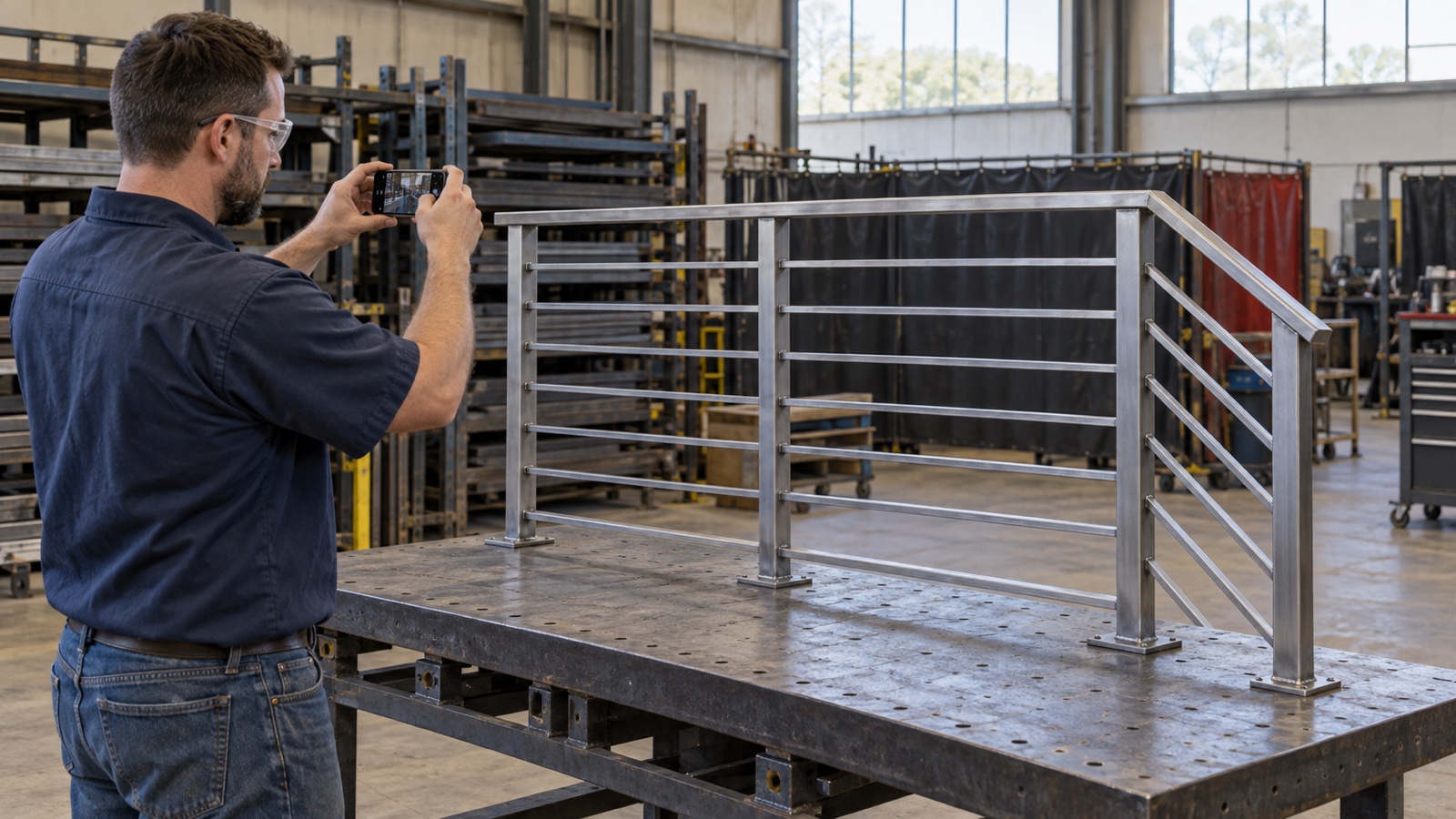
A bare-steel railing can tell its whole story. The fit-up marks are still visible. The miters have not disappeared under primer. You can see where the fabricator had room to work, where access tightened up and how the assembly came together. Then the piece is painted, wrapped, shipped and installed. The public sees the finished rail. Much of the work that made it possible is gone from view.
That is why a phone comes out before the job leaves the table.
The shop photo is easy to dismiss as a little vanity: one more picture of a bead, a cart or a stair stringer headed into the camera roll. At its best, though, it does something useful. It preserves a stage of the job that will never exist again. It gives the person who made the piece a record, gives the crew something concrete to discuss and gives the trade a way to show its work without pretending the arc is the only interesting moment.
A photograph can hold the work that disappears
Welding is physical, but it is also an information job. The U.S. Department of Labor’s O*NET profile for welders lists examining workpieces for defects, measuring for conformance and marking material with job or piece identifiers among the occupation’s core tasks. The same profile includes communicating with coworkers, evaluating information and documenting or recording information among the broader work activities.
That does not turn every welder into a photographer. It does explain why a useful shop picture is rarely just a beauty shot.
A wide frame can preserve the overall arrangement. A side view can show proportion and access. A close detail can capture a joint before coating covers the edges. A final frame of the job number or piece mark can keep the images from becoming four anonymous chunks of steel six months later. None of those pictures replaces a drawing, inspection report, weld map or customer-required record. They are memory aids, not a homemade quality system.
The distinction matters. A sharp photograph can show what was visible from one angle at one moment. It cannot establish what happened inside a joint, prove a procedure was followed or stand in for an inspection the job requires. Good shops know the difference between a useful picture and a controlled record.
For the individual fabricator, the value is more personal. Some jobs leave before anyone has time to look twice. Months later, the photo brings back the sequence: the fixture that made the repeat parts possible, the clamp that finally reached, the order that kept the assembly from pulling itself crooked. It also captures progress. A person scrolling back through two years of work can see changes in layout, restraint and judgment that were too gradual to notice during a shift.
The camera roll can become a teaching tool
The best shop-photo conversations are not built around a row of fire emojis. They start with a question.
Why was this side welded first? How did you hold that return? What would you change if the opening were two inches tighter? A finished assembly gives the question a common reference. An apprentice does not have to imagine the fit-up from a verbal description, and an experienced hand can point to a real decision without turning the conversation into a lecture.
The same photograph can also make the invisible parts of craft visible to people outside the trade. A customer may never see the temporary bracing. A family member may not understand why a small landing took most of a day. A clean, honest frame can show that fabrication is a chain of choices—not a shower of sparks followed by a finished object.
Old industrial photographs make the point at a larger scale. A 1942 Library of Congress image records a welder at Higgins Industries examining a bead on a steel ramp boat. The picture cannot certify the weld or tell us everything about the job. It does preserve a worker’s posture, the scale of the structure and the act of stopping to look. Eight decades later, those details still carry meaning because somebody made the frame.
Today’s phone photo may never enter an archive. It can still preserve the working life of a shop for the people who were there.
Take the picture without getting in the way
There is a right moment for the camera, and it is not while someone else is striking an arc.
Federal welding rules require protection for people adjacent to arc-welding areas through appropriate screens, shields or eye protection. They also require hot metal to be marked or otherwise identified after welding so other workers are warned. Those provisions in 29 CFR 1910.252 are a useful reality check: the photograph is secondary to the work area. Do not step around a screen for a dramatic angle, distract an operator, handle a hot part or create a trip hazard for a better post.
The cleaner habit is simple: stop the work, make the area safe, get permission and take only the frames that have a purpose. A practical four-shot set is usually enough:
- one wide view of the complete assembly
- one angle that shows depth, access or proportion
- one close detail worth remembering or discussing
- one identifier that ties the set to the correct job, when company policy allows it
Permission matters beyond the shop floor. Customer names, drawings, serial numbers, computer screens, addresses and unreleased projects can sit quietly in the background of an otherwise innocent picture. Company rules and customer agreements come before a personal feed. Crop deliberately, review the whole frame and ask before sharing. Keeping the photo for your own work record is not the same as having permission to publish it.
That restraint makes the pictures better. Less clutter. Less staged drama. More attention on the object and the decisions inside it.
The finished piece will have another life after it leaves: painted, installed, loaded, repaired, leaned on, driven over or forgotten behind a wall. The shop photo catches the brief moment when the work is complete but its evidence is still exposed. It is not proof of perfection. It is a record that someone looked closely and thought the work was worth remembering.
What is the one job in your camera roll that still teaches you something? If you have a story behind it—not just the finished bead—bring it into the Arc Life community. The trade deserves to be remembered in more than sparks.

Leave a Reply