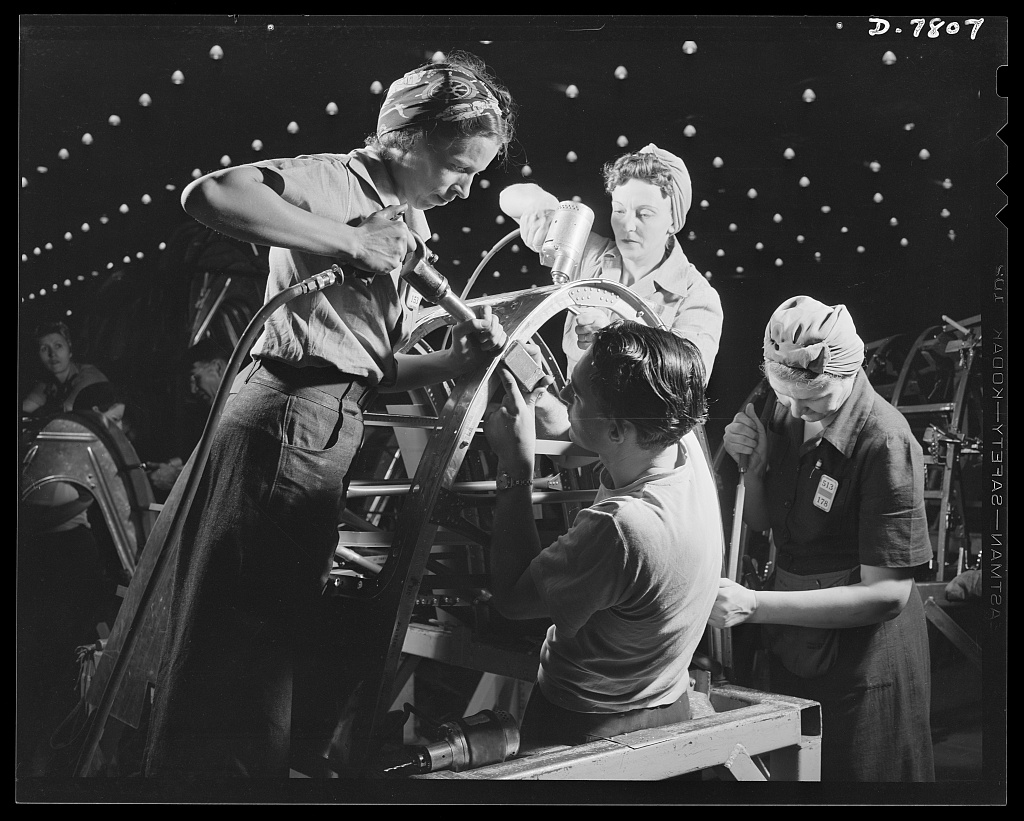
A historical shop photograph is most useful when we let it describe one particular job before asking it to stand for an entire trade. Alfred T. Palmer’s October 1942 photograph of a riveting crew at Douglas Aircraft Company gives us a good place to practice. The workers are gathered around an open, curved assembly. Their attention is on the structure between them, not on a finished airplane.
The Library of Congress record identifies the location as Long Beach, California, and the work as assembling the frame of a nacelle for a B-17F heavy bomber. Those details give the image its footing. From there, we can look closely, appreciate the craft and still leave room for what the photograph cannot tell us.
Begin with the job the caption actually names
It would be easy to share this image under a general slogan about wartime production. But the original description is more useful than a slogan: a particular crew, at a particular plant, working on a particular aircraft component. Keeping those details attached prevents the picture from drifting into a different factory, year or trade each time it is reused.
The record credits Palmer as photographer, dates the image to October 1942 and associates it with the United States Office of War Information. It also explains that the title and other information came from a caption card. That is worth retaining. A caption is a source with a history, not a voice coming directly from everyone in the frame.
The displayed catalog entry does not supply the workers’ names, their training histories or their conversations. We do not need to invent those details to make the picture matter. Naming the documented work carefully is already a form of respect.
Look at the assembly, not just the faces
The picture rewards a second look at its center. Curved members form the outline of the assembly, while smaller pieces cross the open space inside it. People are positioned above, beside and partly within that outline. Hands, tools and lines converge around the work rather than forming a neat row for the camera.
Those are visible features. They make the unfinished structure easier to notice than it would be in a photograph of a complete aircraft. The image preserves an intermediate state: an object far enough along to have shape, but still open enough for the viewer to see something of its construction.
For a fabrication reader, that is the interesting point. The familiar finished object is not the only place where craft becomes visible. A partial assembly can draw attention to access, sequence and the relationship between a person and a part. Here those are prompts for looking, not measurements or instructions extracted from a photograph.
Do not turn riveting into a welding story
This is a riveting crew. Calling the workers welders simply because the photograph appears on a welding-oriented site would erase the very distinction the caption preserves. A shop culture worth celebrating has room for neighboring crafts without giving every task the same name.
The photograph can interest welders without becoming a lesson in riveting technique. It does not provide a drawing, a material specification, an approved procedure or inspection results. Nor can the frame establish the completed assembly’s quality. Its value here is historical and cultural: it lets us pay attention to a documented piece of work and the people pictured doing it.
Our article on welding and Liberty ship construction follows a different wartime manufacturing story. Reading the two separately is more useful than treating every factory photograph as evidence for the same process.
Keep three kinds of statements separate
A practical way to discuss an old industrial image is to sort observations before building a story around them. The exercise works particularly well with this photograph because the catalog supplies a clear identification while the picture leaves many ordinary questions unanswered.
- Documented: Palmer made the photograph in October 1942; the catalog identifies Douglas Aircraft Company’s Long Beach plant and a crew assembling a B-17F nacelle frame.
- Visible: several workers surround a curved, open assembly, with tools and hands directed toward it. These observations describe this frame, not an entire shift.
- Unestablished: individual identities, experience, production pace, the exact sequence before and after the exposure, and the finished component’s inspection outcome.
This separation does not make the conversation dry. It gives curiosity somewhere honest to go. Instead of announcing that we know how the crew felt, we can ask what records might tell us more. Instead of guessing a tool setting, we can acknowledge that this image is not the source for one.
Give the record room to remain incomplete
A compelling photograph can tempt a writer to finish every missing sentence. The crew must have been exhausted. Someone must have been new. A particular person must have been the leader. None of those conclusions follows just because a face or posture catches our attention.
Leaving those questions open is not a failure to honor the workers. It avoids replacing their unknown lives with our preferred story. The documented task and visible concentration are enough to hold our attention without invented names, quotations or claims of personal experience.
The same restraint applies to the work environment. This is a historical image, not a modern safety example or an operating guide. Clothing, posture and tool placement in a single archival frame should not be offered as instructions for today’s shop.
Keep the photograph attached to its source
If this image starts a shop-history conversation, keep the Library of Congress link with it. The catalog identifier is 2017695373 and the reproduction number is LC-USE6-D-007807. Those details make it possible for another reader to find the record rather than relying on a cropped copy and a recycled caption.
For the present-day side of that conversation, see why fabricators photograph their work. That article concerns making useful records now; this one concerns reading an inherited record without asking it to prove more than it can.
The photograph does not need to become a symbol of everything. It is already a record of specific work, preserved with enough information to look again. That is a worthwhile way to remember a trade. For more welding-inspired culture and resources, explore Arc Life.
Leave a Reply