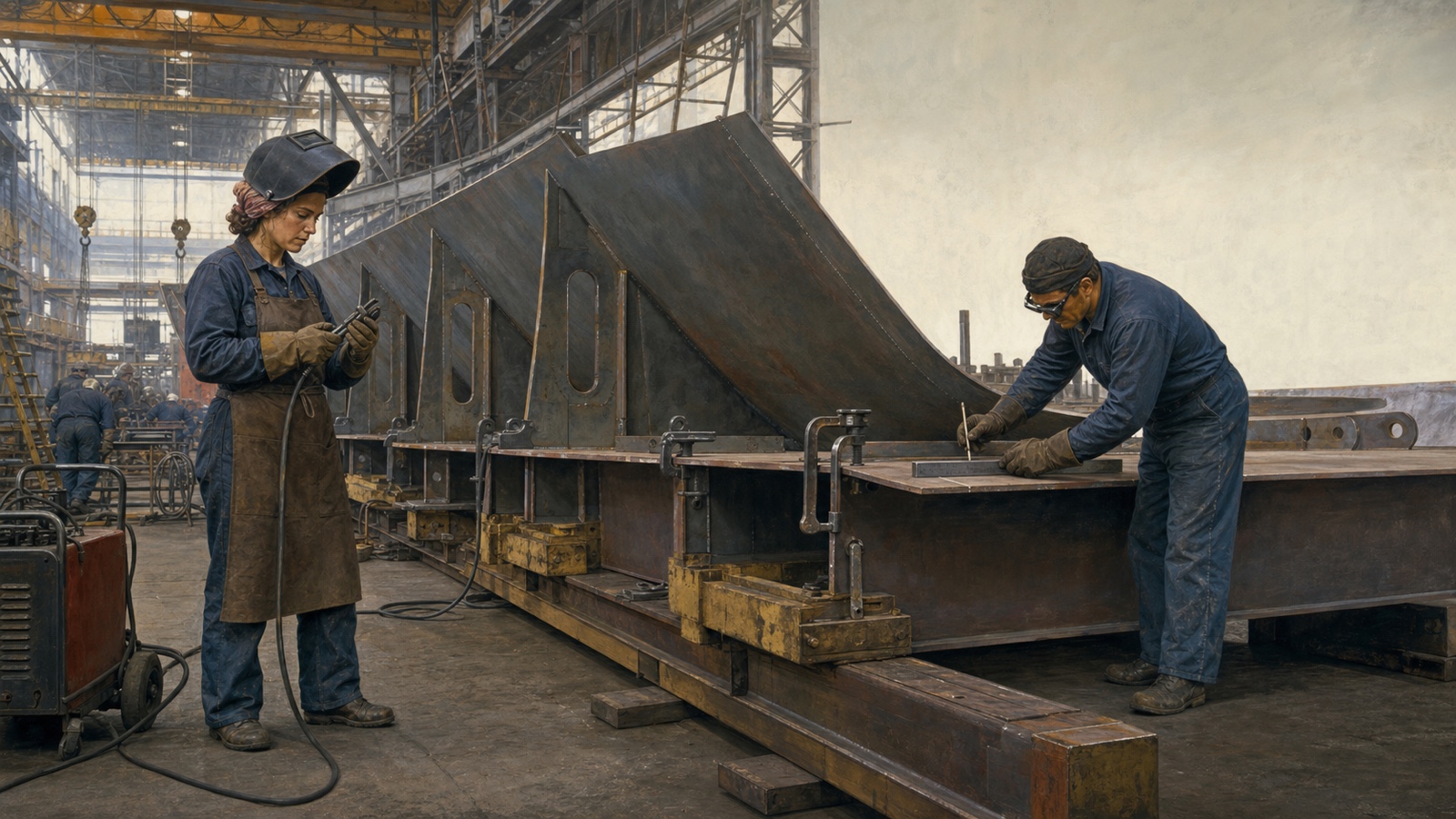
Before welded ship sections became normal, a vessel grew plate by plate on the ways. The Liberty-ship program changed the scale of the work—and left lessons the trade still carries.
Picture the sound before the arc: thousands of hammers driving rivets into a hull that seems to rise one plate at a time. That was the familiar rhythm of shipbuilding. Then American yards faced a demand that familiar methods could not meet. Ships had to be built faster, by a workforce that was expanding almost as quickly as the yards themselves.
The answer was not one miracle machine or one heroic welder. It was a new production system: standardized designs, prefabricated sections, large cranes, focused training and a tremendous amount of welding. The Liberty ships of World War II made that system visible on a national scale. They also exposed weaknesses that forced engineers to think harder about steel, cracks and cold-weather service.
A ship becomes a set of jobs
The U.S. Maritime Commission chose a simple cargo-ship design because speed mattered more than elegance. According to the Maritime Administration’s history of the Emergency Shipbuilding Program, American yards built more than 2,600 Liberty ships as part of a much larger expansion that produced over 6,000 vessels by 1945.
The real shift was in how the work moved. MARAD’s record of the SS Patrick Henry explains that yards built entire sections in workshops, then welded those sections together on the slipway. Instead of requiring every worker to know the whole craft of ship construction, the yard could divide a ship into repeatable operations. A new hire might learn one weld, one joint or one position and become productive there before mastering the larger trade.
That approach sounds ordinary now. Fabrication shops still break large work into fit-up, subassemblies, positioners, fixtures, welding, inspection and final assembly. In the early 1940s, doing it to an ocean-going cargo vessel—and repeating it by the thousands—was a different kind of industrial thinking. Welding was not replacing skill. It was redistributing skill across a much larger crew.
The workforce did not look like the old yard
Shipyard hiring expanded beyond the people who had traditionally been allowed into the better-paid trades. The National Park Service records that Mary Carroll became the first woman hired as a welder at Portland’s Swan Island Shipyard in April 1942. By 1944, the Kaiser yard in Vancouver employed 10,600 women as shipbuilders.
The familiar “Rosie the Riveter” image can flatten that history. The yards also had Wendy the Welders, pipefitters, burners, electricians, crane crews and inspectors. A Library of Congress photograph of welder-trainee Josie Lucille Owens shows one worker helping build the Liberty ship George Washington Carver at Richmond in 1943. The picture matters because it gives the workforce a name and a job, not just a poster pose.
It is not a clean story of doors opening and staying open. National Park Service research documents discrimination in training, assignments and union protections, particularly for Black women, along with harassment and dangerous conditions throughout the yards. Many women were treated as temporary labor even after proving they could do the work. Remembering the accomplishment means remembering who was asked to carry risk without being offered equal opportunity.
Speed revealed what strength tests missed
All-welded construction brought another lesson. Some wartime ships developed long, sudden cracks, especially in cold conditions. The steel could pass the tensile tests used at the time and still lack the toughness to resist a crack once it started. Discontinuities and sharp geometric transitions could create stress concentrations; once moving, a crack could run through low-toughness plate with startling speed.
The failures were not proof that welding was a mistake. They were evidence that a welded structure had to be understood as a system. NIST traces part of its modern metal-toughness work to those ship failures. Its history of the Charpy impact test explains why ordinary strength measurements could not tell the whole story of how a steel would behave around a flaw and at lower temperatures.
That distinction still lives on the shop floor. A sound weld is not judged by appearance alone. Material grade, joint geometry, restraint, temperature, procedure, inspection and service conditions all belong to the same conversation. The lesson is less dramatic than a ship breaking in two, but more useful: production speed never cancels the physics.
The inheritance is a way of working
Liberty ships are often remembered through production records and launch-day photographs. Welders may recognize a different legacy. The yards proved that a massive structure could be divided into sections, built by coordinated crews and joined with repeatable processes. Then the failures forced the industry to improve the materials, details and tests surrounding those processes.
That is the part worth carrying forward. The trade advances when a new method is treated neither as magic nor as a threat, but as a tool that has to earn trust through good fit-up, disciplined procedure and honest inspection. The arc changed shipbuilding. The people who organized the work—and learned from what went wrong—made the change last.
Community question: Did shipyard work or wartime welding touch your family, your town or the shop where you learned? What story has been passed down?
Arc Life tells the human side of the trade: the crews, objects and turning points behind the work. Read what Arc Life is building, then visit the Arc Life collection.
Leave a Reply