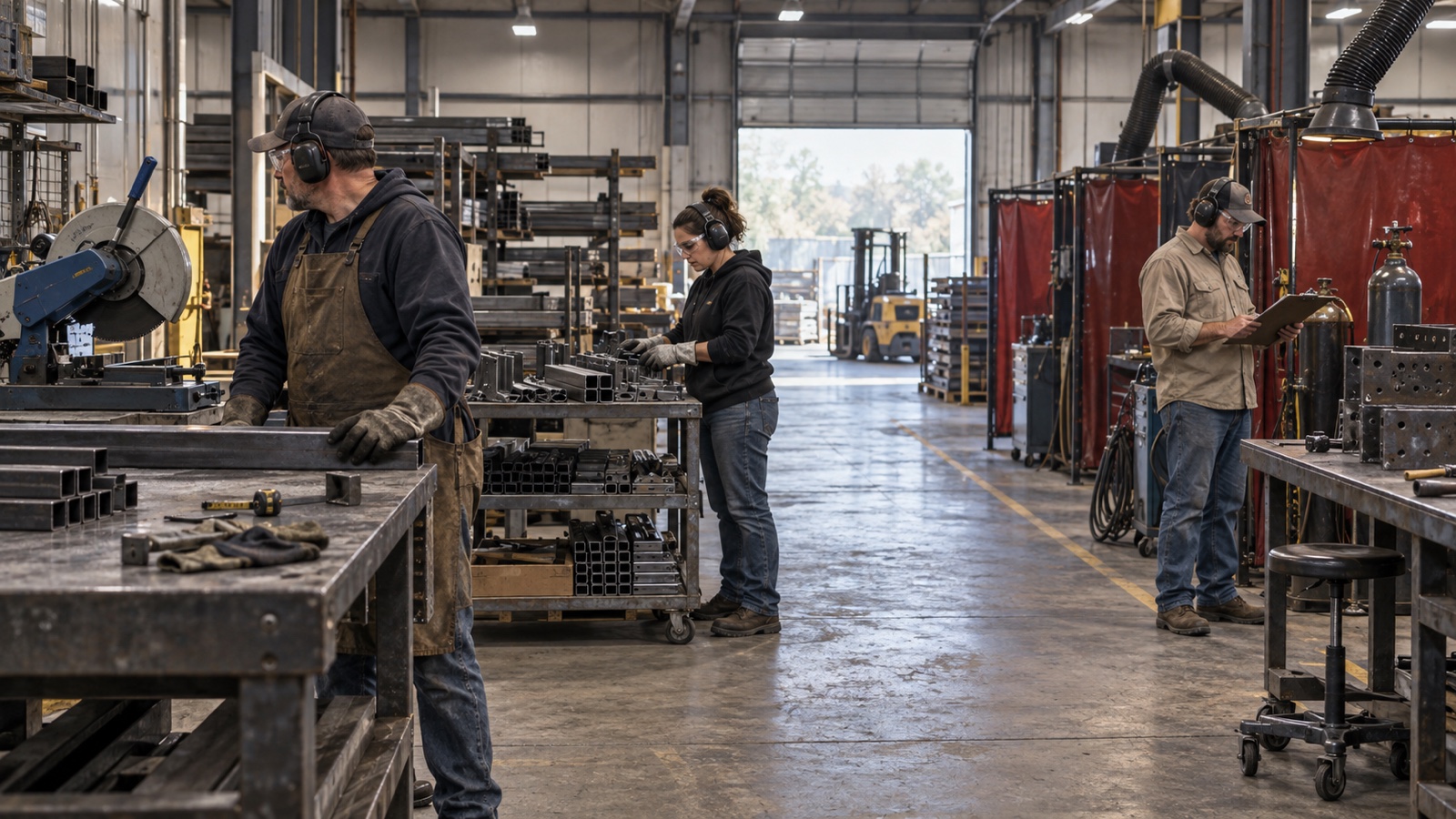
A fabrication shop has a pulse long before anyone calls it culture.
The cold saw bites, stops, then bites again. A grinder climbs in pitch as it reaches an edge. A hood drops. A hammer answers from two bays over. Somewhere behind the welding curtains, a fixture takes three quick taps before a clamp settles. None of it is music in the ordinary sense. Yet after enough shifts, a crew knows when the rhythm is normal—and when one missing sound deserves a look.
That awareness is not mystical. It grows from repetition, shared work and knowing what should happen next. It is also easy to romanticize, so the distinction matters: listening to a shop is never a substitute for guards, procedures, alarms, communication or correctly worn hearing protection. The real craft is learning the rhythm without treating noise as harmless.
The ordinary sounds carry information
Most shop sounds mean exactly what they appear to mean. Material is being cut. Scale is being removed. Parts are moving. A machine is cycling. The useful part is not identifying every noise from across the building; it is recognizing sequence.
An experienced fitter expects the saw to stop before a length is moved. A welder expects the extractor to come on with the booth. A lead notices when a station that had been steady goes quiet in the middle of a run. Often the reason is unremarkable: a measurement check, a new spool, a conversation about the print. Sometimes the pause is the first sign that somebody needs another set of eyes.
That is why a well-run shop can feel alert without feeling frantic. People are not reacting to every bang. They understand which sounds belong to the work, which are warnings, and which changes are worth checking without turning the floor into a courtroom.
The same awareness reaches beyond machines. Crews develop a cadence for moving long stock, clearing a forklift lane and handing off work between fitting, welding and inspection. Much of that coordination is visible. Some of it is carried by short calls, a horn, a backup alarm or the sudden absence of a tool that had been running all morning.
Silence can be part of the signal
The dramatic version of a shop problem is a crash. The more common version may be a pause.
A grinder stops because the operator wants to check the line before taking more metal. A welder breaks rhythm because the joint is not behaving as expected. A saw operator holds the next cut because the material tag and the cut list do not agree. Those pauses are not lost production. They are often the sound of somebody refusing to outrun the information in front of them.
Good crews leave room for that. They do not make a newer worker feel as if stopping to ask a question is an admission of weakness. They also do not confuse speed with flow. Real flow includes inspections, fit checks, cleanup and the occasional reset.
The shop that never pauses is probably not the shop to envy.
Hearing the work does not mean sacrificing hearing
There is a hard safety boundary around this conversation. Occupational noise can permanently damage hearing, and familiarity does not reduce the exposure.
The National Institute for Occupational Safety and Health recommends an exposure limit of 85 A-weighted decibels averaged over an eight-hour workday. NIOSH also emphasizes that risk depends on how loud a sound is, how long exposure lasts and how often it is repeated. A worker’s memory of a shop’s rhythm is not a measurement, and “it has always sounded like that” is not a noise assessment.
NIOSH’s prevention guidance puts reducing noise at the source ahead of relying on personal protective equipment alone. Quieter equipment, maintenance, isolation and barriers can all be part of the answer. When hearing protection is required, it has to be selected and worn correctly as part of a real hearing-loss prevention program—not removed to make the shop easier to read.
This matters for communication, too. NIOSH notes that high noise can reduce awareness of alarms, signals and verbal warnings. The answer is not simply to tolerate more noise or abandon protection. It is to design work so warnings remain effective: appropriate protection, visible signals, established hand signals, clear traffic rules and communication methods suited to the actual environment.
A shop that protects hearing is not a quieter version of shop culture. It is a shop culture that expects people to have a life after the shift.
Rhythm is built by people, not equipment
Two shops can own similar machines and feel completely different.
In one, every interruption carries irritation. Nobody wants to be the person who stops the line. Small changes go unmentioned until they become larger problems. In the other, a question gets answered, a strange cycle gets checked and a material move is called clearly before it begins.
The second shop may not be literally quiet. It is calmer because people know how to respond.
That culture is taught in ordinary moments. A veteran points out why a machine sounds different under load. A lead explains which alarm means clear the lane and which signal means hold position. A coworker checks on a booth that went quiet instead of making a joke about somebody taking a break. The lesson is not “trust your ears.” The lesson is “pay attention, follow the controls and look out for the crew.”
New workers contribute to that rhythm sooner than they may realize. Returning tools, keeping leads out of travel paths, calling a material move, reporting a damaged guard and asking before assuming all make the shop easier to read. Good shop awareness is less about having supernatural instincts than being predictable in useful ways.
What does your shop sound like?
Every crew has a sound that means the day has found its pace. It might be the saw and the press brake trading cycles, the steady start-and-stop behind the curtains, or the brief quiet when everybody checks the first finished piece.
There is usually another sound the crew notices immediately when it changes. Not because they are hunting for drama, but because shared work creates shared expectations.
So here is the Arc Life question: What sound tells you your shop is running right—and what change makes your crew stop and check? Keep the answer grounded in safe work. The best shop instincts support the procedure; they do not replace it.
For more stories about the habits, people and small signals that shape working life, visit Arc Life.
Sources Checked
For a practical equipment check alongside shop awareness, see WSP’s MIG contact-tip burnback troubleshooting guide, covering wire-feed restrictions, liner drag, and contact-tip checks.

Leave a Reply