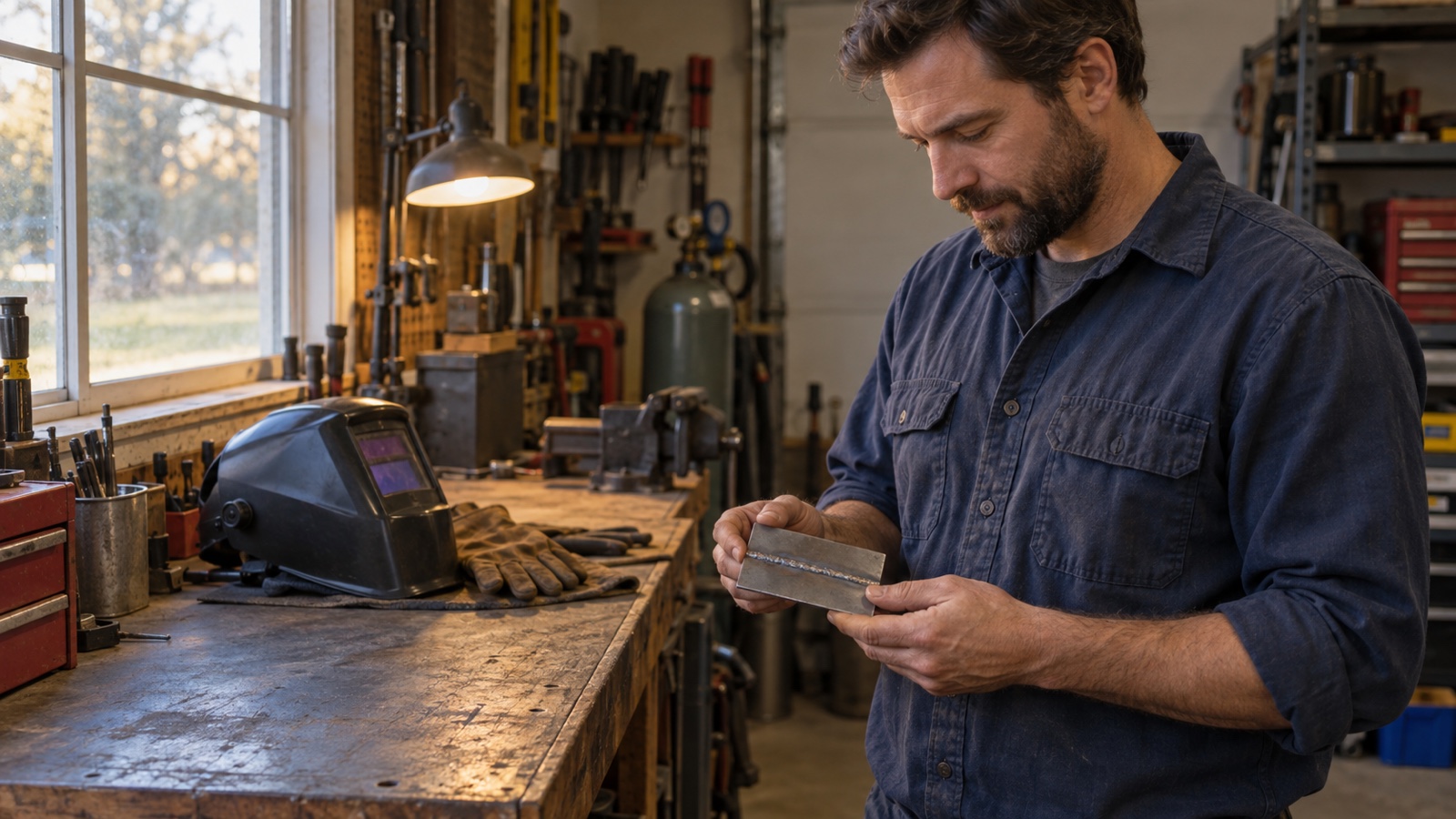
Most welding practice coupons end the same way: cooled on the table, marked up by an instructor, then dropped into the scrap bin. That is where they belong. A booth can produce a small mountain of steel before a student learns to see what the puddle has been trying to say.
But sometimes one piece does not make the trip to the bin.
It may be the first plate that finally looks controlled from one end to the other. It may carry the first bend that did not expose the same old mistake. It may simply be the coupon completed on a day when the hands, eyes and machine seemed to agree for the first time.
With permission, that piece goes home. It lands on a garage shelf, in a toolbox drawer or beside a stack of old photos. Years later, it is still heavier than its few ounces of steel should allow.
Steel keeps an honest record
A photograph can flatter a weld. A practice coupon is less cooperative.
The starts are still there. So are the stops, the wandering edge and the moment travel speed changed. Turn it over and the backside may tell a different story from the face. Hold it next to a newer piece and improvement becomes something a person can touch.
That is the value of keeping one—not because it is perfect, but because it is specific. “I got better” is an idea. Two pieces of steel, made six months apart, are evidence.
Good instructors understand that progress is easier to recognize when the student can compare today’s work with yesterday’s. The comparison also corrects a common beginner’s memory. Once a new technique begins to feel natural, it is easy to forget how awkward it was at first. The old coupon restores the scale of the accomplishment.
It says: your hands did not always know this.
Practice pieces and qualification coupons are not the same thing
There is an important line here. A classroom practice piece is not automatically a qualification record, and a good-looking coupon is not a credential.
The American Welding Society’s Certified Welder Program is performance based. Candidates complete a welder performance qualification test at an AWS Accredited Test Facility, weld to the applicable procedure, and have the completed test coupon evaluated. The facility handles the test record and submits the required documentation after acceptance.
That formal process is bigger than the piece of metal itself. The coupon belongs to an evaluation system: procedure, position, material, inspection, acceptance criteria and records.
So the shop-shelf keepsake should remain what it is—a personal marker from practice or training. Nobody should remove a qualification coupon, production part, customer material or shop scrap without clear permission. If an instructor or supervisor says the piece stays, it stays. If the shop wants it identified, sectioned, tested or recycled, the story is not worth overruling the process.
The best keepsakes come with clean boundaries.
Keep the lesson, not the legend
Welding culture can turn objects into mythology. The battered hood, the old chipping hammer and the first good coupon all invite a story. Stories are useful, but only if they remain honest.
The piece should not become proof that the welder “had it from day one.” Most people did not. The more credible story includes the stack of attempts that came first, the correction that finally made sense and the person who took time to explain it again.
That version is worth telling because it leaves room for other beginners. It says skill arrived through attention and repetition, not through a mysterious gift that some people possess and others do not.
An old coupon can also hold a mentor’s voice. “Watch the top edge.” “Quit outrunning the puddle.” “Clean it before you blame the machine.” The words may sound ordinary outside the booth. Attached to a visible change in the work, they stay useful.
Years later, the welder may not remember the date. The metal remembers the lesson.
A small archive of working life
Not every welder wants a shelf of artifacts. Some people prefer a clean toolbox and an empty scrap bin. Fair enough. The point is not to save everything.
One carefully chosen piece can do the job. Add the date, process and a short note if the owner permits marking it. Record what changed: steadier angle, better fit-up, cleaner restart, more patience. Avoid turning the note into a résumé claim. It is a memory aid, not a certification card.
Over time, that small archive can become useful in an unexpected way. A veteran showing a beginner an imperfect early coupon changes the room. It replaces the polished final result with a visible path. The beginner sees that the person offering corrections once needed corrections too.
That is a generous use of an old mistake.
The piece may also remind an experienced welder what learning felt like before familiarity dulled the edges. Confusion, concentration and the relief of finally seeing the bead settle into place are hard to recover from memory alone. A scarred plate can bring them back quickly.
What deserves a place on the shelf?
The answer is personal. It might be the first coupon an instructor circled instead of crossed out. The first piece made after switching processes. The first bend specimen that came back clean. The plate that exposed a weakness so clearly that the next month of practice finally had direction.
Perfect is not the requirement. Meaning is.
That is why the most valuable coupon in a welder’s shop may look unremarkable to everyone else. It carries no logo, price or public status. Its value comes from knowing what happened before it, what changed during it and what became possible afterward.
So here is the Arc Life question: Did you keep a practice coupon or early project that still matters to you? What lesson is trapped in that piece of steel?
Tell the story to somebody still learning, then visit Arc Life for more stories about the objects, people and turning points that shape a life in the trade.

Leave a Reply