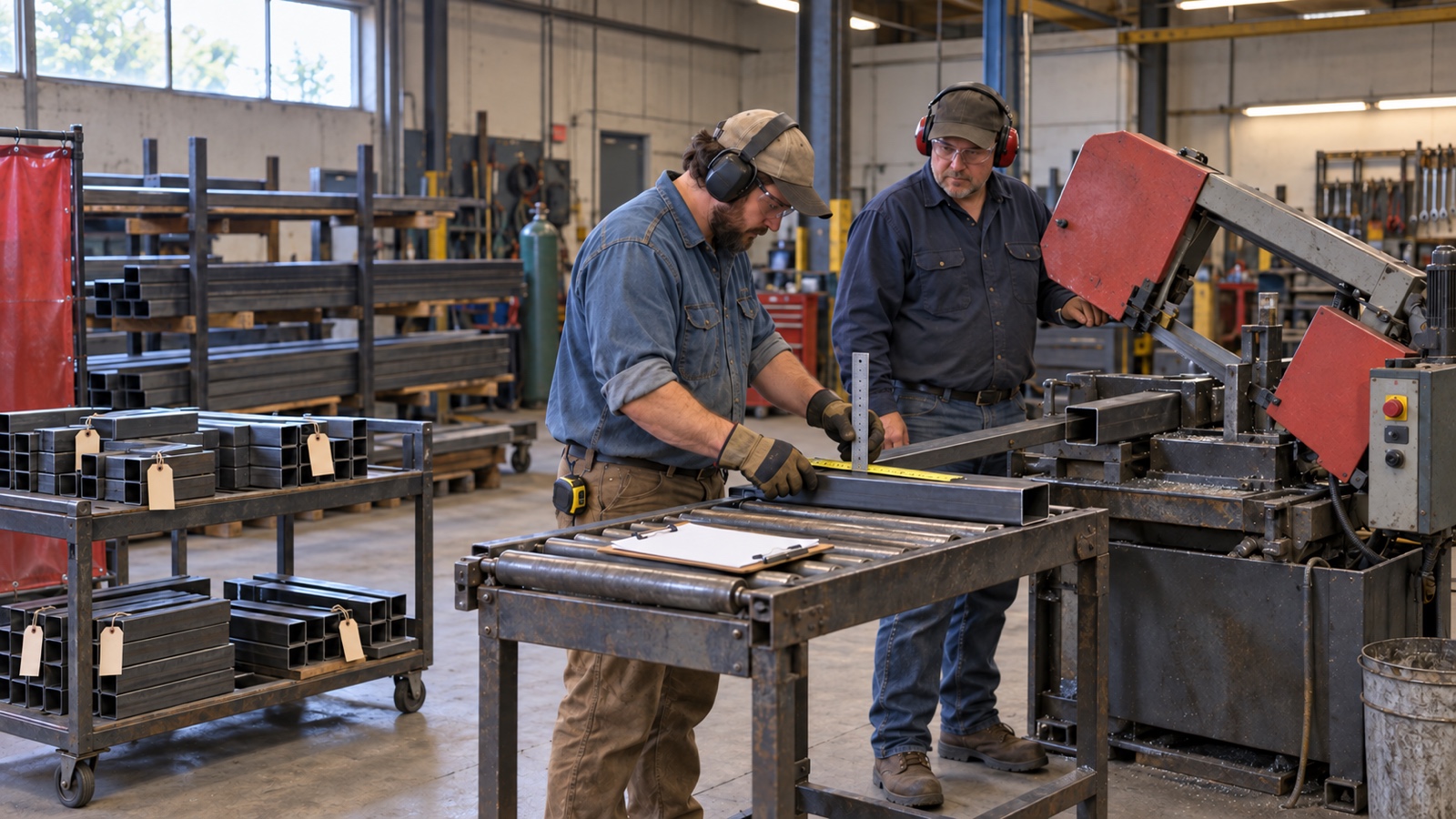
Before the first arc, before the fitter reaches for a square, somebody stands beside a cold length of tube, angle or beam and makes a decision that cannot be put back.
The saw station does not have the theater of welding. There is no blue light behind a hood, no finished bead to photograph, no moment when the whole shop turns to watch. It has a cut list, a stop, a tape, a marker and a rack of material that can look nearly identical from across the aisle.
Then the blade comes down. The project has begun.
That is why a strong saw operator is more than the person who keeps cut pieces moving. The job sits at the front edge of fabrication, where information becomes length and a drawing becomes a stack of real parts. A good first cut will not guarantee a good build. A careless one can make every station after it work harder.
The saw station turns information into steel
“Saw operator” sounds like a narrow title until you look at what the work actually asks of a person. The U.S. Department of Labor’s O*NET profile for metal and plastic cutting-machine operators includes saw operator among the reported job titles. Its core tasks include reading work orders for material and dimension requirements, measuring completed pieces against specifications and examining them for defects.
The button is the easy part. Translation is the work.
A line on a cut list has to become the correct material, the correct quantity and a piece another person can trust. In a busy shop, that also means keeping like-looking stock separated, keeping parts identified and knowing when a question needs to travel back upstream instead of becoming a guess at the saw.
The best operators develop a memory for the work without pretending memory is documentation. They may recognize the recurring frame, know which job is likely to need the drop, or spot that a quantity does not match the assembly. But they still build from the approved information in front of them. Experience helps them notice a problem. It does not authorize them to invent an answer.
That distinction protects more than material. It protects the crew from the worst kind of shop mystery: a problem that appears three stations later, after nobody can say where it began.
Fit-up remembers the first cut
A fitter can correct plenty. A small burr can be dressed. A part can be repositioned. A sequence can be adjusted. But fit-up has a long memory for whatever arrives on the table.
The related O*NET profile for structural metal fabricators and fitters lists verifying workpieces with squares, rulers and tapes; studying drawings for material requirements and task sequence; examining stock; and positioning and aligning parts to specification. Those tasks make the connection between the saw and the fit-up table plain. The second job depends on the first job delivering pieces that can be identified, checked and assembled as intended.
When the saw station is dialed in, the payoff is rarely dramatic. A cart arrives in order. The piece marks make sense. Mitered parts face the right way. The fitter can check, position and tack instead of sorting a puzzle. The work feels almost ordinary, which is how good production often hides its skill.
When it is not dialed in, the trouble travels. A stack can be the right length but the wrong material. A reversed angle can turn into an awkward rework. One short member can stop an assembly while someone returns to the rack. None of those outcomes belongs automatically to the saw operator; bad revisions, vague cut lists and rushed handoffs can set the station up to fail. The point is that the saw is where those weaknesses become physical.
A good cut list is a conversation
The cleanest saw stations are not necessarily the quietest. They are the ones where questions can move without becoming accusations.
If a drawing revision changed, the operator needs the current one. If two materials share dimensions but not grade or heat identity, the job needs a reliable identification system. If the orientation of a miter matters, the cut information needs to show it clearly. If a bundle is missing one part, the crew needs to know if that piece was never cut, was moved or belongs to another job.
This is where respect becomes practical. Do not toss a handwritten mystery onto the saw table and then treat a question as a delay. Do not make the operator hunt down the person who knows what “same as last time” means. And do not wait until fit-up to mention that the pieces were supposed to stay paired.
The return respect matters too: label what leaves the station, keep cut pieces organized, flag uncertainty and hand off anything unusual before it disappears into the next pile. The goal is not paperwork for its own sake. It is a shared picture of what the crew is building.
Treat the saw like production equipment
Because a saw station can look simple, familiarity can flatten the danger. It should not. OSHA’s machine-guarding requirements identify power saws among the machines that usually require point-of-operation guarding and say exposed danger zones must be guarded during the operating cycle.
That is the right frame for the culture around the station: the saw is production equipment, not a shortcut bench. Guards, manufacturer instructions, company procedures, machine condition and training all belong ahead of speed. So does waiting for the machine to be in a safe state before measuring, clearing or handling near the cutting area.
Safety and quality meet in the same habit: slow down long enough to confirm what is about to become irreversible.
Give the first cut its share of the credit
Welding shops tend to celebrate the visible finish. That makes sense. A clean bead or a square assembly shows the result. But a crew is stronger when it notices the less visible control points too.
The saw operator is one of them. This is the person balancing material, dimensions, sequence, machine care and the needs of people farther down the line. When the station runs well, a fitter receives confidence instead of questions. When it runs exceptionally well, nobody may notice how many problems never happened.
So here is the shop question: What saw-station habit saves your crew the most time later? Is it paired parts, cleaner labels, a second dimension check, organized drops or simply asking before cutting?
Share the habit worth keeping with your crew, then visit Arc Life for more stories about the people and practical culture behind the trade.

Leave a Reply