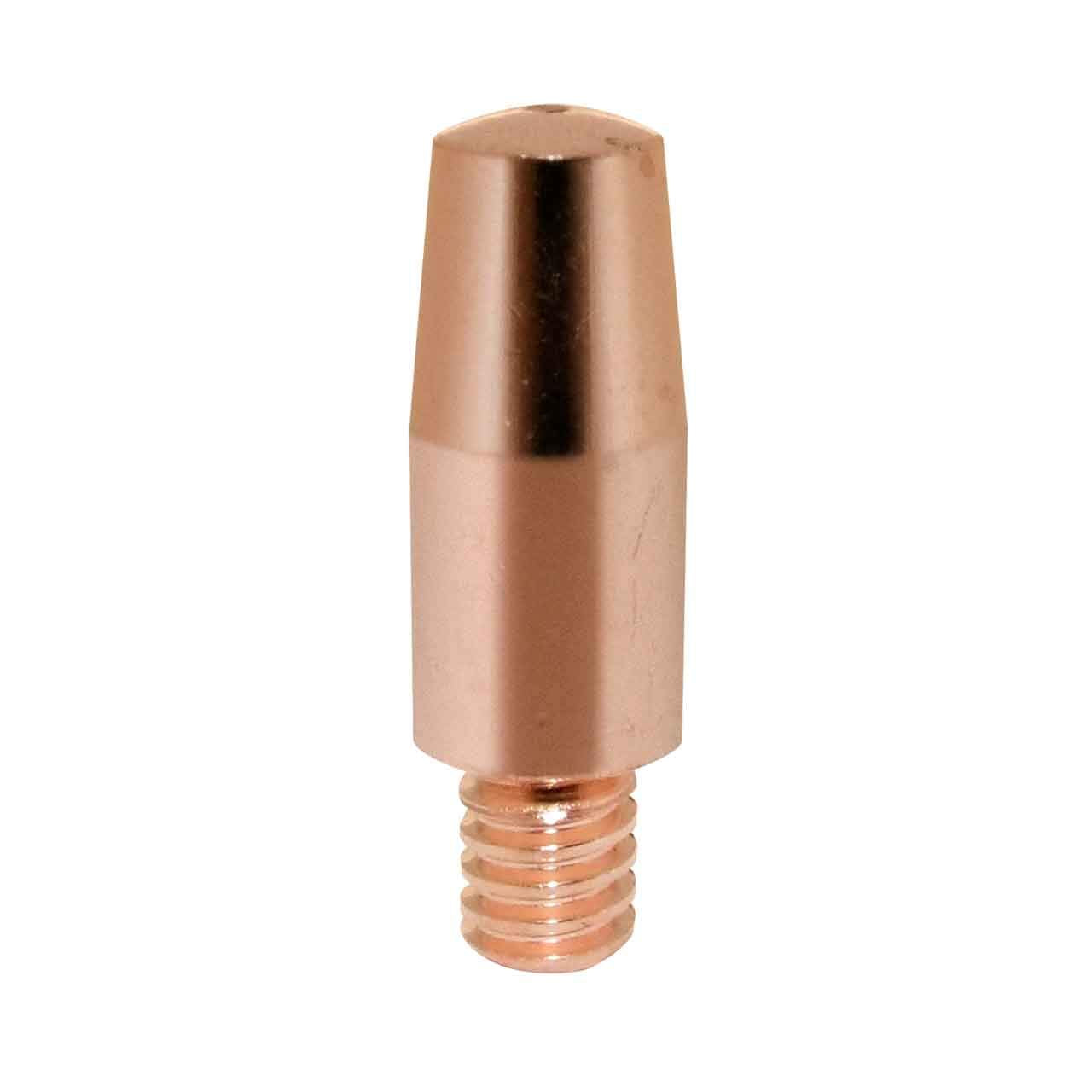

The Lincoln Electric KP2744-040 Copper Plus Contact Tip 350A .040 in (1.0 mm), 10 pack is a MIG consumable used to transfer current to the electrode wire at the gun front end. For buyers and maintenance teams, the main job is simple: keep the wire feeding smoothly and maintain a stable electrical path. When a contact tip is the wrong size, worn, or contaminated, the result is usually inconsistent arc behavior, feeding drag, or premature tip failure.
This breakdown stays focused on what to check before you buy, install, or troubleshoot this tip in service. The listing indicates a 350A rating and .040 in (1.0 mm) wire size. Any other fit or application detail should be treated as Unknown (Verify) unless confirmed by your torch, gun, and OEM documentation.
Key Takeaways
- The KP2744-040 is a standard MIG contact tip for .040 in (1.0 mm) wire.
- Contact tips are wear items. Plan inspection and replacement as part of routine gun maintenance.
- Stable performance depends on correct wire diameter, correct tip seating, and clean current transfer surfaces.
- Do not assume compatibility with every gun, neck, diffuser, or gas nozzle. Verify part match before installation.
What a Contact Tip Does
A contact tip serves two functions. First, it conducts welding current into the wire. Second, it constrains wire guidance at the point where the arc starts. If the internal bore is oversized, worn, or distorted, the wire can wander and the arc can become erratic. If the bore is undersized or contaminated, wire feed drag rises and the wire may bind.
For production and repair welding, the practical goal is not just arc starts. It is repeatable current transfer over time with minimal interruption. That means the tip condition matters as much as the wire size printed on the package.
Check Before You Install
- Check wire diameter. Verify the feeder is loaded with .040 in (1.0 mm) wire. Do not rely on setup memory. Read the spool label and measure if needed.
- Inspect the gun front end. Verify the diffuser, nozzle, and tip adapter threads are clean and not cross-threaded.
- Inspect the old tip. Look for burnback, spatter bridging, oval wear, or blue heat discoloration. These are signs of poor current transfer or excessive heat load.
- Verify seating. The tip should install fully and seat squarely. If it rocks, binds, or bottoms out incorrectly, stop and verify the torch parts.
- Confirm the part number. Match the replacement tip to the gun system and consumable family in the OEM reference. Unknown (Verify) if the torch family is not documented.
Inspect During Service
Routine inspection prevents avoidable downtime. A quick daily check is enough for many shops, with more frequent checks in high-duty production cells.
- Inspect the bore: Look for ovaling, enlarged entry, or visible erosion at the wire path.
- Inspect the face: Look for spatter buildup that can change wire exit geometry.
- Inspect the threads: Look for galling, damaged starts, or evidence that the tip has been over-tightened.
- Inspect the wire feed: Verify the wire exits without hesitation when jogging the feeder.
- Inspect arc starts: Note hard starts, wandering starts, or intermittent loss of conductivity.
Troubleshooting Support
If the weld system is not behaving normally, the contact tip is one of the first consumables to verify. Use a simple check/inspect/verify sequence.
Problem: Wire feed hesitation
- Check: Does the wire drag at the gun front end?
- Inspect: Look for tip bore damage, spatter blockage, or a wire size mismatch.
- Verify: Confirm the liner, drive rolls, and tip are all matched to the same wire size.
Problem: Burnback at the tip
- Check: Is the arc starting too close to the tip face?
- Inspect: Look for worn internal bore, excessive stickout variation, or poor feed consistency.
- Verify: Confirm procedure settings and front-end consumable condition before changing process variables.
Problem: Unstable arc or spatter increase
- Check: Is the tip worn, loose, or contaminated?
- Inspect: Look for oxidation, thread damage, and tip-to-diffuser seating problems.
- Verify: Confirm the contact tip is the correct diameter and style for the torch system.
Product and Parts Notes
The Lincoln Electric KP2744-040 Copper Plus Contact Tip is listed as a 350A, standard-style MIG contact tip for .040 in (1.0 mm) wire. Beyond that, any torch-family compatibility, current-duty interpretation, or service-life claim should be treated as Unknown (Verify) unless confirmed by the manufacturer or gun documentation.
For buyers, the practical value of this type of tip is in consistency. A consistent contact tip reduces unnecessary troubleshooting time because it removes one variable from the front-end system. For maintenance teams, that means fewer false alarms when a feeding issue is really a wear issue at the tip.
If you need to compare this consumable against a broader wire or process plan, a related internal resource may help with wire selection context: Aluminum ER 5554 3/64″ X 5lb. MIG Welding Wire Spool By Washington Alloy – Weld Support Parts Blog. Use that page as a starting point for material selection context, not as a procedure approval for this tip.
Maintenance Buying Considerations
For stocked spares, contact tips should be treated as high-turn consumables. Keep them organized by wire diameter and torch family. Do not mix bins or assume one .040 in tip matches every gun. That mistake causes time loss at the workbench and at the machine.
When building a PM kit, include the tip, diffuser, nozzle, and any related front-end consumables that commonly wear together. If the root cause of tip failure is recurring, look upstream at wire cleanliness, drive roll setup, liner condition, and gun angle.
Safety Notes
- De-energize the welding system before changing front-end consumables.
- Allow hot parts to cool before handling.
- Use gloves when removing spatter-contaminated tips.
- Do not force threaded parts. Cross-threading can damage the gun and the consumable.
- Use approved PPE and follow your shop’s lockout and welding safety procedures.
FAQ
Is the KP2744-040 only for .040 in wire?
The listed size is .040 in (1.0 mm). Use that as the primary match point. Any other wire size should be treated as Unknown (Verify).
Can I use this tip in any MIG gun?
No. Compatibility depends on the torch, diffuser, and thread style. Verify against the gun manufacturer’s consumable chart before installing.
What are the first signs that the tip should be replaced?
Watch for wire feed hesitation, burnback, unstable starts, visible bore wear, spatter bridging, and damaged threads.
Should I replace the tip when changing wire?
Not automatically. Inspect the tip first. Replace it if wear, sizing mismatch, or contamination is present.
Sources Checked
- Provided ArcWeld product page for Lincoln Electric KP2744-040 Copper Plus Contact Tip 350A .040 in (1.0 mm), 10 pack.
- Provided internal link: Aluminum ER 5554 3/64″ X 5lb. MIG Welding Wire Spool By Washington Alloy – Weld Support Parts Blog.

Leave a Reply