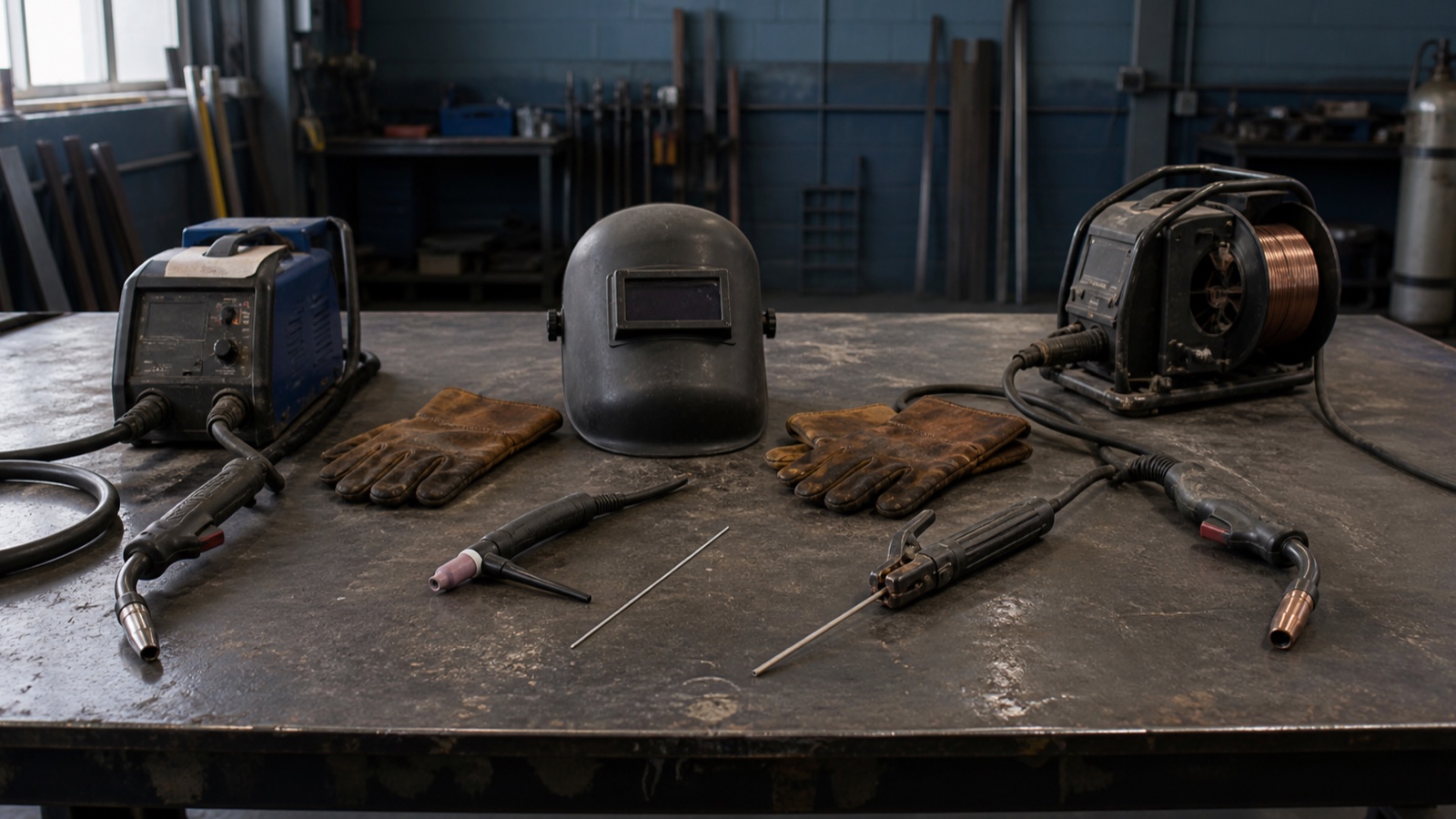
You can usually tell what part of a welding shop you have walked into before you see the machine.
One bay carries the steady urgency of wire feeding through a gun. Another has the quieter concentration of a TIG welder waiting on a puddle that cannot be rushed. Somewhere else, a stick electrode scratches, catches, and settles into its familiar crackle. Flux-core brings a heavier rhythm, followed by the scrape and knock of slag coming off.
The processes sound different because they work differently. They also ask the person behind the hood to think differently.
That does not mean MIG welders, TIG welders, stick welders, and flux-core welders belong in separate personality boxes. Plenty of people move among all four in the same week. But every process changes the pace of the work, the feedback coming through the hands, and the decisions that demand attention.
The machine does not decide who you are. It does reveal how many ways there are to practice the same trade.
A Process Is Not a Personality Test
Shop talk likes a clean rivalry. TIG is precise. Stick is tough. MIG is fast. Flux-core is built for serious work. Those descriptions contain a little truth and a lot of missing context.
The job still decides what matters. Material, joint design, position, environment, procedure, production demands, and required quality all shape process selection. A beautiful process used in the wrong application is still the wrong process.
The useful question is not which arc has the most status. It is what kind of attention each process asks the welder to bring.
MIG Rewards Flow—Not Autopilot
Gas metal arc welding, commonly called MIG, uses a continuously fed consumable wire electrode and external shielding gas. That continuous feed changes the rhythm immediately. There is no rod to replace every few inches and no separate filler hand to coordinate.
From the outside, that can make MIG look automatic. From inside the hood, it is anything but absent-minded.
The process rewards a steady relationship among travel speed, gun position, stickout, fit-up, and machine settings. In production, it also rewards the ability to repeat a good decision without letting repetition turn into carelessness. The pace can be quick, but the welder still has to notice when the joint, sound, puddle, or fit stops behaving like the last one.
MIG’s personality is momentum with awareness. It suits people who enjoy finding a rhythm, then protecting it.
TIG Puts More of the Conversation in Your Hands
Gas tungsten arc welding uses a nonconsumable tungsten electrode to create the arc. Filler metal, when needed, is added separately. Depending on the setup, amperage may also be managed with a foot pedal or torch control.
That separation gives the welder more individual inputs to coordinate. Miller’s current comparison of MIG and TIG describes the difference less as a contest of difficulty and more as a difference in control: TIG puts amperage, filler addition, and torch movement more directly in the operator’s hands.
The result is a process that makes small changes feel immediate. A little extra heat, a hurried filler dab, or a drifting arc length can alter the puddle in front of you. TIG does not reward drama. It rewards patience, positioning, and the willingness to listen to feedback that arrives in fractions of an inch.
Its personality is deliberate control. That does not make it superior. It makes it honest about how much coordination the welder has taken on.
Stick Makes Every Restart Part of the Work
Shielded metal arc welding uses a covered consumable electrode. The electrode coating helps provide the shielding the weld needs, so the process does not depend on an external shielding-gas cylinder in the same way MIG and TIG commonly do.
Stick has interruptions built into it. Electrodes burn down. Stubs come out. New rods go in. Arc length is maintained by the welder as the electrode gets shorter. Starts and restarts are not side issues; they are part of the process.
That creates a direct kind of work. You feel the electrode through the holder. You manage the arc instead of letting a wire feeder maintain the supply. On repair and field jobs, that compact, adaptable setup has kept stick relevant for generations.
Its personality is self-reliance with no room for pretending. The process may be forgiving in some working conditions, but it is never an excuse for weak preparation or casual technique.
Flux-Core Carries Momentum—and Housekeeping
Flux-cored arc welding also uses a continuously fed consumable electrode, but the wire is tubular and filled with flux. Some versions are self-shielded; others add external shielding gas. The process leaves slag that must be respected and removed.
The American Welding Society describes FCAW as combining wire-fed productivity with the penetration and deposition needed for heavy-duty applications. That is why its natural habitat often includes structural work, heavy fabrication, shipbuilding, equipment repair, and long seams where deposited metal matters.
Flux-core can feel muscular, but its real personality is disciplined momentum. The wire keeps arriving. The puddle moves. The slag follows. The welder has to manage all three, then clean thoroughly enough that the next pass is built on weld metal rather than wishful thinking.
It is productive work with a cleanup bill attached.
Good Welders Learn More Than One Gear
Process loyalty is understandable. People take pride in the work they have earned the right to do well. A pipe welder may feel at home with a stinger or TIG torch. A production welder may know a MIG arc so well that a small change in sound stands out across a noisy bay. A structural welder may read flux-core slag almost as closely as the puddle beneath it.
That familiarity is valuable. The trouble begins only when pride turns into contempt for work done another way.
MIG is not a shortcut. TIG is not a crown. Stick is not proof of toughness. Flux-core is not simply MIG with more smoke. Each process carries its own limits, advantages, habits, and applications. Each can produce excellent work in qualified hands and poor work when judgment goes missing.
The strongest process identity is not “mine is better.” It is knowing what your process asks from you—and recognizing when the job asks for another one.
That is one of the quiet pleasures of the trade. There is more than one way to hold an arc, more than one rhythm that feels like home, and always another way of working worth understanding.
Shop question: Which welding process feels most natural to you—and what does it ask you to notice that the others do not?
For more stories about the people, habits, and culture behind the hood, visit About Arc Life or explore the Arc Life collection.

Leave a Reply