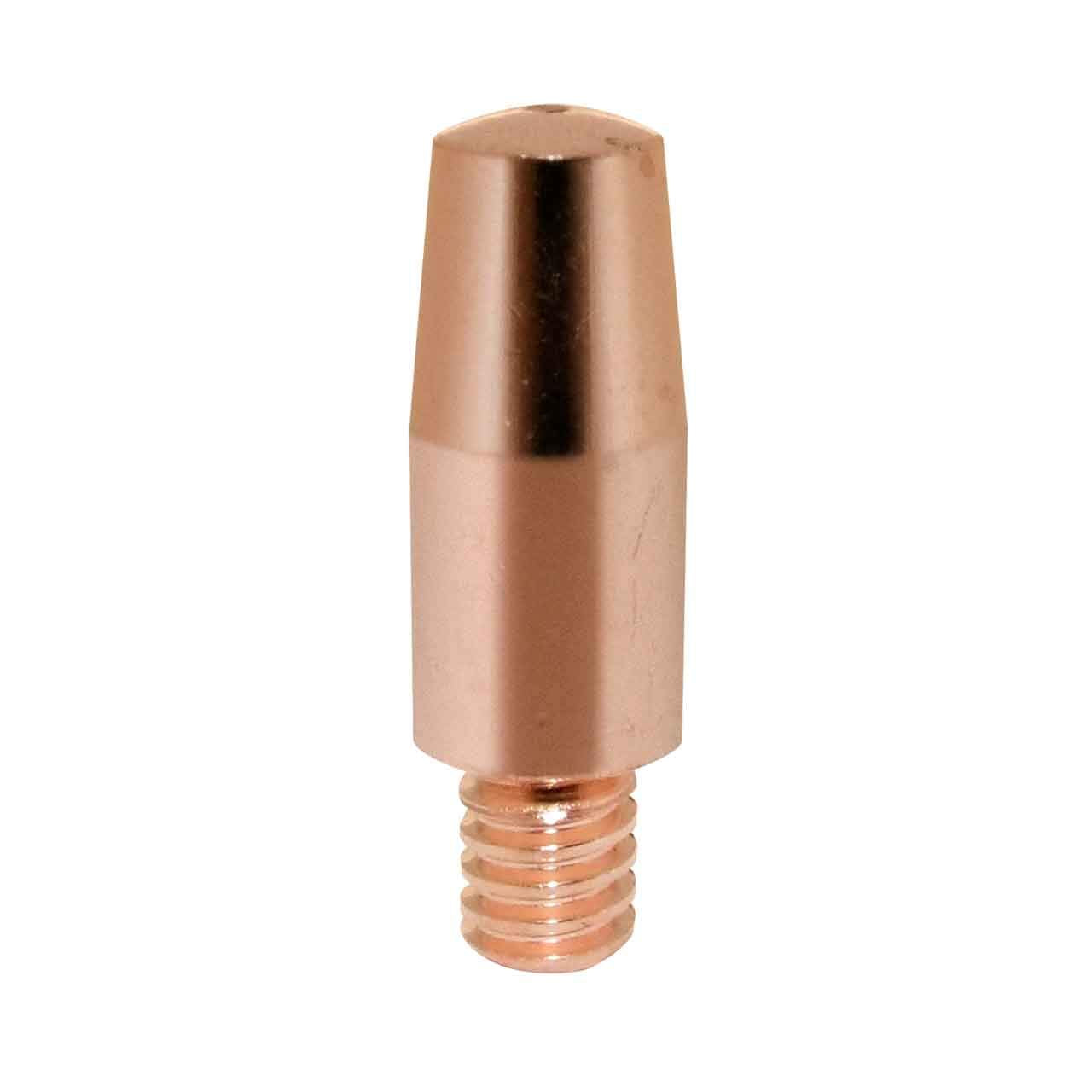
Poor arc stability on a Millermatic 211 is usually not a board failure. Start with the parts that directly control the arc: contact tip, wire feed path, drive roll groove, gun liner, work clamp, polarity, gas coverage, and input power. A stuttering arc, burnback, popping, excess spatter, or a bead that alternates between cold and hot normally points to inconsistent wire delivery or an unstable electrical return path before it points to the machine.
The Millermatic 211 family has changed over time, so verify the exact machine version and gun before ordering. Older Millermatic 211 Auto-Set MVP units may use an M-10 or M-100 style gun path. Newer Millermatic 211 units commonly use the MDX-100 / AccuLock MDX consumable path. Do not order tips, liners, nozzles, or diffusers by “211” alone. Confirm the gun label, wire diameter, and consumable series first.
Common Symptoms
- Arc pops, snaps, or surges while wire speed sounds uneven.
- Wire burns back into the contact tip.
- Spatter increases even though settings did not change.
- Arc starts clean, then gets erratic after the gun lead bends.
- Wire feeds, but weld output is weak or inconsistent.
- Bead alternates between tall/cold and flat/hot.
Most Likely Causes
| Symptom | Likely Cause | First Check |
|---|---|---|
| Burnback at tip | Worn, blocked, loose, or wrong-size contact tip | Install a tip matching wire diameter |
| Arc surges with feed changes | Liner drag, tight gun bend, or spool drag | Lay gun cable straight and test feed |
| Wire slips at feeder | Drive roll pressure wrong or wrong groove selected | Set correct groove and adjust pressure gradually |
| Arc weak but wire feeds | Poor work clamp contact or wrong polarity | Clean work clamp area and verify polarity |
| Porosity plus unstable arc | Gas flow issue, leak, blocked nozzle, draft | Check nozzle, regulator flow, hose, and gas type |
| Worse on 120 V | Low input voltage or extension cord voltage drop | Test on proper circuit or 240 V when available |
Quick Checks Before Replacing Parts
- Clip the wire clean and remove the nozzle.
- Inspect the contact tip bore. Replace it if oval, dirty, spattered, loose, or oversized.
- Confirm wire size matches the tip size: .024, .030, or .035 for common solid-wire setups.
- Lay the MIG gun lead as straight as possible and jog wire through the gun.
- Open the drive housing and confirm the wire is sitting in the correct drive roll groove.
- Set drive roll pressure only tight enough to feed without slipping. Too much pressure can deform wire and create liner debris.
- Check spool hub tension. The spool should not freewheel, but it also should not drag hard.
- Clean the work clamp area to bare metal and clamp close to the weld.
- Verify polarity for the wire being used: solid wire with gas and self-shielded flux-cored wire commonly require different polarity. Verify by wire label.
- Check gas flow, gas type, nozzle blockage, and drafts before blaming parameters.
What Wears Out First
The contact tip wears first because it carries welding current and guides the wire at the arc. Once the bore becomes oversized, dirty, or heat-damaged, the wire no longer transfers current consistently. That creates a wandering, harsh, or sputtering arc. Replace the tip before changing major settings.
The liner is the next common failure point. A dirty or kinked liner increases drag, especially when the gun cable is coiled or bent. That drag slows wire at the arc even when the feeder motor sounds normal. The result is burnback, stubbing, or a surging bead.
Compatibility Notes
For current Millermatic 211 machines using the MDX-100 gun, verify AccuLock MDX consumables and the correct wire diameter before ordering. Weld Support Parts lists the MDX-100 gun with AccuLock MDX consumables and .030-.035 in wire coverage here: Miller MDX-100 MIG Gun Parts.
If the gun is missing, swapped, or the machine is older, use the Miller MIG Gun Selection Chart and the Miller MIG Guns page before ordering. For machine-family lookup, start with Miller MIG Support.
Test Procedure: Separate Arc Problem From Feed Problem
- Install a known-good contact tip and clean nozzle.
- Use clean wire from a dry spool.
- Set the machine using the chart or Auto-Set for the exact wire/gas combination.
- Run wire through the gun with the lead straight. Watch for pulsing, hesitation, or shaving.
- Make a short bead on clean steel with the work clamp on bare metal.
- If the bead improves, the issue was consumable, feed, ground, or setup related.
- If the bead still surges with known-good feed and ground, check input voltage and have the machine inspected by a qualified service technician.
Field Fix vs Proper Fix
A field fix is replacing the contact tip, cleaning the nozzle, straightening the gun cable, tightening the work clamp, and slightly correcting wire speed. That may get the weld finished.
The proper fix is a full wire-path inspection: tip, diffuser, liner, inlet guide, drive roll groove, drive pressure, spool brake, polarity, gas delivery, and work lead. If the liner is dirty or the tip keeps burning back, replace the worn consumables instead of chasing voltage and wire speed all day.
Common Wrong-Part Mistakes
- Ordering tips for the machine model instead of the actual MIG gun installed.
- Mixing AccuLock MDX, AccuLock S, M-Series, Tweco-style, or Bernard-style consumables.
- Using a .035 tip with .030 wire because it “feeds easier.” This can reduce current transfer stability.
- Installing a liner for the wrong wire range.
- Using flux-cored polarity with solid wire and gas, or the reverse.
- Assuming a spool gun part fits the standard MIG gun. Spoolmate consumables are a different path. See Miller Spoolmate 100 Consumables if aluminum spool-gun setup is involved.
Related Failure Paths
- Burnback into contact tip
- Birdnesting at drive rolls
- Porosity from poor gas coverage
- Wire feed surging from liner drag
- Low output from poor work clamp contact
- Wrong consumable family after gun replacement
Safety Notes
Turn off and disconnect input power before servicing the gun, liner, drive rolls, or internal machine parts. Do not touch live electrical parts. Keep the work clamp insulated when not connected to the workpiece. Use proper eye, hand, body, and respiratory protection. If the machine has repeated low output, overheating, electrical odor, damaged cords, or erratic behavior after feed and ground checks, stop welding and send it to a qualified service center.
Sources Checked
- Miller Millermatic 211 Auto-Set with MVP owner’s manual
- Miller Millermatic 211 product specification sheet
- Miller Millermatic 211 PRO product page
- Weld Support Parts Miller MDX-100 gun page
- Weld Support Parts Miller MIG gun selection and MIG support pages