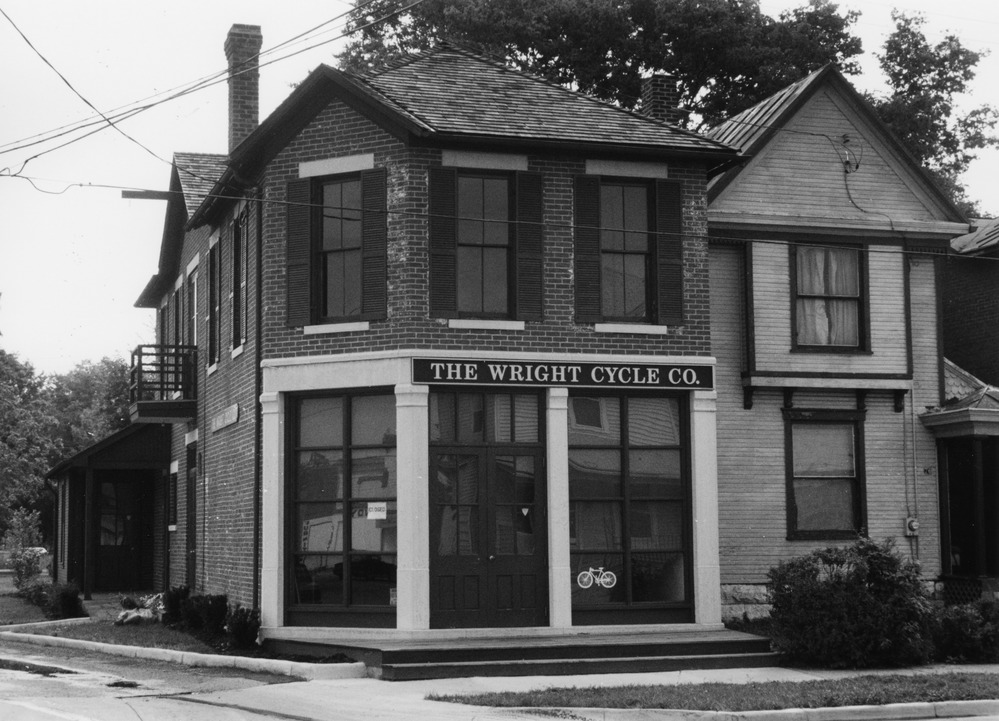
The Wright brothers’ bicycle shop offers a useful way to think about making a test: the test equipment is part of the work, not merely a place to display the result. Before the famous powered flights, a Dayton workshop became a place to question measurements, shape small models and learn why an expected result had not arrived. For a fabricator, that part of the story deserves attention alongside the airplane.
This is a historical look at shop craft, not a guide to building aircraft or copying an early test apparatus. The useful connection is a habit of mind: separate the object you are trying to improve from the method you use to judge it. Both can need work, and an impressive-looking sample cannot answer a question the test was never designed to ask.
A working business, not an empty laboratory
The National Park Service’s Wright Cycle Company history describes a business making bicycles to order, initially using purchased frames and other materials. The brothers developed their own models and features, but their aviation interest did not immediately replace ordinary bicycle work. They planned trips to Kitty Hawk around slower business periods and arranged coverage for the shop. The bicycle business continued until 1908.
That makes the setting more interesting than the familiar image of an inventor alone at a bench. There were customers and existing responsibilities as well as experiments. A new question had to find room inside an operating business. The distinction matters: a shop can be a place of discovery without every job on the schedule being an experiment.
For a modern crew, the parallel is not permission to turn a customer’s part into a trial. It is a reason to give development work a clear boundary. Identify what belongs to the approved job, what belongs to a separate investigation and who decides when evidence is sufficient. Curiosity is useful; an unrecorded change to someone else’s requirements is a different matter.
The measuring arrangement needed attention too
In NASA Glenn’s account of the 1901 wind tunnel, disappointing glider results led the brothers to question the aerodynamic data behind their designs. They made a wooden test tunnel, driven from the engine used for their shop tools, and built models and balances to examine lift and drag. The apparatus itself was not instantly satisfactory: they spent nearly a month developing devices to straighten the airflow after the fan.
NASA also describes preliminary model testing followed by more detailed comparisons in which a single design variable changed between models. That is an important distinction between making many different objects and arranging a comparison that can explain a difference. The small models were not just miniature airplanes for display. They were tools for asking narrower questions.
The shop lesson is not that a homemade instrument is automatically trustworthy. It is almost the opposite: the arrangement needs scrutiny before its readings become the basis of a confident decision. If an observation contradicts an expectation, the object, the assumptions and the way the observation was made all deserve consideration. Historical ingenuity is not a substitute for today’s calibration, engineering or acceptance requirements.
Give the supporting craft its name
The National Park Service’s account of Charles E. Taylor adds another person to the workshop story. Taylor joined the Wright Cycle Company in June 1901, handling bicycle repairs and helping run the business. His work later included the wind tunnel and the engine for the 1903 Flyer. The NPS describes engine components made with tools primarily used for bicycle repair, while the crankcase casting came from a local foundry.
The division of work is worth noticing without turning it into a claim that any shop can safely make any machine. A project can depend on the person who keeps ordinary work moving, the person who builds the measuring fixture and a specialist outside the building. The finished object alone does not reveal that network of contributions.
WSP’s look at a pattern shop’s place in the trade considers another example of supporting work that can disappear from the final object. The connection is not that the two shops used identical methods. It is that giving credit only to the last visible operation leaves much of the craft out of the story.
Keep the question smaller than the ambition
A useful discussion after reading this history can begin with three questions. What exactly were the workers trying to learn? What did their measuring arrangement allow them to observe? What remained outside that observation? Those questions keep a story about invention from collapsing into a slogan about trying harder.
In a current shop, they can also improve a handoff. A note saying that a trial “worked” may hide the most useful information. A clearer note states the question, identifies the sample and records the observed result and limitations. It does not need to claim that the whole design is proven. The person receiving it should be able to distinguish a promising observation from a released production requirement.
For another view of how careful observation supports shop work, read WSP’s article about the people who keep equipment moving. The Wright workshop offers a historical companion: sometimes progress begins by improving the question and the means of answering it, not by making the final object more elaborate. For shop paperwork tools and welding-inspired gear, explore Arc Life.
Leave a Reply