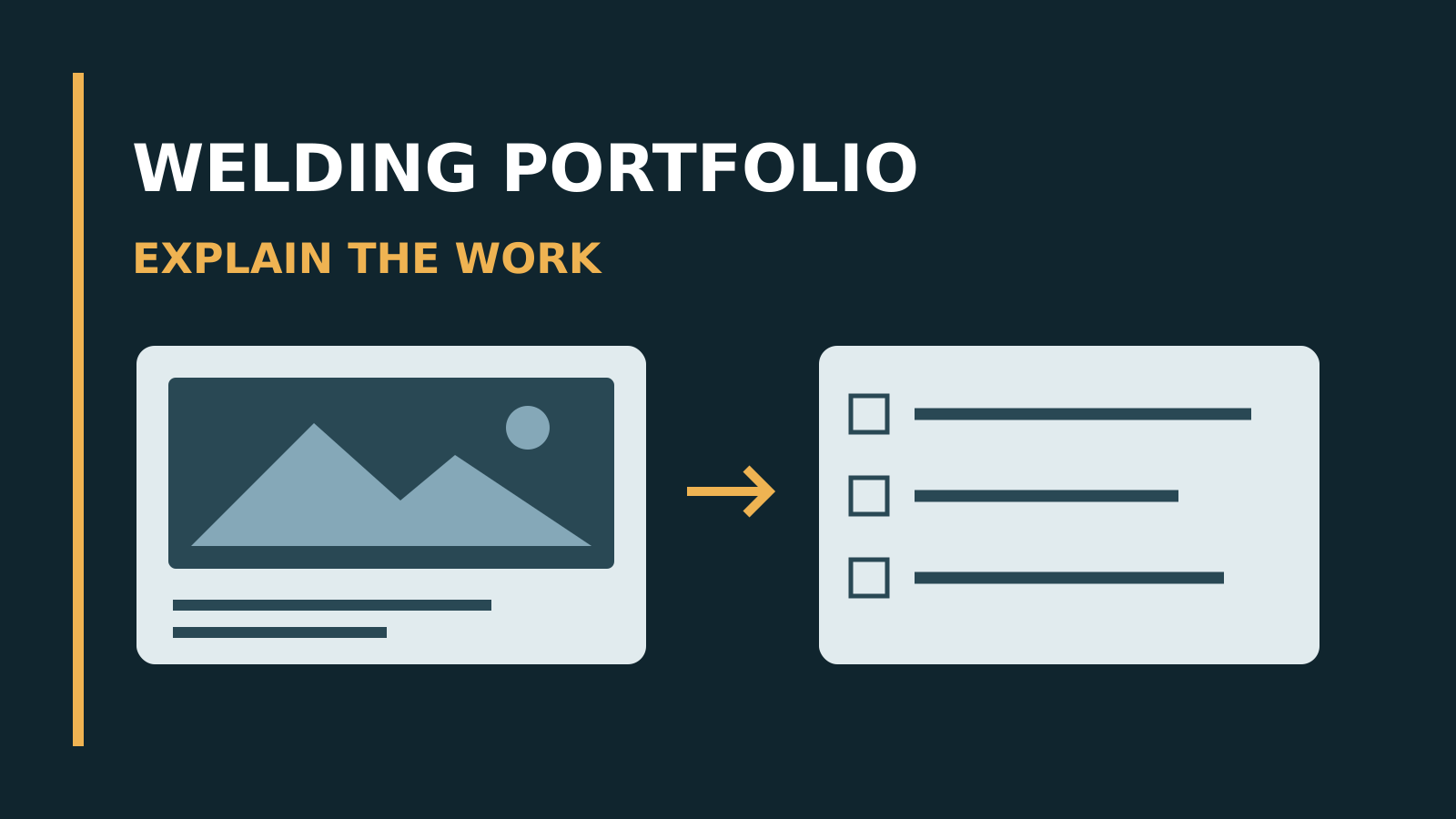
A welding portfolio should help someone understand what you actually did. A close-up photograph can start that conversation, but it cannot explain your role, the setting, the requirements or the limits of the evidence by itself. The useful portfolio puts those details beside the picture instead of expecting an interviewer to guess.
This is an original, practical way to organize work samples for a career conversation. It is not an employer requirement, a qualification system or a promise of a job. Start with a small selection of examples you are allowed to share, then make each example easy to discuss honestly.
Start with the role you want to explain
Before choosing photographs, write down the kind of work you want the portfolio to discuss. A general album of attractive welds is different from a set of examples showing how you read a drawing, prepared a part, followed instructions or contributed to a team project. Choose the question first; select the sample second.
The U.S. Bureau of Labor Statistics occupational profile includes interpreting drawings and specifications, measuring parts and inspecting materials among typical duties in this occupation. That broader description is a useful reminder: a photograph of the final bead is only one possible part of the story. It does not mean every applicant performs every listed duty.
For each proposed example, finish this sentence: this sample helps me explain ____. If the answer is simply that it looks impressive, consider whether another example would communicate your contribution more clearly. A modest training exercise with an accurate explanation can be more useful than a dramatic project whose details you cannot discuss.
Check permission before building the page
Do not assume that taking a photograph, appearing in it or helping make the part gives you permission to include it in a job application or public album. Ask the appropriate employer, instructor or project owner what may be shared and with whom. Keep that answer with your working notes. If the answer is uncertain, leave the material out until it is resolved.
Look beyond the main object. A background can contain a customer name, drawing, serial number, person or screen that does not belong in your portfolio. Follow the applicable rules rather than deciding that a small crop automatically makes a restricted image acceptable. A private interview and a public website are different audiences; permission for one should not be assumed to cover the other.
An alternative is a permitted personal project or classroom exercise that you can identify accurately. Label it as such. Do not stage an example to imply that it came from production work, and do not borrow another person’s image to fill a gap in your experience.
Use one sample card for each example
Give each selected sample a short page rather than a long, unexplained gallery. The following headings are a suggested organization tool, not an official form. Use only details you know and are permitted to disclose.
- Context: A brief project description, approximate date and whether it was training, personal or workplace work.
- My contribution: The tasks you personally performed, separated from work done by others.
- What the sample shows: A factual description of the visible stage, without claiming that the image proves more than it does.
- Requirements followed: A permitted description of the instructions used, without copying restricted drawings or procedures.
- Feedback or evidence: The actual feedback or record you can appropriately reference, and who provided it.
- Limits and next learning: What the example does not establish and what you would like to improve.
Keep the distinction between observation and conclusion visible. Saying that a photo shows a completed classroom assembly identifies the subject. Saying that it proves the assembly is suitable for a service application makes a different claim. If you do not have the relevant evaluation and authority, do not make that leap.
For team projects, describe your part without taking ownership of the whole result. Preparing parts, following a layout, completing assigned welds and helping document the work are different contributions. An honest boundary gives the interviewer something specific to ask about; an inflated claim creates a conversation you may not be able to support.
Keep credentials in a separate section
A portfolio and a credential answer different questions. The AWS Certified Welder Program describes performance-based testing at an Accredited Test Facility and qualifications tied to particular welding procedures and requirements. A photograph or self-written sample card is not a substitute for that process.
Keep actual training and qualification documents separate from your work-sample pages. Describe each by its correct name and its documented scope, rather than turning a course completion record into a broader certification claim. Check current status through the appropriate issuer or record holder when needed. Do not assume an old document settles a prospective employer’s requirements.
If you have no formal credential, do not hide that with an impressive-looking cover or badge. Explain the experience you do have and the questions you want to discuss. Let the employer or training provider explain any required assessment rather than presenting the portfolio as an exemption.
Practice a short, factual walkthrough
Choose one sample and explain its context, your contribution and what you learned without reading every line. Then check your explanation against the page. If the spoken account adds a material, process, result or responsibility that the record does not support, correct the account rather than decorating the page with a guess.
Prepare for a follow-up question you cannot answer. It is reasonable to identify what you remember, what would need checking and what you are not authorized to disclose. Do not invent a measurement or inspection result to make the conversation flow. The point is to make your experience understandable, including its boundaries.
Make a shareable copy, not your whole archive
Keep a working collection for your own organization, then select an appropriate copy for the specific conversation. Remove unrelated personal information and anything outside the agreed sharing permission. Use clear filenames and readable text. Check the file opens before the interview, and ask how the recipient prefers to receive it rather than assuming they want a large attachment or a public link.
Review the selection when your experience changes. Replace weak explanations with clearer ones, and remove material you can no longer appropriately share. A portfolio is useful because it is accurate and relevant, not because it contains every photograph you have ever taken.
For another perspective on keeping evidence of progress, read why one practice coupon can matter. That article concerns a personal keepsake; this checklist concerns explaining selected work to someone else. For welding-inspired gear and shop-paperwork tools, explore Arc Life. No merchandise purchase is needed to make a clear portfolio.
Leave a Reply