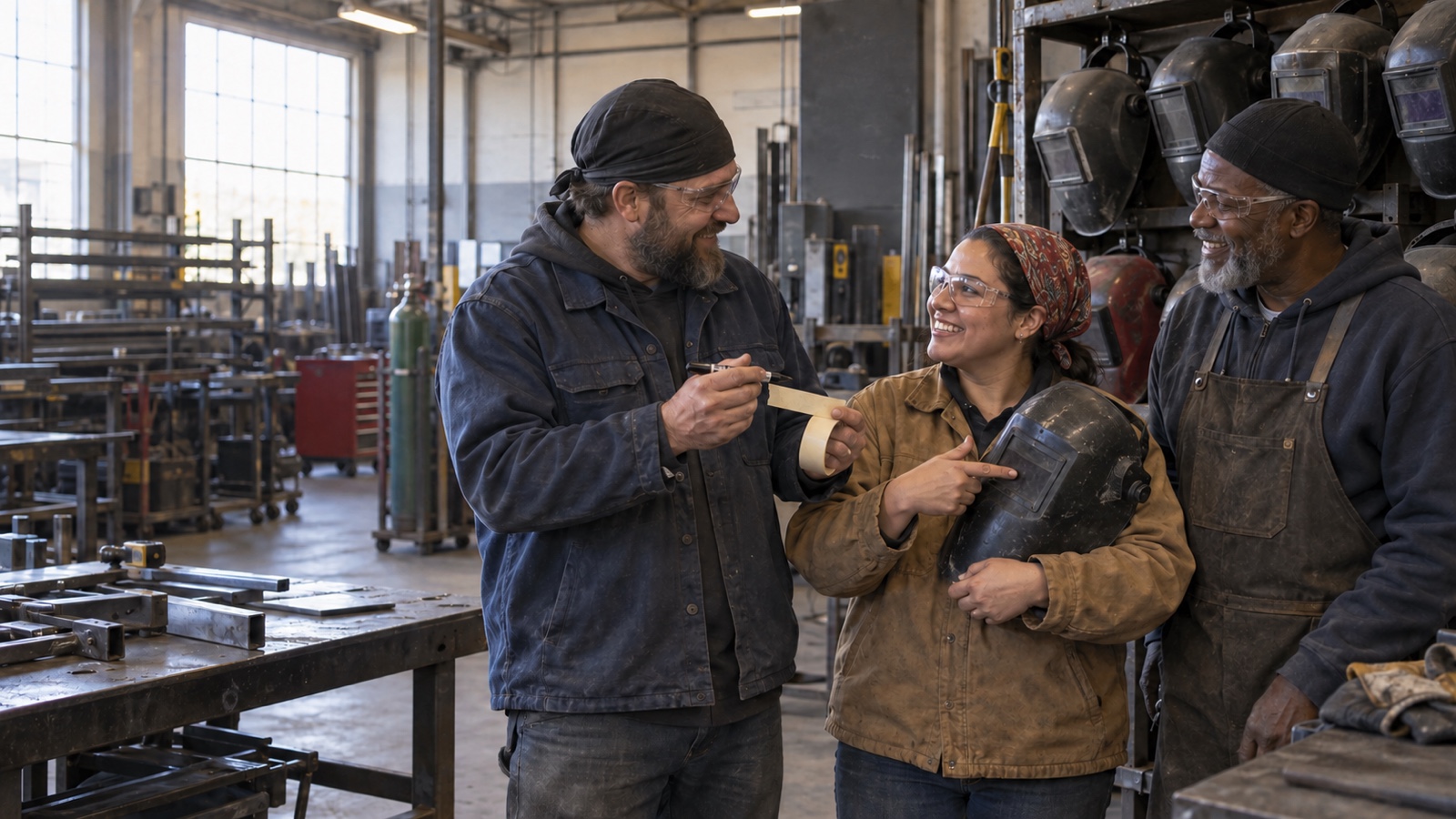
The timecard carries a legal name. The back of the hood may carry something shorter.
Shop nicknames arrive from everywhere: a hometown, a last name that gets trimmed down, a harmless mistake on a first week, a habit nobody else has. Some are chosen. Some are earned. A few appear before lunch and survive longer than the job that created them.
At their best, those names are a small form of belonging. They say the crew knows you well enough to have a language for you. They can cross age groups and job titles, take the edge off a long shift, and turn a row of identical hoods into a map of the people who use them.
At their worst, a nickname is a cheap shot with seniority. The whole shop knows it bothers one person, yet everyone keeps using it because stopping would mean admitting the joke was never shared.
The cleverness is beside the point. What matters is that the person carrying the name wants it.
A good nickname travels both directions
There is a simple test for shop humor: Does the person answer to the name when the supervisor is not standing there—and do they use it for themselves?
That matters because a laugh can be hard to read at work. A new hire may smile along rather than challenge a lead. An apprentice may not want to look thin-skinned in front of a crew that already has years together. A worker on probation has even less room to correct the person deciding who gets the next opportunity.
Consent in a shop rarely arrives as a formal meeting. It sounds more ordinary: “You good with that?” It also has to remain revocable. A name that was funny for six months can stop being funny. The crew does not need a hearing to retire it.
Good nicknames also work in both directions. The person can wear the name on a hood, introduce themselves with it, or throw it back into the conversation without becoming the crew’s permanent punch line. If the joke only moves downward—from senior hand to apprentice, lead to helper, majority to the one person who is different—it is not carrying the same weight for everyone.
The shop still has work to communicate
This is more than an etiquette question. Welding is team work even when one person is under the hood. The current O*NET profile for welders reports that face-to-face discussion with individuals and teams is a daily part of the job for 67 percent of respondents. The same profile includes communicating with peers and supervisors, solving problems, maintaining cooperative relationships and building trust among relevant work activities.
That communication has to survive noise, distance, respirators, hearing protection and the urgency of a moving job. A name used for a crane signal, hot-work warning or equipment problem cannot be ambiguous. Two people with the same first name may need a clear call sign. A nickname nobody recognizes—or one the person deliberately ignores—does not help.
The strongest crew culture makes room for both speed and respect. Ask what someone wants to be called. Use the answer. Save the elaborate story for break time. When the work turns serious, the name should get the right person’s attention immediately.
There is another practical reason to watch the line: people do better work where they can speak. The U.S. Department of Labor’s Job Quality Continuum treats organizational culture and worker voice as parts of a good job, including a workplace where people are respected and their voices are heard. A welder who cannot say “Don’t call me that” may also hesitate before saying “That fixture moved” or “This setup does not match the drawing.”
Humor is supposed to lower the pressure. If it makes useful disagreement more expensive, it is working against the crew.
Do not wait for the legal line
A shop does not need to turn every rough joke into a policy seminar. It also should not pretend that everything said with a grin is harmless.
The U.S. Equal Employment Opportunity Commission describes workplace harassment as unwelcome conduct based on protected characteristics such as race, religion, sex, national origin, age 40 or older, disability or genetic information. The agency also says prevention is the best tool for eliminating harassment.
Not every unwanted nickname meets the legal definition of harassment. That is a poor standard for everyday conduct anyway. A healthy shop corrects a problem before anyone has to prove it is severe enough for a case file.
The practical boundary is easy to understand. Do not build a nickname from a protected characteristic, a disability, somebody’s body, or a rumor about their private life. Do not keep pushing after the person says stop. Do not make the newest worker buy acceptance by absorbing whatever the senior crew wants to throw.
Leads set the temperature here. They do not need to ban personality from the building. They can laugh, tell stories and carry their own old nicknames. Their job is to notice when the room is laughing together and when one person is doing the work of pretending.
Keep the stories, lose the hostage situation
Shop culture is not manufactured by a poster in the break room. It is built from repeated signals: who gets listened to, whose mistakes become permanent identities, who can give an honest warning, and what happens after someone says enough.
A nickname can become one of the good signals. It can hold a whole chapter of a career in two syllables. Years later, hearing it can bring back the layout table, the truck, the crew and the shift that made it stick.
But belonging cannot be assigned by force. The name works because the person inside it claims it too.
So keep the shorthand. Keep the stories that improve with every telling. Keep the harmless names people are proud to answer to. And retire the one that needs an audience more than it needs the person wearing it.
What is the best shop nickname you have heard—and what made it feel like respect instead of a cheap shot?
Arc Life tells the human side of welding: the habits, humor and unwritten rules that shape a crew. Find more stories from the welding life and add your own perspective to the conversation.

Leave a Reply