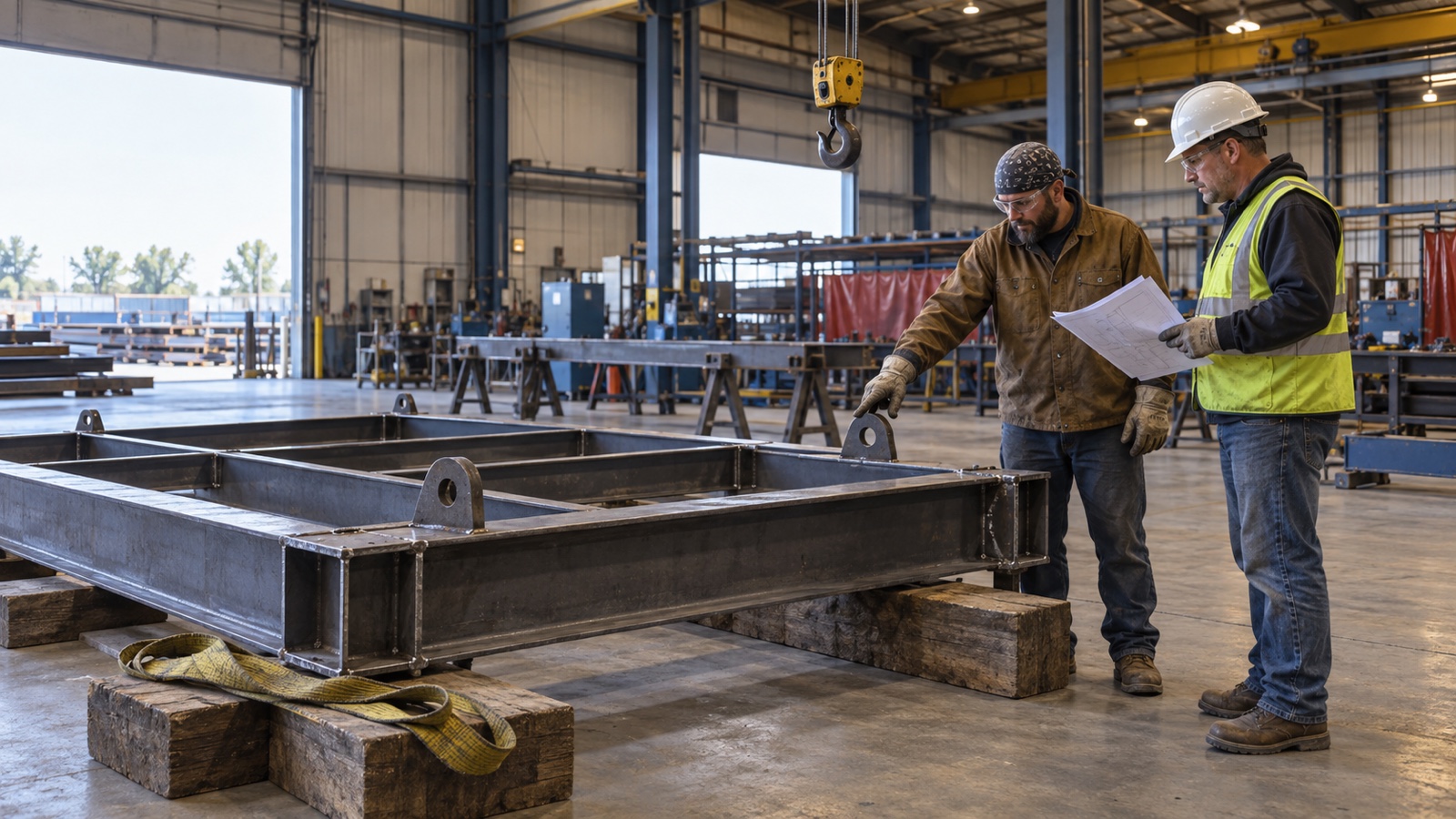
A fabricated frame can sit on stands for days while it is fitted, tacked, squared, welded and dressed. Then the hook arrives. The room changes.
The easy conversation thins out. One person watches the pick points. Another watches the hook. Somebody checks the travel path again. A piece that felt like a workbench problem a minute ago is about to become a moving object with weight, balance and consequences.
That moment belongs to more than one trade. The welder knows how the assembly was built. The rigger knows how it can be handled. The operator sees the machine and the path from a different seat. A good lift depends on all three views meeting before anything leaves the dunnage.
This is one of the quieter partnerships in fabrication. It rarely gets photographed, and it is hard to reduce to a dramatic shower of sparks. Yet the trust between welders and riggers says a great deal about how serious shop work actually gets done.
The handoff starts before the lift
The rigger does not simply arrive at the end and attach hardware to whatever the shop has produced. The work begins with questions the fabrication crew can help answer: Where is the weight concentrated? Is the assembly complete? Are temporary braces still doing a job? Which surfaces can tolerate contact, and which have to arrive without a scar? Is there an obvious place to control the piece once it moves?
Those questions are not a critique of the weld. They are the bridge between making an object and moving it.
The U.S. Department of Labor’s current O*NET profile for riggers describes the occupation across construction sites, manufacturing plants, shipyards and other settings. Its core tasks include testing rigging, selecting gear for a load, attaching loads and directing workers during hoisting. The description makes the coordination plain: this is skilled work built around equipment, judgment and communication.
The fabricator contributes a different kind of knowledge. A drawing may show the finished dimensions, but the person who built the piece remembers the heavy end, the open side, the temporary attachment and the corner that pulled during welding. That shop-floor memory can be useful during the lift discussion. It does not replace an approved plan or a qualified person’s decisions. It makes the conversation better.
Clear signals beat shop-floor shorthand
Fabrication has plenty of efficient shorthand. A glance across the table can mean hold that end. A tap on a square can mean check it again. That economy is useful when everyone can see the same work at arm’s length.
A lift is different. The operator may not share the crew’s sightline. Noise can swallow a shouted word. A familiar gesture can look like something else from a distance. The safest crews do not treat clarity as an insult to experience; they treat it as part of experience.
Federal rules for cranes and derricks in construction draw a firm line around that responsibility. OSHA’s signal-person qualification standard requires a signal person to understand the signals being used, apply them competently, grasp relevant equipment limitations and demonstrate that knowledge through testing. Those requirements apply to the construction-crane situations covered by the rule, not automatically to every hoist in every shop. Still, the cultural lesson travels well: one clear system is stronger than a circle of people giving improvised directions.
There is another rule worth noticing. In that same construction-crane context, OSHA says anyone who becomes aware of a safety problem must give the stop or emergency-stop signal. The authority to stop is not reserved for the loudest voice or the longest résumé.
That principle matters because trust is not the absence of questions. Trust is knowing a question will be heard before the next move.
The best lift looks almost uneventful
The most memorable shop stories usually involve a save: the person who caught a bad fit before the root pass, found the reversed detail on a print or heard a bearing change tone before it failed. Those stories deserve their place. But they can make competence sound like a string of last-second rescues.
Good lifting work is often less theatrical. The piece rises a little and pauses. Balance is confirmed. The route is already clear. People know where they belong. The operator receives one readable direction. The load reaches its next support without becoming a story anyone has to retell at lunch.
That calm result contains a lot of invisible labor. It reflects preparation, inspected equipment, an understood plan and people willing to say they do not like what they see. It also reflects restraint. A welder who knows the assembly well still respects the rigger’s role. A rigger who knows the lift still listens when the fabricator points out something unusual in the build.
The relationship works because neither person has to pretend to know the other’s whole job.
What the hook reveals about a shop
You can learn something about a shop in the minute before a heavy piece moves.
Does the crew slow down, or does production pressure make everyone rush the handoff? Are instructions coming from one understood source? Can a newer worker raise a concern without being brushed aside? Does the fabrication team think about handling while the piece is still being built, or only after the truck is waiting?
These are culture questions disguised as logistics. A clean bead proves that somebody controlled an arc. A calm handoff proves that several people controlled themselves.
The work also leaves a useful reminder for welders: the finished object will have a life beyond the table. It has to be turned, coated, loaded, installed, inspected, maintained or repaired. Thinking about the next pair of hands is not extra courtesy. It is part of making something that can move through the world.
So here is the shop-floor question: what does a good welder do during a lift that makes the rigger’s job easier—and what do the best riggers do that earns a fabricator’s trust?
Arc Life is here for the parts of the trade that live between the formal job descriptions: the habits, handoffs and people that make a shop run. Find more of that welding culture at The Welder’s Life.

Leave a Reply