Series: Shop Floor Stories
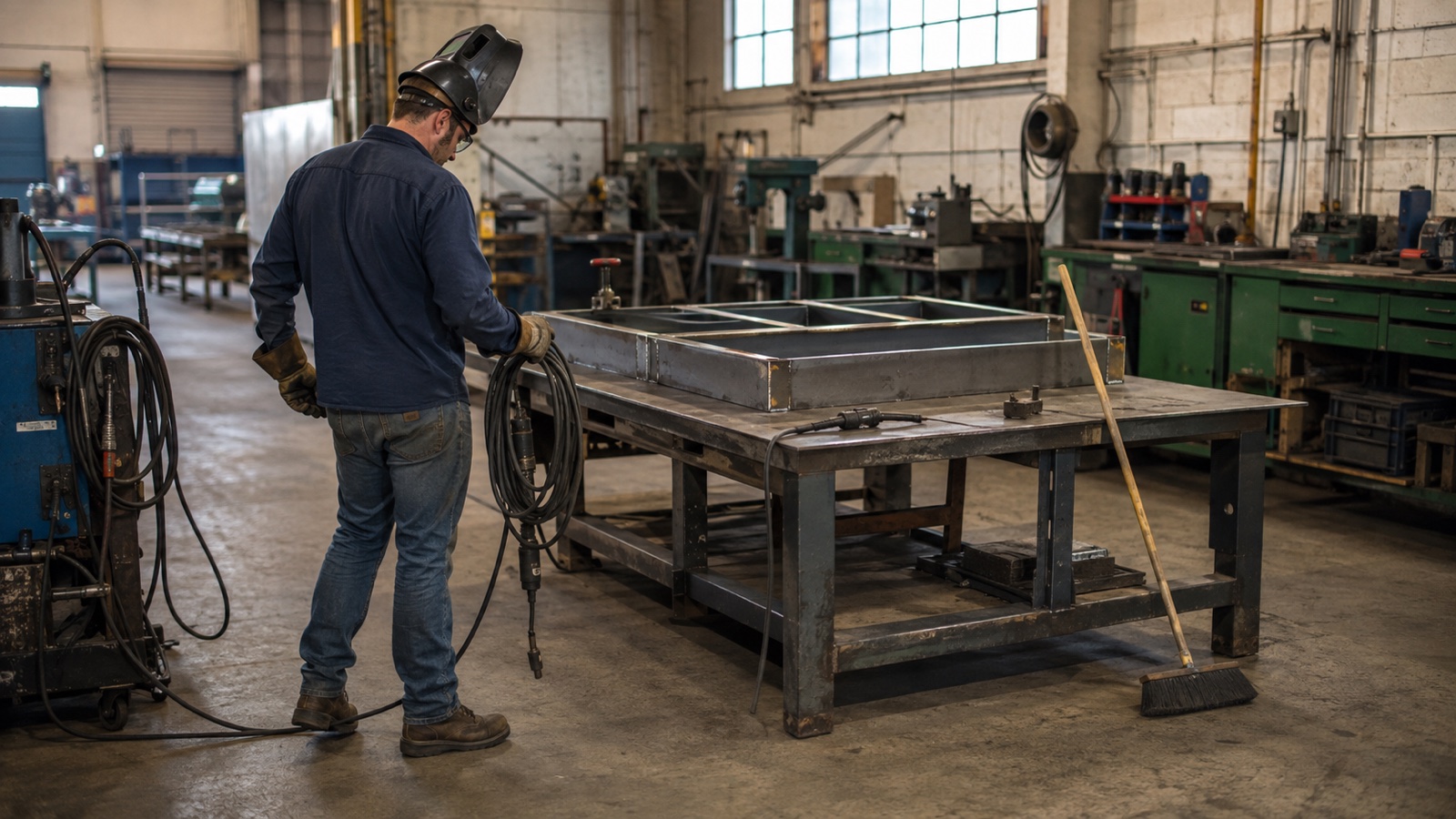
The last arc goes out. The blue-white reflection disappears from the wall. A fan keeps turning, a steel assembly keeps holding heat, and somewhere near the time clock somebody is already thinking about the long weekend.
But the shop is not finished just because the welding is.
The final minutes of a shift rarely make the photograph. Nobody frames a shot of a welder returning a square, separating usable drops from trash, marking a hot piece, or writing down that a machine behaved strangely on the last joint. Yet those minutes tell the next crew what kind of shop they have walked into.
Ahead of Labor Day, it is worth noticing this quiet part of the work. The U.S. Department of Labor describes the holiday as a celebration of workers’ social and economic achievements. In a welding shop, some of that achievement lives in the finished fabrication. Some of it lives in the condition of the floor, table and information left behind.
Quitting time has its own sound
During production, a shop announces itself: wire feeds, grinders bite, clamps ring against plate. At the end of the shift, the sounds get smaller. A lead slides across concrete. A drawer closes. Somebody calls out that a piece is still hot.
These are not glamorous motions, and they should not be treated as unpaid favors performed after the clock. A proper shutdown and handoff belong inside the scheduled work. They are part of making the shift complete.
Experienced crews understand the difference between cleaning for appearance and leaving an area ready to trust. A table can look neat while hiding a damaged lead under it. A floor can be swept while a sharp cutoff remains where a boot will find it. A machine can be silent while the next operator has no idea that the feed hesitated twice during the last hour.
The useful question is not, “Does this booth look good?” It is, “What will the next person need to know before starting?”
A finished weld is not always a finished area
Hot work has a long tail. Steel does not cool on the time clock, and sparks can reach places the person under the hood never saw. OSHA’s welding standard requires fire watchers in specified higher-risk conditions and says that, when a fire watch is required, it must continue for at least 30 minutes after welding or cutting ends. That is not a universal timer for every weld. It is a reminder that the job-site plan—not impatience—decides when an area is clear.
The ordinary floor matters, too. OSHA’s walking-working-surface rule requires work areas to be kept clean and orderly and free of hazards such as sharp or protruding objects, leaks and spills. In a fabrication shop, that language becomes concrete: offcuts do not belong in a travel path, leads should not surprise the next set of boots, and an uncertain hot piece needs the shop’s approved warning method.
None of that turns a welder into the maintenance department or the safety manager. It does mean that a person who sees a problem owns the next honest step: make the immediate area safe within their role, then report what needs somebody else’s authority or skill.
The handoff is written in small things
A strong handoff does not require a speech. It often fits into a few observable facts.
The assembly is complete through this joint. The next piece is staged here. This drop is saved for a reason; that pile is scrap. The machine fault appeared after the last changeover. The cylinder, lead, gun, torch or fixture needs attention according to the shop’s process. The metal near this mark may still be hot.
Notice what is missing: guesswork dressed up as certainty. “It acted weird” leaves the next person with a mystery. “The wire hesitated twice on the last two starts; I stopped and reported it” gives them something real. Good crews do not pass along a diagnosis they have not earned. They pass along evidence.
That habit is a form of respect. The next shift should not have to reconstruct the last ten minutes from a half-empty box, a moved clamp and a machine left in an unexplained state.
The clean booth is a promise, not a personality test
Shop culture can get foolish about neatness. One person treats a spotless bench as proof of character. Another acts as if cleanup is beneath the people who produce. Both miss the point.
The goal is not to make every booth look identical. The goal is to leave the work understandable and the shared space dependable. A veteran may arrange tools differently from an apprentice. A pipe station will not reset like a production MIG cell. The standard is functional: hazards addressed, tools where the crew expects them, material identified, equipment concerns reported, and the next operation clear.
That standard also protects the worker who is leaving. A written note or tag prevents an unfinished issue from becoming somebody’s foggy memory on Tuesday morning. A deliberate shutdown draws a clean line between what was completed and what still belongs to the job.
Labor Day was built to recognize work and the people who do it. In the welding trade, the visible bead deserves pride. So does the less visible discipline that keeps a shared shop from becoming a collection of other people’s surprises.
The arc going dark is a moment. Finishing the shift is a craft.
Shop question: What is one end-of-shift habit that tells you the person before you cared about the crew coming in next?
Arc Life tells stories about the people, habits and identity behind the hood. Read what Arc Life is about, then visit the Arc Life collection if you want to carry a little of that shop culture beyond the booth.
Leave a Reply