Shop Talk
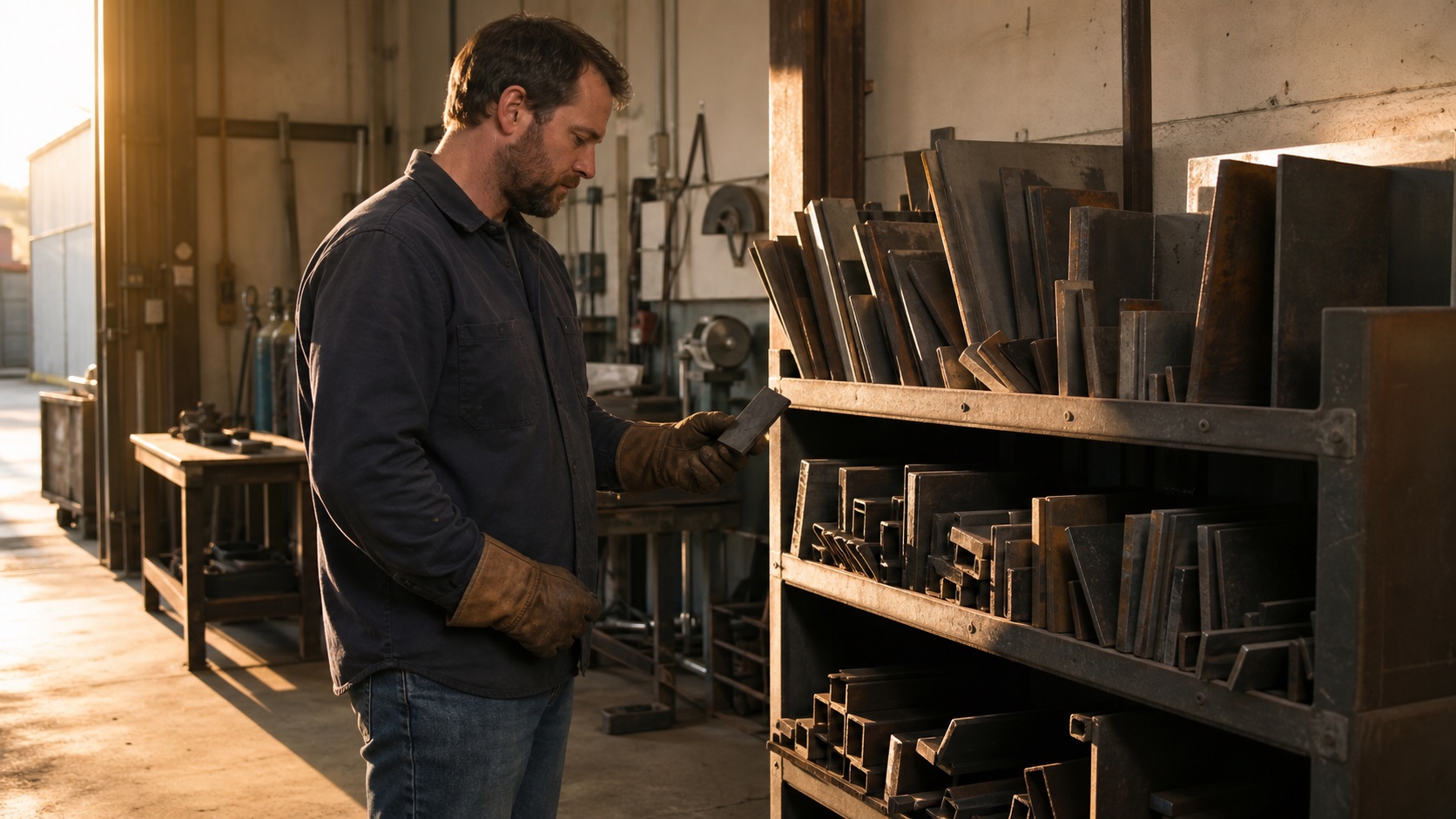
There is a moment at the end of almost every cut when a welder has to make a small decision: scrap bin or save pile?
The piece in your hand may be too short for the job that created it and perfect for something that has not happened yet. A length of angle becomes a stop. A plate remnant becomes a base. A square of sheet becomes the answer to a repair that walks through the door three weeks later.
To someone outside the trade, the rack can look like leftovers. To a welder, the right offcut is stored possibility.
Scrap Is a Judgment Call
Keeping metal is easy. Knowing what is worth keeping is the skill.
A useful remnant has enough size, shape, and known material to solve a realistic problem. It can be stored without creating a hazard. Someone can find it again. It saves more time than it steals from the shop.
That last part matters. A mountain of mystery metal is not a resource just because nobody has thrown it away. If every short drop, bent strip, and rusted fragment gets a permanent home, the save pile becomes a tax paid in floor space and frustration. Good shop judgment lives between tossing everything and keeping everything.
A Useful Offcut Still Has a Future
The good pieces tend to announce themselves. A clean section of tube is long enough to become a spacer or short brace. A flat plate can support a fixture, a practice setup, or a weekend project. Small sections of angle can help hold work in a repeatable position. None of those possibilities needs to be assigned today.
That is part of what makes the rack satisfying. It is not a pile of finished ideas. It is a shelf of options.
The habit also reflects how fabricators think. Welding is often described as joining metal, but much of the real work happens earlier: seeing relationships between shapes, deciding what can support what, and imagining a finished object before the pieces agree. The offcut rack gives that imagination somewhere to wait.
The Best Save Piles Have Rules
The shops that get value from remnants usually impose some kind of order, even if the system is simple. Plate stays with plate. Tube is separated by shape. Longer pieces do not hide beneath handfuls of tiny fragments. Questionable material gets identified or moved along instead of being promoted to shop folklore.
The point is not to turn every rack into a showroom. The point is to make the material usable without making the workspace worse.
That boundary is practical as well as cultural. OSHA’s general requirements for walking-working surfaces say work areas and passageways must be kept clean and orderly, with surfaces free of hazards such as sharp or protruding objects. A saved piece has not earned the right to live in an aisle.
- Keep enough to be useful: The dimensions should support a job you can reasonably imagine.
- Know what it is: If material identity matters later, guesswork is not a labeling system.
- Store it deliberately: A rack or bin should protect walkways, hands, and access to the shop.
- Thin it out: If nothing in the pile ever leaves, the pile is not working.
Saving Material Is Also Saving Time
The value of an offcut is not only the price of steel. Sometimes the real value is avoiding a material run for one small piece, keeping a repair moving, or having something on hand when an idea finally becomes clear.
Reuse has a wider logic too. The U.S. Environmental Protection Agency’s materials-management hierarchy places source reduction and reuse ahead of recycling and disposal. A shop remnant that becomes a useful fixture or project part is not performing a grand environmental rescue. It is simply getting more work out of material that has already been cut, moved, and paid for.
That modesty matters. Shop thrift does not need a slogan to be worthwhile. It can be one well-chosen piece saved from the bin and used where it actually fits.
The Rack Becomes a Record of the Shop
Over time, a good remnant rack starts to carry the fingerprints of the work that passes through the building. A certain wall thickness points back to a run of frames. A stack of small plates recalls a base that was repeated all month. An odd curve hints at the one-off job that demanded more head scratching than anyone expected.
It also becomes part of how shop judgment is passed along. New welders learn that not every leftover is trash, and not every leftover is treasure. They learn to look at size, condition, identity, storage, and the kinds of problems the crew actually solves. That lesson is bigger than scrap. It is practice in seeing potential without losing discipline.
Possibility Needs a Place to Live
The best scrap pile is not really a pile. It is a working library of steel—edited, organized, and used often enough to justify the room it takes.
That may be why welders have such a hard time walking past a good offcut. The piece is unfinished in the most interesting way. Its first job is over, but its useful life might not be.
Arc Life pays attention to those habits around the trade—the choices, instincts, and shared language that follow welders beyond a single bead. Read more on About Arc Life, or browse the current Arc Life collection.
Community question: What is the best thing you have ever built from a piece that almost went into the scrap bin?

Leave a Reply