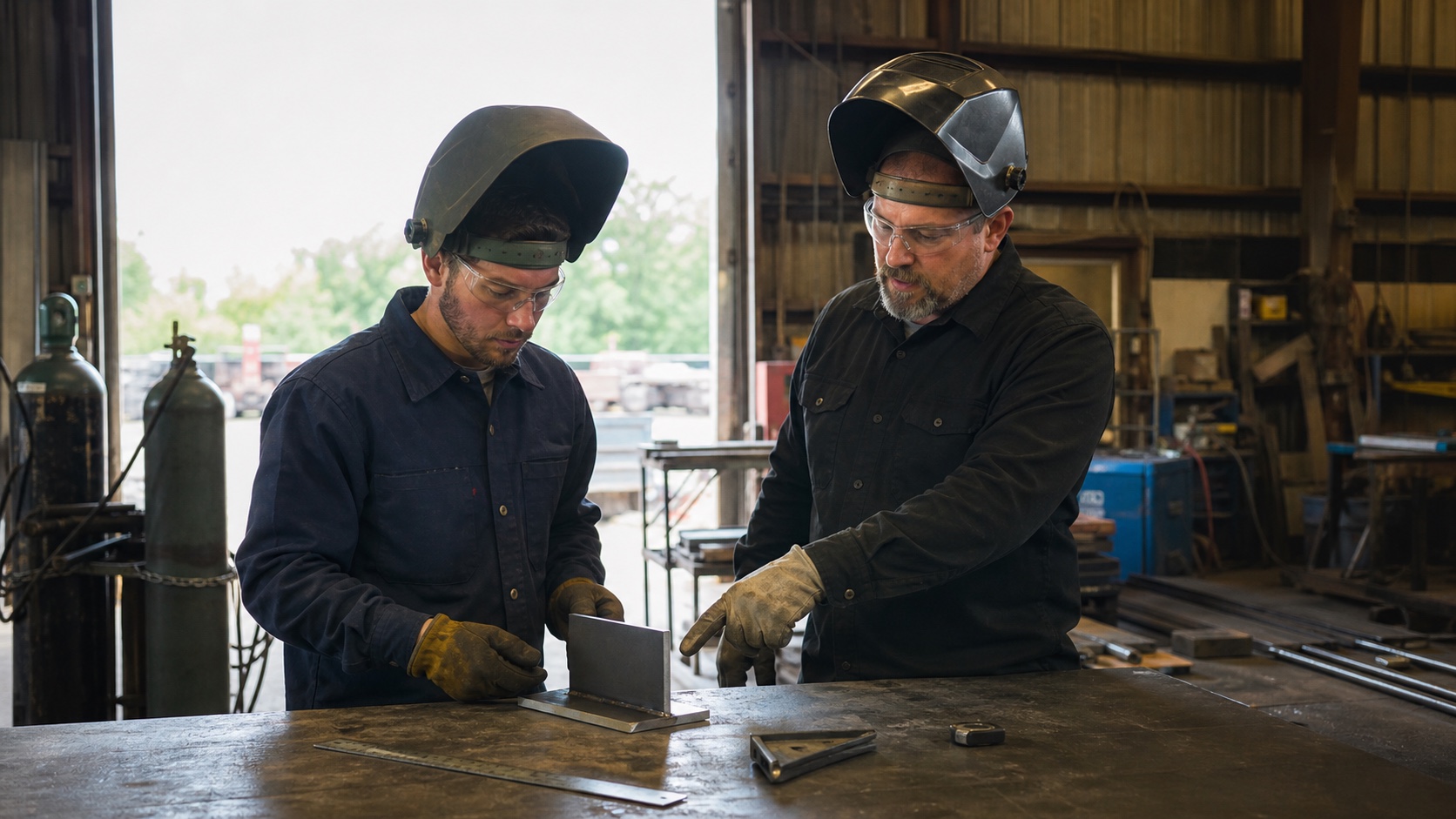
The fastest way to finish one weld is to take over. The better way to build a welder is to leave the torch in their hand.
There is a moment every experienced hand recognizes. A newer welder is stuck at the table. The fit-up is fighting back, the setup does not look right, or the next move has become harder than it should be. The veteran standing nearby already sees the answer.
The quickest move is obvious: reach in, grab the tool, fix the problem, and get production moving again. Sometimes the job really does require that. Deadlines are real, safety comes first, and some mistakes cannot be allowed to continue.
But when every teaching moment ends with the experienced welder taking over, the part may get finished while the person does not move forward. Good mentorship lives in that narrow space between letting someone struggle without direction and solving every problem for them.
The Instinct to Take Over
Experience compresses time. What once required ten decisions starts to feel like one motion. A seasoned welder can look at a joint, body position, sequence, or machine setup and notice trouble before a newer hand has named it.
That ability is valuable, but it can make teaching harder. The veteran remembers the solution more clearly than the confusion that came before it. Advice gets shortened to “just do this,” and a demonstration becomes a rescue. The new welder watches a clean result appear without seeing the chain of judgment behind it.
A mentor’s real job is not to prove that experience is faster. Everyone at the table already knows that. The job is to make some of that experience visible and usable to another person.
Explain the Decision, Not Only the Motion
New welders often receive instructions as a series of movements: hold here, angle there, move slower, keep it tight. Those cues can help, but they become much stronger when the reason travels with them.
Instead of correcting five things at once, a good mentor identifies the one decision that matters most in that moment. What is the welder trying to see? What signal should change the next move? Which condition needs to be corrected before the arc begins? The exact answer changes with the job, but the teaching pattern stays useful: name the goal, point out the evidence, and let the learner make the adjustment.
That turns a borrowed instruction into judgment. The next time the situation looks different, the welder has something more durable than a memorized motion.
Show Once, Then Hand It Back
Demonstration still matters. Some ideas are easier to understand when they are seen at the table instead of described across a noisy shop. The difference is what happens after the demonstration.
If the mentor completes the whole task, the learner becomes an audience. If the mentor shows one controlled example, explains what to watch, and returns the work, the learner gets an immediate chance to connect observation with action.
This is where patience becomes practical. The second attempt may still be rough. That does not mean the explanation failed. It means knowledge has not yet become coordination. A good mentor gives the learner room to make the next decision while staying close enough to stop unsafe or costly errors.
Correction Without Humiliation
Shop humor can make a long shift lighter, but embarrassment is a poor training system. If asking a question always earns a public takedown, people learn to hide uncertainty. In welding, hidden uncertainty can become rework, damaged equipment, or a safety problem.
Respect does not require soft standards. A mentor can be direct: the setup is not ready, the result does not meet the requirement, or the procedure has to be followed. What matters is separating the work from the person. “This needs to change” teaches. “You will never get it” closes the door.
Useful feedback is specific enough to act on and honest enough to trust. False praise does not build confidence; evidence does. Point out the improvement that actually happened, then name the next thing to work on. Progress becomes visible without pretending the job is finished.
Mentorship Is Part of the Trade’s Infrastructure
Passing down skill is not an extra activity that happens after the “real work.” It is part of how the real work survives.
The federal Registered Apprenticeship model explicitly includes structured on-the-job learning with instruction from an experienced mentor. The American Welding Society’s Certified Welding Educator program likewise treats teaching methods, instructional strategy, and the ability to guide welders as skills worth developing—not automatic byproducts of being good under the hood.
That distinction matters. Welding ability and teaching ability overlap, but they are not identical. A welder can keep improving as a mentor by learning how to explain decisions, read frustration, set a useful challenge, and return ownership of the work at the right moment.
The Measure of a Good Mentor
The best proof of mentorship is not that the mentor can produce the cleanest result in the room. It is that the person beside them begins to notice more, ask better questions, recover from mistakes, and work safely without waiting for rescue.
That kind of teaching rarely looks dramatic. It may be a short explanation before a setup, one question asked at the right time, or the decision not to grab the torch. But those moments accumulate. Eventually the learner becomes the person who sees the problem early—and, if the shop culture is healthy, the person who knows how to help the next new hand see it too.
Who taught you something important in the trade without taking the work out of your hands?
Keep the Knowledge Moving
Arc Life is built around the people, habits, stories, and hard-earned identity that keep the welding community alive. Visit About Arc Life, then tell us about the mentor—or the lesson—you still carry into the shop.
Safety note: Mentorship never replaces workplace procedures, qualified supervision, manufacturer instructions, or applicable welding and safety standards.

Leave a Reply