The Evolution S28MAG is a 120-volt portable magnetic drill for steelwork where a stationary drill press cannot reach the work. The buying decision is not just whether its 10-amp motor has enough power. Check the steel thickness and surface needed for magnetic attachment, the intended cutter diameter and depth, the arbor and chuck arrangement, access around the hole, and the exact accessories included. A mag drill with a large advertised magnetic adhesion number is not an automatic fit for every fabrication job.
As an Amazon Associate I earn from qualifying purchases.
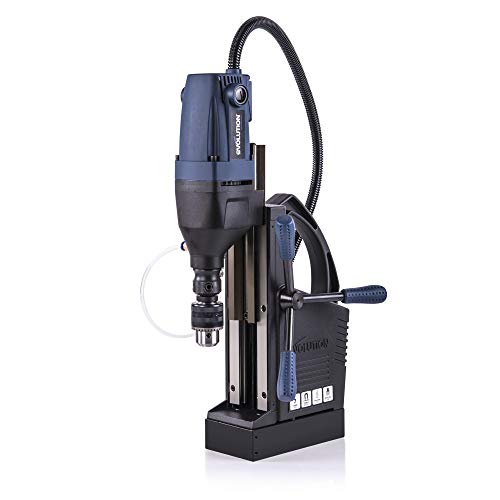
- [Heavy Duty] – Built to stand by you on the toughest job sites, the Evolution S28MAG has a powerful 10A motor and durable double dovetail slide to guarantee long lasting precision.
- [Powerful 2-Stage Magnet] – With 2860 lbs of holding force, this machine isn’t moving an inch. 2-stage magnet allows you to accurately position the machine to drill the perfect hole.
- [On-board Coolant] – Coolant bottle with quick push fit tube connection included for long cutter life and smooth drilling.
- [Annular Cutter & Twist Drill Compatible] –– Quick and easy to fit annular cutters directly to the arbor or insert the supplied chuck to use traditional twist drills.
- [3-Year Warranty] – This heavy duty mag drill is extremely robust and durable and backed by a 3-year warranty and friendly US-based customer service team.
Last update on 2026-11-04 / Affiliate links / Images from Amazon Product Advertising API
What the S28MAG is built to do
Evolution identifies its S28MAG as a 1-1/8-inch magnetic drill with a carry case. The current U.S. manufacturer’s listing specifies a 10 A motor at 120 V/60 Hz, one speed and 450 rpm no-load speed. It also states a maximum 1-1/8-inch annular cutting diameter and 2-inch cutting depth. Those values provide a useful starting specification, but maximum catalog capacity is not the same as an instruction to use any cutter in any material or orientation.
The manufacturer lists a 3/4-inch cutter shank and a standard twist-drill capacity of 1/2 inch. A prospective buyer must distinguish an annular cutter with the specified shank from a conventional twist drill used in the supplied chuck. These cutting systems need the correct accessory and safe operating method. Do not assume a random 3/4-inch tool will fit just because a shank size appears in the catalog.
The first buying gate: the steel surface
Evolution lists a minimum plate thickness of 3/8 inch for the S28MAG. The unit uses a two-stage magnetic base; its nominal magnetic adhesion value is 2,860 lbf. This is a manufacturer’s rating, not a guarantee of retention on thin, curved, coated, dirty or otherwise unsuitable work. Contact area, material condition, steel thickness, work geometry and other conditions can affect actual holding performance. Follow the current manual and the site’s risk controls before deciding that the drill is appropriate.
For a shop routinely making holes in small loose coupons, a magnetic drill may be the wrong machine, regardless of the motor rating. The workpiece needs to meet the manufacturer’s requirements for securing the drill safely. A stationary drill press, properly engineered fixture or another drilling method may be more appropriate depending on the job. Never bypass the magnet’s required workpiece conditions or rely solely on the advertised adhesion figure.
Match the cutter to the hole—not just the drill
Annular cutters remove a ring of material instead of removing the full hole cross-section in the manner of a conventional twist drill. This can make them useful for producing larger holes in appropriate steel, but cutter selection is a separate purchase and engineering decision. Match the needed hole diameter, cutting depth, material, cutter-shank type and approved coolant to the manufacturer’s requirements. Verify whether the job calls for a finished hole or a hole to be further processed.
The S28MAG’s advertised maximum cutter diameter is 1-1/8 inches and cutting depth is 2 inches. These are upper limits on the manufacturer’s U.S. product page, not recommended settings for every application. If the part calls for a larger hole, deeper cut or an unusual cutter, do not exceed the specified capability or improvise an adapter. Confirm an appropriate model and accessory combination instead.
What comes in the case
Evolution’s currently published U.S. included-items list covers the instruction manual, coolant system, safety guard and fixings, safety strap, three feed handles, two hex keys, chuck with chuck key, and carrying case. That is a meaningful equipment package, but it does not state that a chosen annular cutter is included. Confirm the exact Amazon seller’s offer and accessories before ordering a cutter separately or assuming a ready-to-cut kit.
- Portable mag drill: exact model S28MAG for the U.S. 120 V/60 Hz listing.
- Annular-cutter capacity: manufacturer maximum 1-1/8-inch diameter, 2-inch cutting depth.
- Tool interface: 3/4-inch cutter shank; supplied chuck accommodates standard twist drills within the documented 1/2-inch limit.
- Machine setup: specified 3/8-inch minimum steel plate thickness; confirm all workpiece conditions in the current manual.
- Included accessories: guard, safety strap, coolant system, chuck/key, handles, hex keys, manual and case.
- Cutter choice: verify actual annular cutter, diameter, length and shank on the offer; do not assume a cutting tool is bundled.
- Selling unit: confirm one magnetic drill kit versus cutter sets or replacement parts sold separately.
A realistic package comparison
A portable magnetic drill, a standard benchtop drill press and a handheld electric drill do not solve identical problems. A bench press uses its own spindle and table arrangement. A magnetic drill uses an approved ferrous workpiece to anchor a portable spindle at a location that may be difficult to bring to a bench. A handheld drill offers portability without the same fixed magnetic base, but must not be treated as a direct substitute for controlled annular-cutting work.
The comparison should start with the work, not the tool category. If most jobs involve large beams or fabricated structural members that cannot easily be moved, a magnetic drill can be worth considering. If the work is small, thin or unsuitable for magnetic attachment, a different machine or fixture is needed. If holes are primarily small twist-drill sizes, verify whether the magnetic drill’s separate setup and access requirements justify it.
Power, feed and access questions
The manufacturer’s listed no-load speed is 450 rpm with one speed. Do not use that number as a recommended cutting speed without checking the particular cutter, material and current manufacturer instructions. Likewise, a 10 A motor rating does not tell the buyer how every steel grade, hole diameter or cutting tool will behave. Select the approved cutter and follow the cutter manufacturer’s documented limits.
Check physical access before ordering. Evolution lists an approximately 26 lb product and a maximum height of 25-5/8 inches. That helps with a general carrying and clearance decision, but the exact setup’s handle sweep, cutting head position, cable and coolant arrangement can matter more than the overall box dimensions. Confirm that the machine can be placed squarely and safely without obstructing adjacent weldments, clamps or other hardware.
Safety checks are part of the buying decision
A magnetic drill is a powered machine with rotating cutting tools and a magnet that depends on appropriate work conditions. Use the supplied guard and safety strap as required by the manual; verify workpiece suitability and electrical supply. Do not drill where the tool or workpiece cannot be secured under the manufacturer’s instructions. Hot material, overhead work, poor magnetic contact, damaged cords, hidden services or insufficient operator clearance may change whether this machine is acceptable.
The site must apply its approved machine guarding, lockout and training requirements. OSHA’s machine-guarding standard, 29 CFR 1910.212, provides a general regulatory reference, not operating instructions for this particular drill. The Evolution S28MAG manual and current site procedures control actual operation. Do not infer that a published adhesion number or tool weight alone determines a safe method.
Buying checklist for maintenance and fabrication teams
- Record the required holes: diameter, depth, material, tolerance and whether an annular or twist drill is approved.
- Verify 120 V/60 Hz electrical compatibility and the exact S28MAG seller variant.
- Check workpiece plate thickness and magnetic holding surface against current Evolution requirements.
- Confirm that 1-1/8-inch annular capacity and 2-inch depth cover the proposed job with the chosen cutter.
- Check whether cutter, pilot pin or accessory purchases are separate from the listed case contents.
- Plan machine clearance, feed-handle space, cable routing and work area controls.
- Verify training, safety strap, guard and coolant requirements with the manufacturer’s manual.
- Confirm the actual Amazon listing’s product name, selling unit, accessory package and return terms before placing an order.
Where WSP helps with the surrounding equipment
When equipment or replacement hardware needs identification, start with the WSP part lookup rather than ordering an accessory by appearance. The fixture-before-the-bead article discusses why the setup can determine the quality of later work. For safety and process questions, the manufacturer’s drill and cutter documentation is the primary authority.
Bottom line
The Evolution S28MAG is a reasonable candidate for appropriate steel fabrication work that needs portable magnetic drilling within its specified 1-1/8-inch annular diameter and 2-inch depth limits. Purchase it only after confirming the material and minimum plate thickness, safe magnetic mounting, cutter interface, working clearance and full kit contents. Do not treat the advertised magnet force as a universal safe-holding guarantee, and do not assume that a suitable annular cutter comes with every offer.
Primary sources
- Evolution S28MAG official U.S. product page — capacities, machine details and included items.
- OSHA 29 CFR 1910.212 — machine guarding.
- WSP Find My Part — equipment identification starting point.
Leave a Reply