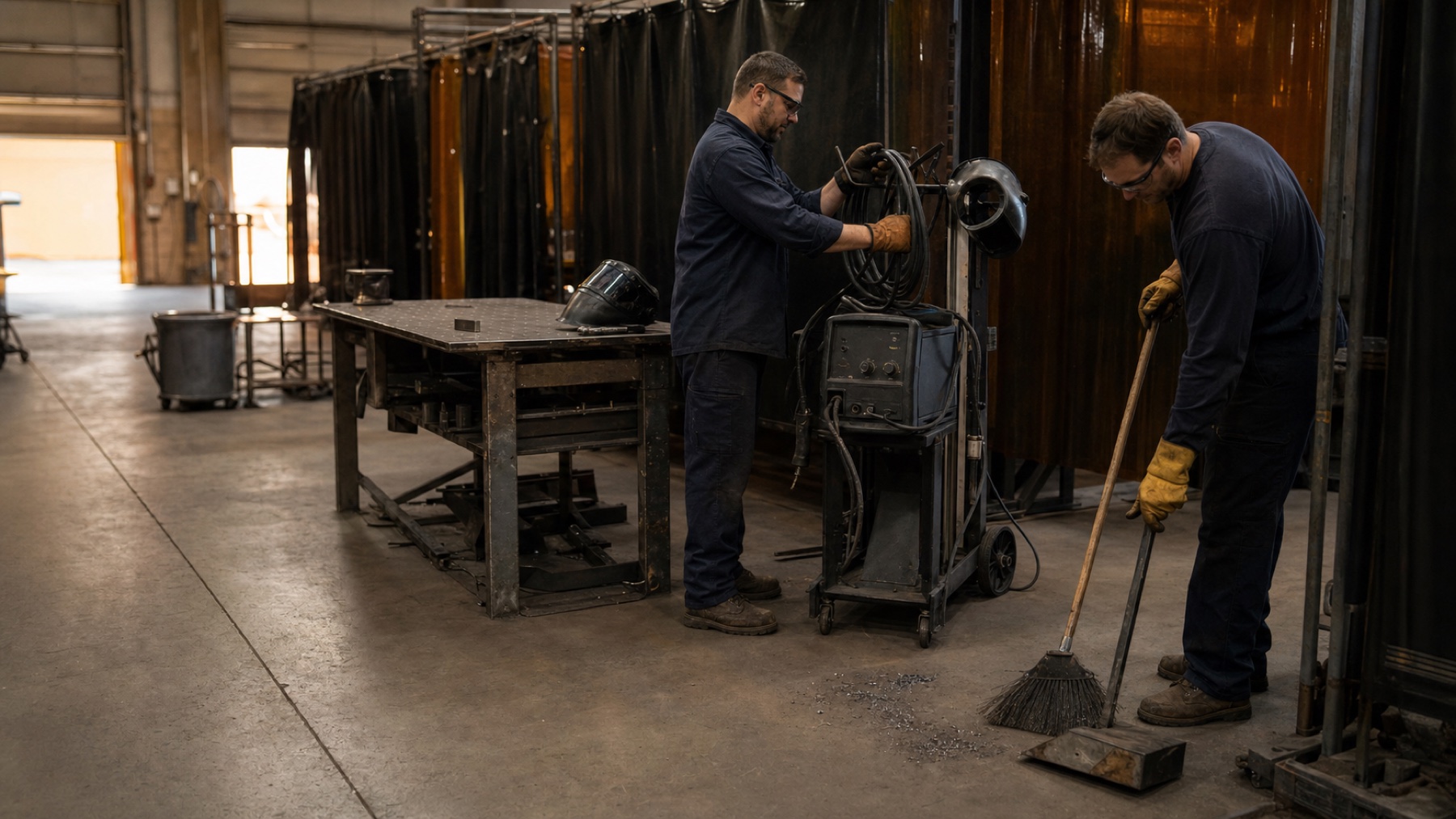
The arc is off. The fan is winding down. Somewhere near the time clock, the next part of the day is already calling. Those last five minutes are when a welding booth tells the truth about the crew that uses it.
A shop does not need to look like a showroom. Real work leaves dust, scratches, heat tint, stub ends, and a table that has seen more than one hard week. But there is a difference between a booth that looks worked in and one that has simply been abandoned.
The difference is not perfection. It is the handoff.
The Shift Ends, but the Work Keeps Moving
In many shops, another welder will step into that space tomorrow—or on the very next shift. They will reach for the same lead, walk the same path, use the same table, and inherit whatever was left behind.
A tangled cable, an unmarked hot part, a pile of sharp drops, or a grinder left where it can fall is more than clutter. It is a message: the next person can deal with it. A booth left ready sends a different message. It says the work belongs to all of us.
Clean Does Not Mean Untouched
There is no prize for making an active fabrication area look unused. The goal is not to erase every sign of labor. The goal is to leave the space understandable.
The tools needed for the job have a place. Leads and hoses are not waiting in a walkway. Scrap and consumable waste are handled the way the shop requires. Hot material, equipment problems, unfinished work, and anything the next shift needs to know are communicated instead of hidden.
That distinction matters. Housekeeping is not decoration. The OSHA walking-working surfaces standard requires work areas and passageways to be kept clean and orderly, with hazards corrected or guarded. OSHA’s shipyard housekeeping guidance specifically identifies welding hoses, cables, debris, blocked exits, combustible waste, and cluttered work surfaces as hazards that good housekeeping helps control.
The Five-Minute Handoff
A good end-of-shift routine is rarely dramatic. It is a short sequence repeated often enough to become part of the craft.
You look over the area before walking away. You deal with what belongs in scrap and what still belongs to the job. You return shared tools. You keep access to exits and safety equipment clear. You make sure leads, cords, and hoses are routed or stored according to the shop’s practice. If something is damaged, missing, still hot, or unfinished, you tell the person who needs to know.
That final point is the one a broom cannot solve. A clean table does not replace a clear handoff. The next welder should not have to discover a machine problem, questionable part, changed setting, or hidden hazard by accident.
Respect Has a Physical Shape
Shop respect is often discussed as attitude, but it also has a physical shape. It looks like a shared tool returned before somebody has to hunt for it. It looks like a cable kept out of the path. It looks like the fixture ready for the next operation and a note that makes sense to someone who was not standing there when the decision was made.
These habits matter even more when the crew is under pressure. Anybody can slow down when the schedule is light. Professionalism shows up when the clock is close, the day has been long, and leaving the problem for tomorrow would be easy.
The Booth Teaches the New Person What the Shop Values
New welders learn culture by watching what experienced people tolerate. A safety poster can say one thing while the floor says another. If veterans step over cables, leave hot drops in the wrong place, or treat cleanup as work for somebody with less seniority, that becomes the real lesson.
The opposite is also true. When the most experienced person in the bay takes a minute to reset the area, it removes the idea that housekeeping is beneath skilled work. It shows that controlling the space is part of controlling the job.
Five Minutes Cannot Replace a Procedure
The last-five-minutes idea is a culture habit, not a substitute for employer rules, hot-work procedures, inspections, lockout/tagout, fire-watch duties, or required maintenance. Some conditions need more than a quick reset, and the correct response may be to stop, isolate the area, and report the problem.
OSHA’s hot-work guidance emphasizes following written procedures, removing combustible materials, inspecting the work area and equipment, using required PPE, and reporting incidents or near misses. The point is not to race through a checklist before the buzzer. It is to finish with the same attention used to start.
Leave the Booth Like You Plan to Come Back
A clean handoff will never be the most photographed part of welding. Nobody hangs a picture of a properly stored lead on the wall. But these quiet habits are what make a crew easier to trust—and a shop easier to work in.
That is Arc Life at its best: pride that continues after the hood comes up. If that view of the trade feels familiar, read more about the people and shop-floor experience behind Arc Life Co.
Shop question: What is the one end-of-shift habit every good welding crew should share?