Tag: welding PPE

  • Welding Glove Heat Damage Inspection Guide: Burn-Through, Hard Leather, Seam Failure, and Liner Damage

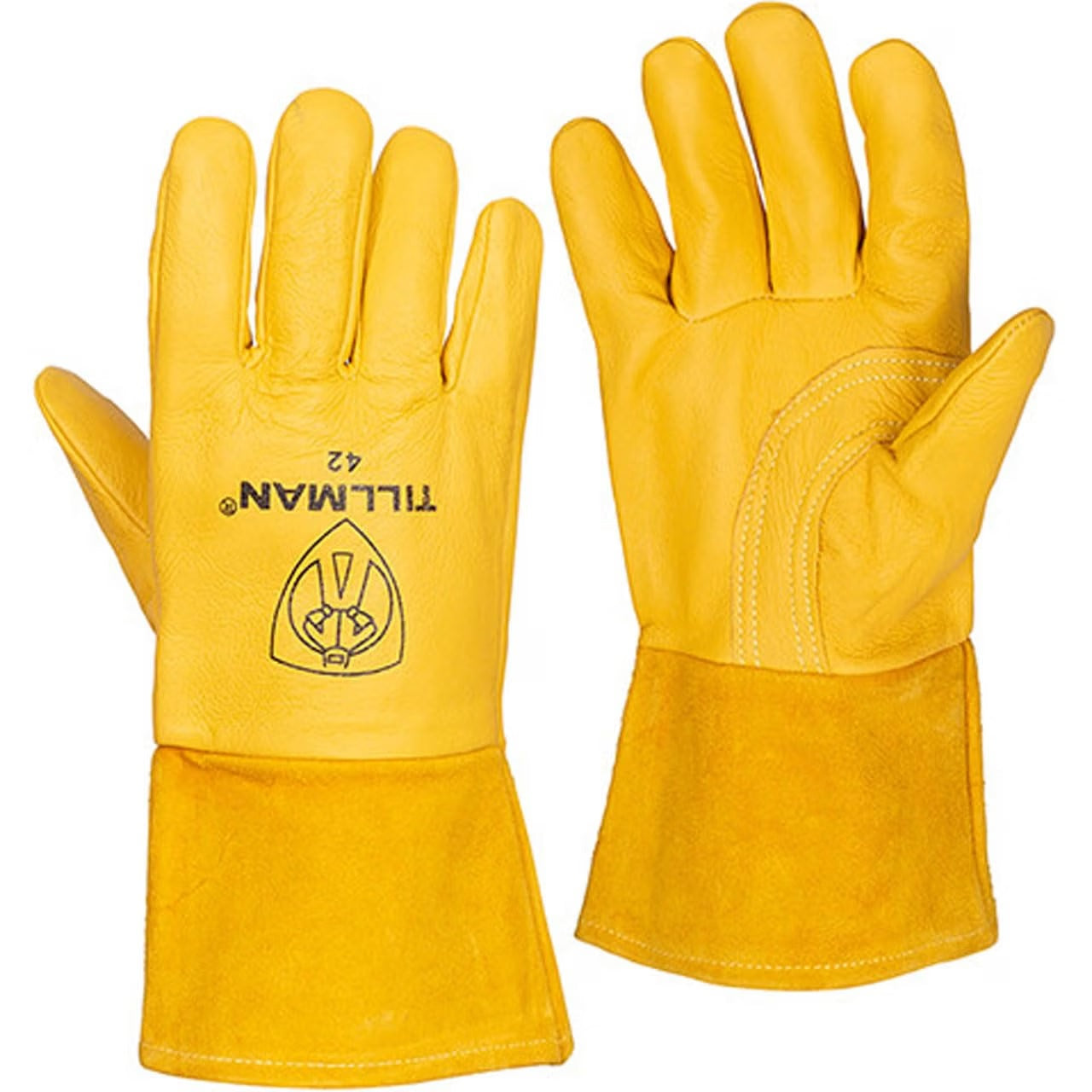
    If welding gloves are stiff, cracked, burned through, oil-soaked, seam-split, shrunken, brittle, or thin at the palm and fingers, remove them from welding service. Heat-damaged gloves lose insulation, grip, dexterity, and electrical protection. The risk is not just a hot hand. Failed gloves can expose skin to spatter, slag, arc heat, sharp metal, hot workpieces, and shock hazards from damp or compromised insulation.

    The fast inspection is to check the palm, thumb crotch, fingertips, seams, cuff, liner, back of hand, and any reinforced heat zones before every shift and after high-exposure work. Do not tape burned gloves, keep using gloves with holes, or substitute thin TIG gloves for high-spatter stick, flux-core, gouging, or overhead MIG work. For related PPE checks, see welding safety equipment inspection checklist, Tillman gloves for MIG, TIG, or stick welding fit, and TIG welding fingertip heat shield use.

    Common Symptoms

    • Leather feels hard, glassy, curled, shrunken, or brittle.
    • Fingertips are thin, shiny, darkened, cracked, or burned through.
    • Thumb crotch is split from torch/gun handling and heat cycling.
    • Palm insulation feels compressed, lumpy, missing, or uneven.
    • Stitching is burned, frayed, broken, or pulled open.
    • Liner bunches up, melts, separates, tears, or exposes hot spots.
    • Cuff is scorched, shortened, curled, or no longer covers the wrist.
    • Glove smells burned, oily, solvent-contaminated, or chemical-soaked.
    • Spatter sticks to the leather instead of brushing off.
    • Hands feel heat faster than they did with the same process and settings.

    Likely Causes

    CauseWhat It DamagesQuick Check
    Excessive radiant heatLeather dries, shrinks, stiffens, and cracksCheck back of hand, palm, and cuff browning
    Molten spatter or slagBurn holes and seam failureInspect fingertips, cuff opening, and seam channels
    Wrong glove for processToo little insulation for heat loadCompare TIG, MIG, stick, flux-core, gouging, and cutting exposure
    Wet or damp glovesReduced insulation and shock riskFeel liner and cuff for moisture before welding
    Oil or solvent contaminationFire risk and leather breakdownSmell glove and check dark oily patches
    Dragging hot metalPalm thinning and burn-throughLook for smooth shiny wear on palm and fingers
    Repeated high-duty workCompressed insulation and hard leatherCompare heat feel to a new glove of same type
    Poor storageMoisture, cracking, chemical contaminationCheck gloves stored near coolant, oil, rain, or grinding dust

    Fast Inspection Sequence

    1. Let gloves cool before inspection. Do not inspect while hot enough to burn skin.
    2. Check both gloves, not only the torch hand. The filler hand, stinger hand, or workpiece hand may be more damaged.
    3. Flex every finger and the thumb crotch. Replace gloves that crack or expose thin leather when flexed.
    4. Press the fingertips and palm. Replace gloves with thin, hard, missing, or compressed insulation.
    5. Open the cuff and inspect the liner for tears, melting, loose material, or trapped slag.
    6. Pull lightly on seams. Replace gloves if stitching separates or heat-damaged thread breaks.
    7. Check for dampness, oil, grease, solvent, coolant, or anti-spatter contamination.
    8. Verify the glove type matches the process: TIG, MIG, stick, flux-core, plasma, gouging, or material handling.
    9. Remove failed gloves from the welding area so they are not reused by another operator.
    10. Document repeat failure patterns by process, station, amperage, position, and exposure.

    Visual Wear Indicators

    • Burn-through: Any hole in palm, finger, cuff, thumb, or back of hand is a replacement condition.
    • Heat hardening: Leather that stays stiff after flexing has lost protective value and dexterity.
    • Seam failure: Broken stitching lets heat and sparks enter the glove even if the leather still looks usable.
    • Liner failure: Torn, melted, bunched, or missing liners create direct hot spots.
    • Cuff failure: Shortened, curled, or split cuffs expose the wrist and sleeve overlap area.
    • Spatter craters: Deep pits and embedded metal show the leather has taken repeated molten-metal impact.
    • Oil saturation: Dark, wet, greasy patches increase fire risk and should not be welded through.
    • Shrinkage: Gloves that tighten after heat exposure can reduce circulation and force poor hand position.

    Test Procedures

    • Flex test: Bend each finger and the thumb crotch. Cracking, powdering, or splitting means the leather is heat-damaged.
    • Pinch test: Pinch fingertips and palm padding. Thin spots, hard spots, and uneven liner thickness are failure signs.
    • Seam pull test: Gently tension the seams. Replace gloves if thread breaks, pulls loose, or exposes liner.
    • Moisture test: Feel inside the cuff and liner. Damp gloves should not be used for welding.
    • Contamination test: Smell and wipe suspect areas. Oil, solvent, fuel, coolant, and chemical residue require removal from service.
    • Process-match test: Compare glove type to actual job. A glove that is fine for TIG may be wrong for overhead flux-core or carbon arc gouging.

    Root Cause Analysis

    Welding glove heat damage usually follows one of three paths. The first is normal wear from repeated heat cycles. Leather dries, stiffens, shrinks, and loses flexibility. The second is direct molten-metal damage from spatter, slag, grinding sparks, or hot workpieces. The third is wrong-PPE selection, where the glove does not have enough insulation, cuff coverage, leather thickness, or seam protection for the process.

    Gloves fail faster when operators use them as hot-metal handling pads, rest them on hot tables, store them wet, or expose them to oil and solvents. A glove can still look mostly intact and fail the job if the fingertips are thin, the liner is compressed, or the thumb seam is split. Inspection has to check structure, insulation, dryness, contamination, and process fit.

    Compatibility Notes

    Do not order welding gloves by size alone. Verify process, heat level, spatter level, welding position, required dexterity, cuff length, liner type, leather type, stitching, cut/puncture requirement, and site PPE standard. TIG gloves prioritize feel and dexterity. MIG gloves balance dexterity with insulation. Stick, flux-core, overhead welding, plasma cutting, and gouging usually require heavier heat and spatter protection.

    For Lincoln glove examples, catalog data separates gloves by TIG/flame, MIG/MAG, MMA, fabrication work, heavy welding applications, thermal insulation, molten-metal splash resistance, and European PPE standards. That does not make any glove universal. Treat glove fitment as Unknown (Verify) until the welding process, exposure level, and job hazard assessment are confirmed.

    What To Verify Before Ordering

    • Welding process: TIG, MIG, stick, flux-core, plasma, gouging, cutting, grinding, or hot handling.
    • Heat exposure: intermittent, production, overhead, high-amperage, preheated parts, or radiant heat.
    • Spatter and slag exposure level.
    • Required dexterity for filler rod, torch, gun, stinger, grinder, or workpiece handling.
    • Leather type: goatskin, cowhide, split leather, grain leather, elk, pigskin, or specialty aluminized back.
    • Liner type: unlined, fleece, cotton, foam, Kevlar, or thermal layer.
    • Cuff length and sleeve overlap.
    • Seam reinforcement and thread type.
    • Applicable ANSI, AWS, EN, CE, OSHA, or employer PPE requirements.
    • Contamination exposure from oil, solvent, coolant, water, paint, or coatings.

    Common Wrong-PPE Mistakes

    • Using thin TIG gloves for stick welding, overhead MIG, flux-core, or gouging.
    • Continuing to weld with stiff gloves because there is no visible hole yet.
    • Repairing burn-through with tape, wire, or scrap leather.
    • Using damp gloves after rain, sweat saturation, or wet storage.
    • Using oil-soaked gloves around sparks or molten metal.
    • Handling hot parts with welding gloves and then blaming the glove for early failure.
    • Ignoring cuff damage that exposes the wrist and sleeve gap.
    • Buying the same glove again without checking whether the process changed.

    Field Fix vs Proper Fix

    ProblemField FixProper Fix
    Minor dry dirtBrush off loose debrisStore clean and dry away from oil and moisture
    Small seam frayRemove from high-heat workReplace if seam strength or protection is compromised
    Burn-through holeStop using gloveReplace immediately
    Wet gloveLet dry fully away from direct flameUse dry spare gloves and fix storage problem
    Heat hardeningMove to non-welding handling only if allowedReplace with glove matched to heat exposure
    Oil contaminationRemove from welding areaReplace and correct contamination source

    Related Failure Paths

    • Hand burns: Thin leather, holes, compressed liners, or wrong glove type expose skin to heat and spatter.
    • Electrical shock risk: Wet or damaged gloves reduce insulation value.
    • Arc control problems: Stiff gloves reduce torch, filler rod, gun, or electrode control.
    • Sleeve burns: Short or curled cuffs leave a gap between glove and sleeve.
    • Fire risk: Oil-soaked gloves and jackets can ignite around sparks or molten metal.
    • Production downtime: Repeated glove failures usually mean wrong glove selection or unmanaged heat exposure.

    Safety Notes

    • Use dry welding gloves in good condition.
    • Do not weld with holes, burn-through, damp liners, oil contamination, or failed seams.
    • Wear safety glasses under the hood when grinding, chipping, or handling damaged gloves and slag.
    • Do not use synthetic general-purpose gloves for welding heat and spatter exposure.
    • Let hot metal cool or use proper tools instead of using gloves as hot pads.
    • Match glove type to welding process, position, amperage, and spatter exposure.
    • Follow the site hazard assessment, manufacturer instructions, OSHA requirements, and ANSI/AWS welding safety practices.

    Sources Checked

    Sources checked include welding PPE inspection guidance, AWS/ANSI welding safety references, glove selection guidance, Lincoln glove catalog data, and related Weld Support Parts PPE articles. Final glove replacement must be verified by process, heat level, spatter level, cuff coverage, liner type, leather type, glove size, site PPE rules, and documented hazard assessment.

  • Why an Air Carbon Arc Gouging Torch Sputters Instead of Cutting Clean

    When an air carbon arc gouging torch sputters, spits molten metal back, or leaves a rough wash instead of a clean groove, the problem is usually not one single part. It is normally a mismatch between amperage, carbon size, compressed air volume, torch angle, electrode stickout, cable condition, or work connection. This guide focuses on heavy-duty gouging setups such as the Weldmark by ArcAir WMK400010 CSK4000 air carbon arc gouging torch and related 1000-amp manual gouging applications.

    For nearby PPE checks, see the existing WSP guide on auto-darkening welding helmet shade range and standards. If fumes or helmet clearance are part of the problem, also compare low-profile welding respirators that fit under a hood.

    Key Takeaways

    • Most sputtering comes from low air flow, low amperage for the carbon size, poor work connection, or an incorrect torch angle.
    • The CSK4000-style gouging setup is commonly listed as a heavy-duty torch with up to 1000-amp capacity, 80 psi compressed air, and about 28 cfm flow requirement.
    • Air carbon arc gouging creates heavy sparks, noise, fumes, and intense arc radiation, so helmet shade, hearing protection, gloves, leathers, ventilation, and fire watch matter.
    • Do not use oxygen in place of compressed air for air carbon arc gouging.
    • Always verify carbon electrode size, machine output, cable capacity, and torch condition before blaming the torch body.

    Problem / Context

    Air carbon arc gouging removes metal by melting the workpiece with an arc while compressed air blows the molten metal out of the groove. When the setup is correct, the groove sounds steady and the metal clears forward. When the setup is wrong, the operator may see sputtering, uneven carbon burn-off, wandering arc, violent blowback, undercut edges, shallow wash, or heavy slag left in the gouge.

    This failure can look like a bad torch, but many shops find the cause upstream: air compressor capacity, hose restrictions, undersized welding leads, weak ground clamp contact, wrong carbon diameter, or a welding power source that cannot hold the required amperage under gouging load.

    Root Causes

    1. Air pressure or air volume is too low

    Air carbon arc gouging needs enough compressed air to clear molten metal from the groove. A gauge near the compressor can be misleading if long hoses, small fittings, clogged filters, or quick-connect restrictions reduce flow at the torch. A CSK4000-style torch is commonly listed with an 80 psi pressure requirement and approximately 28 cfm air flow requirement. If the compressor cannot keep up, the arc may still melt the metal, but the air stream will not clear it cleanly.

    2. Carbon electrode size does not match available amperage

    A larger carbon requires more welding current. If the carbon is too large for the machine output, the gouge may chatter, sputter, or only wash the surface. If the carbon is too small for the current, it can overheat and burn back too quickly. Use the torch manufacturer’s amperage range for the carbon diameter instead of guessing from MIG, stick, or plasma settings.

    3. Work clamp contact is weak

    Carbon arc gouging is demanding on the welding circuit. Paint, mill scale, rust, loose clamps, undersized leads, hot cable lugs, or poor terminal connections can create voltage drop. That voltage drop may show up as arc wander, intermittent cutting, excessive spatter, and inconsistent groove depth.

    4. Torch angle or air jet direction is wrong

    The air jet must push molten metal out of the groove, not back toward the operator or sideways across the plate. If the electrode is rotated incorrectly in the jaws, or the torch angle is too steep, the air stream can fight the puddle instead of clearing it. A shallow travel angle with the air directed behind the arc usually gives a smoother groove.

    5. Electrode stickout is excessive

    Too much carbon stickout can make the electrode unstable and increase heating at the torch head. Too little stickout can put the torch too close to heat and molten metal. Verify the recommended stickout in the torch manual and adjust as the carbon burns back.

    6. Torch head, jaws, cable, or air valve are worn

    Worn jaws may not grip the carbon evenly. A damaged cable hose assembly can create heat, air leaks, or poor current transfer. A sticky air valve can delay air flow and leave molten metal in the groove. Inspect the torch before replacing it, especially if the sputter appears only after the torch heats up.

    Solution

    • Verify compressed air at the torch, not only at the compressor. Check pressure under flow and confirm the compressor can support the required cfm.
    • Remove small quick-connect restrictions where possible. Use air hose and fittings sized for gouging flow.
    • Match the carbon electrode diameter to the welding machine’s actual output and duty cycle.
    • Clean the work clamp location to bright metal and tighten all cable lugs.
    • Confirm polarity. Many manual air carbon arc gouging setups commonly use DCEP, but the torch and carbon manufacturer instructions should control.
    • Set the electrode in the jaws so the air jet points in the direction needed to clear molten metal from the groove.
    • Maintain a stable travel angle and steady travel speed. Do not force the carbon into the plate.
    • Stop if the torch handle, cable, or connections become abnormally hot. Heat can indicate overload, poor connection, or damaged components.

    If arc flash risk or lens selection is also part of the shop setup, compare WSP’s welding safety glasses shade and ANSI Z87.1 guide. For TIG shops that also gouge repairs before rewelding, WSP’s best welding helmet for TIG guide can help separate low-amp TIG lens needs from high-intensity gouging needs.

    Specs / Verification Notes

    ItemVerified / CheckpointNotes
    Product typeAir carbon arc gouging torchUsed for heavy metal removal, back-gouging, weld removal, and repair prep.
    ASINB07143B4VPVerified as Weldmark by ArcAir WMK400010 CSK4000 listing on Amazon regional results.
    Arc Weld Store listingVerifiedArc Weld Store lists Weldmark by ArcAir WMK400010 CSK4000 air carbon arc gouging torch.
    Maximum amperageUp to 1000 ampsVerify against the exact torch label, cable assembly, and power source rating before use.
    Air pressure80 psiCommon listing value for CSK4000-style setup. Verify at the torch under flow.
    Air flow28 cfmCommon listing value. Compressor and hose system must support flow continuously.
    Cable assembly length10 ft / 3 mShown in supplier listings for WMK400010 / CSK4000.
    Compatible carbon sizesUnknown (Verify)Use the exact torch manual and carbon manufacturer chart.
    Power source compatibilityUnknown (Verify)Confirm DC output, amperage range, duty cycle, and polarity requirements.

    Product Section

    The Weldmark by ArcAir WMK400010 CSK4000 is a heavy-duty air carbon arc gouging torch option for shops that already have the correct welding power source, compressed air capacity, leads, PPE, and fire-control setup. Verify the exact model, cable length, amperage rating, air requirement, and return policy before ordering.

    Arc Weld Store option: Weldmark By ArcAir WMK400010 - CSK4000 Air Carbon Arc Gouging Torch

    “>Weldmark by ArcAir WMK400010 CSK4000 Air Carbon Arc Gouging Torch

    Weldmark By ArcAir WMK400010 – CSK4000 Air Carbon Arc Gouging Torch
    • 10Ft. (3M) cable assembly
    • Up to 1000 Amps
    • Air Requirements: Pressure: 80 psi (5.6kg/cm2) and Flow Rate: 28cfm (792.4L/Min)
    • Applications: Heavy-Duty Fabrication / Maintenance / Railroad / Shipyard
    • Weldmark by ArcAir

    Last update on 2026-06-04 / Affiliate links / Images from Amazon Product Advertising API

    Comparison Table

    SymptomLikely CauseCheck FirstCorrective Action
    Molten metal does not clearLow air volumeFlow at torch under loadIncrease air supply capacity, remove restrictions, inspect hose and fittings.
    Carbon burns back too fastToo much current or wrong carbon sizeCarbon diameter and amperage chartReduce current or use the proper carbon size.
    Arc wandersPoor work connection or unstable stickoutClamp location, cable lugs, electrode gripClean ground area, tighten leads, reset electrode in jaws.
    Heavy blowbackWrong torch angle or air jet directionElectrode orientation and air jet pathReposition carbon and travel angle so air clears forward.
    Torch gets hotOverload, loose connection, or damaged cableCable assembly, duty cycle, jaw conditionStop use, inspect components, verify machine rating.

    Related Failure Paths

    • Excessive fumes during gouging: usually tied to coating removal, base metal contamination, ventilation limits, or confined-space controls.
    • Arc flash exposure: commonly tied to wrong shade selection, helmet failure, observers without protection, or grinding mode left active on auto-darkening helmets.
    • Hearing exposure: air carbon arc gouging is loud enough that hearing protection should be part of the setup.
    • Fire risk: gouging throws molten metal farther than many welding operations, so sparks can travel behind fixtures, under benches, and into cable piles.

    For helmet-related failures, the WSP post on welding helmets with grind mode is a useful reminder because grind mode discipline matters any time a hood moves between prep work and arc work.

    Safety Notes

    • Use welding helmet filter protection suitable for arc gouging intensity. OSHA eye protection tables list carbon arc welding at shade 14.
    • Wear safety glasses with side shields under the hood when required by shop policy or impact hazard.
    • Use hearing protection. Air carbon arc gouging creates high noise exposure.
    • Use ventilation or respiratory protection appropriate for the material, coating, and workspace. Air carbon arc gouging can produce heavy fumes.
    • Remove combustibles from the spark path and assign fire watch when needed.
    • Never substitute oxygen for compressed air in an air carbon arc gouging setup.
    • Do not service torch, cable, or power connections while energized.

    FAQ

    Why does my gouging torch sputter even though the arc starts?

    The arc can start even when the air stream is too weak to clear molten metal. Check air flow at the torch under load, not just static pressure at the compressor.

    Can a small shop compressor run a CSK4000-style gouging torch?

    Only if it can supply the required pressure and cfm continuously. Supplier listings commonly show 80 psi and 28 cfm for this class of torch, which is beyond many small portable compressors.

    Is sputtering caused by bad carbon rods?

    Sometimes, but carbon size, amperage, air volume, and work connection should be checked first. Damaged, damp, mismatched, or poor-quality carbons can contribute, but they are not the only cause.

    What polarity should air carbon arc gouging use?

    Many manual gouging instructions show DCEP for common setups, but the exact torch, carbon, and power source instructions should be verified before operation.

    What PPE is most often missed during gouging?

    Hearing protection, side-shield eye protection under the hood, respiratory controls, and full flame-resistant coverage are often missed. Gouging throws heavy sparks and produces significant fumes compared with many basic welding tasks.

    Next Step

    Before replacing the torch, test the system in order: compressed air at the torch, carbon size versus amperage, work clamp contact, cable heat, electrode orientation, and PPE readiness. If the CSK4000 is the correct class of torch for the job, confirm the exact WMK400010 listing through Arc Weld Store or the verified ASIN box above.

    Sources Checked

    • Arc Weld Store: Weldmark by ArcAir WMK400010 CSK4000 Air Carbon Arc Gouging Torch listing.
    • Amazon regional listing results for ASIN B07143B4VP.
    • Victor / Arcair K3000 and K4000 manual gouging torch operating manual.
    • AWS air carbon arc gouging safety and technique guide.
    • OSHA 1910.133 eye and face protection standard.
    • OSHA eye protection against radiant energy during welding and cutting fact sheet.
    • AWS Z49.1 Safety in Welding, Cutting, and Allied Processes.
    • Existing WSP posts on welding helmets, welding safety glasses, respirators, and grind-mode helmet selection.
  • Do Welding Helmet Cover Lenses Block UV, or Is the ADF Doing That?

    A clear welding helmet cover lens is mainly a sacrificial protection plate. It protects the auto-darkening filter, fixed shade plate, and viewing area from spatter, grinding dust, scratches, smoke film, and impact wear. The welding filter or auto-darkening filter is the part that must provide the required welding shade and UV/IR protection for arc exposure.

    This matters because a clean cover lens can make the helmet look safer than it really is. A clear cover plate is not a welding shade. Do not weld with only a clear cover lens, and do not assume a scratched or missing cover lens is harmless. If the auto-darkening cartridge is damaged, missing, incorrectly installed, or not marked for welding protection, the helmet should be removed from service.

    For broader helmet selection and shade checks, see the auto-darkening welding helmet buying guide and the welding safety glasses shade and ANSI Z87.1 guide.

    Key Takeaways

    • The ADF or passive welding filter is the primary part responsible for welding shade and UV/IR protection.
    • The clear outside cover lens mainly protects the filter from spatter, dust, scratches, and impact wear.
    • Some clear cover lenses may meet ANSI Z87.1 impact requirements, but that does not make them welding shade filters.
    • Do not weld with a missing, cracked, heat-warped, or heavily scratched cover lens because it can expose the ADF to damage.
    • Do not weld with only a clear cover lens. Use the correct filter shade for the process and amperage.

    Problem / Context

    The common question is whether the clear lens on the outside of a welding helmet blocks UV, or whether the auto-darkening filter does that job. The practical answer is that the welding filter must be treated as the critical UV/IR and shade-control component. The clear cover lens is a replaceable barrier that helps preserve the filter, but it is not a substitute for the filter.

    Most helmet designs use several layers: the helmet shell, the outside clear cover lens, the ADF or fixed shade filter, and often an inside cover lens. Each part has a different job. Confusing these layers can lead to unsafe shortcuts, especially when a cover lens is cracked or the ADF looks expensive to replace.

    Root Causes of Confusion

    Clear lenses may still have safety markings: A clear replacement cover lens may be sold as ANSI Z87.1 compliant for impact protection. That does not mean it has the correct optical density for welding arc radiation.

    ADF lenses protect in light and dark states: Manufacturer manuals commonly state that the auto-darkening cartridge provides UV/IR protection in both light and dark states. The darkening function controls visible brightness and shade comfort, but the UV/IR filter function should not depend only on the lens switching dark.

    The cover lens sits closest to the arc: Because the clear plate faces sparks and spatter first, welders may assume it is the main safety lens. Its real job is to protect the more expensive filter behind it.

    Damaged cover lenses can hide filter problems: A cloudy, pitted, or heat-warped cover lens reduces visibility and can make welders raise their hood, lean into bad positions, or miss a damaged ADF. See the ArcOne S240-10 auto-darkening filter support guide for fit and visibility checks.

    Some helmets cannot be used without cover lenses: Several helmet manuals warn against using the helmet without the inside and outside cover lenses properly installed. Missing cover lenses can allow spatter, heat, and debris to damage the filter cartridge.

    Solution

    1. Confirm the helmet has a proper ADF or passive welding filter installed. A clear cover lens alone is not enough.
    2. Check the helmet and filter markings for ANSI Z87.1 and manufacturer identification.
    3. Confirm the shade range or fixed shade number matches the welding process and amperage.
    4. Inspect the outside cover lens for cracks, spatter pits, smoke film, deep scratches, or heat warping.
    5. Inspect the inside cover lens if the helmet uses one. Replace it if it is cracked, dirty, pitted, or loose.
    6. Use only replacement cover lenses specified by the helmet manufacturer when possible.
    7. Replace the cover lens before visibility drops enough to affect puddle control or sensor performance.
    8. Remove the helmet from service if the ADF cartridge is cracked, loose, delaminated, water-damaged, or not darkening correctly.
    9. Wear safety glasses or goggles under the helmet where grinding, chipping, or flying particle hazards exist.

    Specs / Verification Notes

    Helmet LayerMain JobCan It Replace the ADF?Verification Note
    Outside clear cover lensProtects the welding filter from spatter, dust, scratches, and impact wearNoSize, material, and helmet fit: Unknown (Verify)
    Auto-darkening filterProvides welding shade and UV/IR protection according to the helmet designRequired for ADF helmetsConfirm shade range and ANSI marking
    Passive filter plateProvides fixed welding shade and radiation filteringRequired for passive helmetsConfirm shade number for process and amperage
    Inside cover lensProtects the inside face of the filter from dust, handling damage, and debrisNoHelmet-specific fit: Unknown (Verify)
    Safety glasses under hoodProtects against flying particles when requiredNoConfirm ANSI Z87.1 marking

    Product Section

    Replacement cover lenses are maintenance parts, not shade filters. The example below is a 2 in x 4-1/4 in clear cover lens. Confirm helmet fit, lens size, manufacturer approval, and ANSI marking before use. Compatibility with any specific helmet is Unknown (Verify).

    Forney 56800 Cover Lens, Plastic, 2-Inch-by-4-1/4-Inch, Clear
    • package dimensions :13.208 cm L x 5.588 cm W x 0.254 cm H
    • Product type :TOOLS
    • country of origin:China
    • This are highly durable

    Last update on 2026-06-04 / Affiliate links / Images from Amazon Product Advertising API

    Comparison Table

    QuestionCorrect AnswerShop Mistake to Avoid
    Does the clear cover lens provide welding shade?No. It is not the welding filter.Do not weld through only a clear cover lens.
    Does the ADF provide UV/IR protection?Manufacturer manuals commonly state UV/IR protection is present in light and dark states.Do not keep using a cracked or unverified ADF.
    Can a cracked cover lens be ignored?No. Replace it before welding.Do not let spatter or debris reach the filter cartridge.
    Can any clear lens fit any helmet?No. Size and helmet model matter.Do not force a loose, undersized, or warped cover plate into service.
    Are safety glasses still needed?They may be required for flying particle hazards.Do not rely on the helmet alone during grinding or chipping.

    Related Failure Paths

    ADF does not darken: If the lens stays light, flashes, or responds inconsistently, use the auto-darkening welding helmet not working checklist.

    ADF flickers on TIG: A dirty cover lens or blocked sensor can contribute to flicker on low-current TIG. See why auto-darkening helmets flicker on aluminum TIG.

    Passive versus auto-darkening confusion: Passive helmets and ADF helmets both require proper filter protection, but they work differently. Compare the practical differences in auto-darkening vs passive welding helmets.

    Shade number mismatch: A clear cover lens does not determine whether shade 9, 10, 11, 12, or 13 is correct. Use the process, amperage, and manufacturer chart to select shade. The helmet lens speed, shade range, and standards guide gives broader selection context.

    Safety Notes

    Arc welding emits visible light, ultraviolet radiation, and infrared radiation. Use a welding helmet with the correct filter lens shade for the process and current. OSHA guidance also notes that workers using welding helmets may need safety glasses with side shields or goggles where flying particle hazards exist.

    Do not treat a clear cover plate as UV/IR proof for welding exposure unless the complete helmet, filter, and replacement part are being used exactly as specified by the manufacturer. Even if a clear cover lens has some UV-blocking material property, it is not a substitute for a welding filter shade.

    Stop using the helmet if the filter cartridge is cracked, loose, heat damaged, water damaged, or visibly compromised. Manufacturer warnings commonly state that UV/IR protection may be compromised when the product is damaged.

    FAQ

    Does the clear outside cover lens block UV?

    Do not rely on it as the welding UV/IR protection layer. The cover lens is mainly a protective plate. The ADF or passive welding filter is the critical radiation-filtering component.

    Does an auto-darkening helmet protect from UV before it darkens?

    Manufacturer manuals for auto-darkening helmets commonly state that the ADF protects against UV/IR in both light and dark states. The darkening function controls visible light shade, but the helmet still must be undamaged, properly assembled, and correctly rated.

    Can welding flash happen if the ADF fails to darken?

    Yes. Even when UV/IR filtering is present, a lens that fails to darken can expose the user to excessive visible light and unsafe viewing conditions. Stop welding and troubleshoot the helmet.

    Can a clear cover lens be used for grinding?

    Only if the complete helmet setup is rated and configured for grinding or impact hazards. Grinding mode does not make the helmet a welding shade, and welding mode does not replace safety glasses where flying particles are present.

    How often should cover lenses be replaced?

    Replace them when cracked, soiled, pitted, deeply scratched, heat-warped, loose, or visibility is reduced. Replacement interval depends on welding process, spatter level, grinding exposure, and shop conditions.

    Can aftermarket cover lenses be used?

    Only after verifying size, fit, material, safety marking, and helmet manufacturer guidance. OEM lenses are preferred when the helmet manual specifies exact replacement parts.

    Next Step

    Inspect the helmet in layers: outside cover lens, ADF or passive filter, inside cover lens, shell, headgear, and safety glasses. Replace damaged cover lenses, verify the correct filter shade, and remove the hood from service if the ADF or passive filter is cracked, loose, unmarked, or not working correctly.

    Sources Checked

    • OSHA Eye Protection against Radiant Energy during Welding and Cutting fact sheet: filter lens shade guidance and safety glasses or goggles for flying particle hazards.
    • Lincoln Electric auto-darkening helmet manuals: UV/IR protection in dark and light states, warnings about damaged products, and use of specified cover lenses.
    • 3M Speedglas welding PPE product guide: permanent UV/IR protection references for Speedglas ADF products.
    • Forney 56800 cover lens manufacturer listing: 2 in x 4-1/4 in clear plastic cover lens, impact and spatter protection, ANSI Z87.1 reference, and fit notes.
    • Weld Support Parts: Auto-Darkening Welding Helmet Buying Guide 2025.
    • Weld Support Parts: Welding Safety Glasses Guide 2025.
    • Weld Support Parts: Auto-Darkening Welding Helmet Not Working: Causes and Fixes.
    • Weld Support Parts: ArcOne S240-10 Auto-Darkening Welding Filter Support Guide.
    • Weld Support Parts: Auto-Darkening vs Passive Welding Helmets.
  • Millermatic 211 PRO MIG Welder: Consumables Setup, Burnback Prevention, and Spare Parts Checklist

    The Millermatic 211 PRO is a portable dual-voltage MIG and flux-cored welder, but the machine is only part of the setup. Most day-to-day welding problems still come back to contact tips, nozzle spatter, liner drag, wire size mismatch, gas coverage, or poor work lead contact.

    This guide is for buyers comparing the Millermatic 211 PRO and for owners who want the right consumable strategy before burnback, birdnesting, sputtering, or porosity starts wasting tips and wire.

    Millermatic 211 PRO MIG Welder Machine – Dual-Voltage Portable Flux Core Welder with Auto-Set & Spool Gun Detection – Aluminum, Mild & Stainless Steel Welding Machine – Wire Feed Gas Welder
    • Versatile MIG Welding: Miller MIG welder supports welding on mild steel, stainless steel, aluminum (with spool gun), and flux-cored wire; a go-to multifunctional welding machine for a variety of applications; Now with continually upgradable USB-enabled software for expanded machine capabilities
    • Auto-Set & Smooth-Start Technology: Built for efficiency, this Miller welder includes Auto-Set to simplify setup and Smooth-Start for spatter-free arc starts; weld longer with a higher duty cycle, ideal for users who need a dependable, high-performance MIG welding machine.
    • Dual Voltage with MVP Plug: Easily switch between 120V & 240V with no tools needed; this 240/120V welder offers plug-and-play power flexibility, making it a top choice for those seeking a portable MIG welder.
    • Built-In Spool Gun Detection: Our 240/120 volt welder automatically detects when a spool gun is connected, eliminating manual adjustments; this feature transforms the aluminum welder into a reliable spool gun welder; Extend your reach with the 15-ft MIG gun – comes standard with the Millermatic 211 PRO.
    • Heavy-Duty Drive System & Quick Setup: Includes an angled cast-aluminum drive, Quick Select drive roll, and support for .024–.045 in. wires; great for pros needing a wire feed welder, flux core welder, or gas MIG welder that’s built to last.

    Last update on 2026-06-04 / Affiliate links / Images from Amazon Product Advertising API

    Key Takeaways

    • The verified ASIN B0FFWV5DJG is associated with the Miller Millermatic 211 PRO MIG welder listing found in Amazon search results.
    • Miller lists the Millermatic 211 PRO for 120 V or 240 V input, solid/stainless wire from .024–.035 in., flux-cored wire from .030–.035 in., and 60–600 IPM wire feed speed.
    • The first wear items to stock are contact tips, nozzles, wire liner, drive rolls matched to wire type, anti-spatter, and PPE.
    • Burnback is usually not a “bad welder” problem. Start with tip size, wire feed drag, nozzle spatter, stickout, and voltage/wire speed balance.
    • For best shop readiness, keep spare contact tips in every wire size you run and verify MDX-100 consumable compatibility before ordering.

    Problem / Context: Why a Good MIG Welder Still Needs a Consumables Plan

    A new MIG welder can feel like an upgrade right away, but consumable neglect will make even a capable machine act inconsistent. The symptoms usually show up as wire burning back into the tip, wire stubbing into the puddle, erratic arc starts, excess spatter, or weld porosity.

    The Millermatic 211 PRO gives you dual-voltage flexibility and enough wire-feed range for common shop work, but the gun still depends on correct fit-up: the contact tip must match the wire diameter, the liner must match the wire and gun length, the nozzle must stay clear, and the drive system must feed without crushing or slipping the wire.

    Verified Product Snapshot

    ProductMiller Millermatic 211 PRO MIG Welder
    Verified ASINB0FFWV5DJG
    Process focusMIG / GMAW and flux-cored welding
    Input voltage120 V or 240 V, per Miller product data
    Wire feed speed60–600 IPM, per Miller product data
    Solid / stainless wire range.024–.035 in., per Miller product data
    Flux-cored wire range.030–.035 in., per Miller product data
    Included gun compatibilityMDX-100 MIG gun referenced in Miller literature; verify exact package contents and consumables before purchase

    Root Causes of Common Problems After Buying a Millermatic 211 PRO

    1. Contact Tip Burnback

    Burnback happens when the wire fuses to the contact tip. Common triggers include too little wire speed, too short stickout, wrong tip size, a worn tip bore, a clogged nozzle, poor work clamp contact, or wire drag inside the gun.

    Related internal guide: Why Does My MIG Wire Burn Back and Stick to the Contact Tip?

    2. Birdnesting at the Drive Rolls

    Birdnesting usually points to feed resistance downstream of the drive rolls. Check the contact tip first, then the liner, gun cable bends, drive roll groove, wire spool tension, and drive tension. Do not simply crank down the drive rolls; crushed wire sheds debris and can make the liner problem worse.

    3. Porosity from Poor Gas Coverage

    Porosity can come from contamination, wind, low shielding gas, wrong gas, leaks, a clogged nozzle, or an excessive stickout. Before blaming the machine, clean the base metal, inspect nozzle spatter, verify gas flow, and make a test bead on clean scrap.

    4. Sputtering and Inconsistent Arc

    Sputtering often looks like a settings problem, but worn contact tips, incorrect wire size, dirty liner, poor ground, and feed tension issues are frequent causes. Check consumables before making large voltage or wire speed changes.

    Related internal guide: MIG Settings Troubleshooting

    What Wears Out First

    Wear ItemWhat FailsTypical SymptomAction
    Contact tipBore wears, spatter sticks, wire fusesBurnback, erratic arc, wire dragReplace with correct wire diameter
    NozzleSpatter restricts gas flowPorosity, spatter, unstable arcClean or replace
    LinerDebris, kinks, wrong diameterSurging feed, birdnesting, burnbackReplace with compatible liner
    Drive rollsWrong groove or worn grooveWire slipping or shavingMatch roll to wire type and size
    Work clamp / cable connectionLoose or dirty contactHard starts, unstable arcClean and tighten
    Shielding gas setupLeaks, incorrect flow, empty cylinderPorosity, oxidation, dirty beadLeak-check and verify flow

    Visual Wear Indicators

    • Oval contact tip hole: replace the tip.
    • Wire welded into the tip: replace the tip and check feed drag.
    • Heavy spatter inside nozzle: clean or replace the nozzle.
    • Wire dust near drive rolls: reduce over-tension and inspect liner.
    • Arc surges when gun cable is bent: suspect liner drag or a kinked gun lead.
    • Porosity appears after several minutes of welding: check nozzle blockage, gas flow, and cylinder level.

    Solution: Millermatic 211 PRO Setup Checklist Before the First Weld

    1. Confirm input voltage and plug setup for the job.
    2. Install wire that falls within the machine’s supported wire diameter range.
    3. Match the contact tip to the exact wire diameter.
    4. Match the drive roll groove to the wire type and size.
    5. Keep the gun cable as straight as practical while feeding wire.
    6. Set drive tension only tight enough to feed without slipping.
    7. Clean the base metal and attach the work clamp to clean metal.
    8. Verify shielding gas flow when using solid wire.
    9. Use flux-cored polarity only as specified by the wire and machine setup instructions.
    10. Run a test bead on scrap before welding the final part.

    Product Recommendations

    Best Overall Machine Pick: Millermatic 211 PRO MIG Welder

    For a buyer who wants a higher-quality portable MIG platform instead of a bargain welder, the Millermatic 211 PRO is the central pick for this page. It makes the most sense for a shop that wants 120 V convenience, 240 V capability, solid wire, stainless wire, flux-cored wire, and a consumables ecosystem that can be maintained over time.

    Millermatic 211 PRO MIG Welder Machine – Dual-Voltage Portable Flux Core Welder with Auto-Set & Spool Gun Detection – Aluminum, Mild & Stainless Steel Welding Machine – Wire Feed Gas Welder
    • Versatile MIG Welding: Miller MIG welder supports welding on mild steel, stainless steel, aluminum (with spool gun), and flux-cored wire; a go-to multifunctional welding machine for a variety of applications; Now with continually upgradable USB-enabled software for expanded machine capabilities
    • Auto-Set & Smooth-Start Technology: Built for efficiency, this Miller welder includes Auto-Set to simplify setup and Smooth-Start for spatter-free arc starts; weld longer with a higher duty cycle, ideal for users who need a dependable, high-performance MIG welding machine.
    • Dual Voltage with MVP Plug: Easily switch between 120V & 240V with no tools needed; this 240/120V welder offers plug-and-play power flexibility, making it a top choice for those seeking a portable MIG welder.
    • Built-In Spool Gun Detection: Our 240/120 volt welder automatically detects when a spool gun is connected, eliminating manual adjustments; this feature transforms the aluminum welder into a reliable spool gun welder; Extend your reach with the 15-ft MIG gun – comes standard with the Millermatic 211 PRO.
    • Heavy-Duty Drive System & Quick Setup: Includes an angled cast-aluminum drive, Quick Select drive roll, and support for .024–.045 in. wires; great for pros needing a wire feed welder, flux core welder, or gas MIG welder that’s built to last.

    Last update on 2026-06-04 / Affiliate links / Images from Amazon Product Advertising API

    Budget Option: Consumables First

    If the machine is already in your shop, the budget upgrade is not another welder. Start with correct-size contact tips, a clean nozzle, anti-spatter, fresh wire, and a liner inspection. Unknown ASINs: Verify before adding AAWP boxes.

    Heavy-Duty Option: Spare Gun Consumables Kit

    For repeated shop use, keep a dedicated MDX-100-compatible consumables kit with contact tips, nozzles, diffuser-related parts, and a spare liner. Compatibility must be verified against the exact gun and Miller part numbers before purchase.

    Upgrade Path: Spool Gun for Aluminum

    If aluminum MIG is part of the plan, verify the supported Miller spool gun for the Millermatic 211 PRO package. Aluminum wire is soft and feed-sensitive, so a spool gun can reduce feed problems compared with pushing soft wire through a long MIG gun liner. Exact spool gun compatibility: Unknown (Verify).

    Related Accessory: Anti-Spatter and Nozzle Cleaning Tools

    Anti-spatter and a nozzle cleaning tool are low-cost prevention items. They help keep gas flow open around the contact tip and reduce the chance that spatter buildup gets misdiagnosed as a machine settings problem.

    Comparison Table: Machine vs. Consumables vs. Accessories

    CategoryBest UseBuyer IntentAAWP Status
    Millermatic 211 PROPrimary MIG / flux-cored welding platformBest overall machine upgradeVerified ASIN: B0FFWV5DJG
    Contact tipsBurnback, unstable arc, wire dragReplacement consumableUnknown ASIN (Verify)
    NozzlesPorosity and spatter controlReplacement consumableUnknown ASIN (Verify)
    Gun linerBirdnesting, surging feed, wire dragTroubleshooting replacementUnknown ASIN (Verify)
    Drive rollsWire slipping, shaving, flux-core setupCompatibility partUnknown ASIN (Verify)
    Anti-spatterNozzle maintenancePreventative itemUnknown ASIN (Verify)
    Welding gloves / helmetArc, heat, sparks, grinding prepPPE buying intentUnknown ASIN (Verify)

    Recommended Spare Quantity

    • Contact tips: keep 10 per wire size you use most often.
    • Nozzles: keep 2–3 spares for the gun.
    • Liner: keep 1 spare liner matched to wire size and gun length.
    • Drive rolls: keep the correct roll set for solid wire and flux-cored wire if you run both.
    • Wire: keep one sealed backup spool of your most common diameter.
    • PPE: keep spare cover lenses, gloves, safety glasses, and ear protection near the welder.

    Recommended Shop Setup

    A practical Millermatic 211 PRO setup includes the welder, cart or stable surface, properly chained gas cylinder, clean work clamp area, dry wire storage, tip/nozzle organizer, anti-spatter, nozzle pliers, wire brush, flap discs, gloves, helmet, safety glasses, and ventilation appropriate for the material being welded.

    Related internal guide: Flap Disc Prep and Weld Cleaning

    Related internal guide: Welding Safety Equipment

    Common Misdiagnosis

    • “The welder is defective” when the contact tip is actually worn or the liner is dragging.
    • “I need more drive roll tension” when the wire path is blocked downstream.
    • “The gas is bad” when the nozzle is packed with spatter.
    • “The voltage is wrong” when the work clamp is attached to dirty metal.
    • “The wire is junk” when the wrong contact tip size is installed.

    If Ignored

    Ignoring consumable wear leads to wasted contact tips, wasted wire, poor starts, spatter cleanup, porosity repairs, and unnecessary troubleshooting time. In production or repair work, the hidden cost is often not the contact tip itself; it is the time spent stopping, clipping wire, clearing the gun, grinding defects, and restarting.

    Related Failures

    FAQ

    Is B0FFWV5DJG the Millermatic 211 PRO?

    Search results verified B0FFWV5DJG as an Amazon listing associated with the Miller Millermatic 211 PRO MIG welder. Always confirm the product title, seller, package contents, and warranty details on Amazon before publishing or purchasing.

    What contact tips fit the Millermatic 211 PRO?

    The Millermatic 211 PRO literature references MDX-100 MIG gun consumables, but exact tip part numbers and compatibility should be verified against the included gun, wire size, and current Miller documentation before ordering.

    Why does my MIG wire burn back into the tip?

    Burnback usually comes from poor wire feed, incorrect stickout, wrong contact tip size, too little wire speed for the voltage, a dirty nozzle, liner drag, or poor work lead contact. Replace the damaged tip first, then isolate feed resistance.

    Should I buy extra consumables with the welder?

    Yes. At minimum, keep contact tips for each wire size, spare nozzles, a liner, anti-spatter, and PPE consumables. A good welder without spare tips can still stop a job over a minor burnback event.

    Can the Millermatic 211 PRO weld aluminum?

    Miller and Amazon listing text reference aluminum capability with a spool gun. Verify the exact supported spool gun, package contents, calibration steps, and aluminum wire requirements before buying accessories.

    Is a larger MIG welder better than replacing consumables?

    Not when the symptom is burnback, birdnesting, porosity, or erratic arc caused by the gun setup. Replace worn consumables and verify wire feed first. Upgrade machine capacity only when the material thickness, duty cycle, or process needs exceed the welder’s limits.

    Safety Notes

    • Disconnect or power down the welder before removing the contact tip, nozzle, liner, or drive roll components.
    • Wear welding helmet, gloves, flame-resistant clothing, and safety glasses during welding and grinding prep.
    • Secure shielding gas cylinders upright so they cannot fall.
    • Use ventilation suitable for the material, coating, filler wire, and work area.
    • Do not weld on unknown coated, galvanized, painted, or contaminated metal without proper hazard controls.
    • Follow the Miller owner’s manual and applicable AWS, OSHA, and ANSI safety guidance.

    Sources Checked

    • Miller Millermatic 211 PRO product page and specification data.
    • Miller Millermatic 211 PRO owner’s manual.
    • Miller Millermatic 211 PRO literature referencing MDX-100 MIG gun consumables.
    • Amazon search result for ASIN B0FFWV5DJG.
    • Weld Support Parts internal MIG troubleshooting, MIG consumables, flap disc, and welding safety pages.
    • OSHA welding, cutting, and brazing safety guidance.
    • ANSI Z49.1 welding safety guidance referenced for general safety context.
  • Why Auto-Darkening Helmets Flicker on Aluminum TIG but Not MIG or Stick

    An auto-darkening helmet that behaves normally on MIG or stick but flickers on aluminum TIG is usually not failing in the same way as a helmet that will not darken at all. Aluminum TIG exposes weak points in sensor detection, sensitivity settings, low-current arc recognition, torch angle, reflected light, and delay settings. The arc can be stable at the weld, but the helmet may not be seeing enough consistent arc signal to stay dark.

    This is a narrower support article for welders who already have a working auto-darkening hood but only see flicker during AC aluminum TIG. For broader helmet selection, see the Best Auto-Darkening Welding Helmet for TIG guide and the auto-darkening welding helmet buying guide.

    Key Takeaways

    • Aluminum TIG flicker is commonly caused by low TIG arc signal, blocked sensors, low sensitivity, short delay, or reflective arc angles.
    • MIG and stick usually create brighter, broader, easier-to-detect arcs, so the same helmet may seem fine on those processes.
    • AC TIG, tight torch angles, cup position, filler hand position, and workpiece geometry can partly shield the arc from the helmet sensors.
    • Increase sensitivity, increase delay, clean the cover lens, replace weak batteries, and confirm that the helmet is rated for the TIG amperage used.
    • Do not keep welding with a helmet that flickers, flashes, or fails a pre-use darkening check.

    Problem / Context

    The symptom is specific: the helmet darkens normally for MIG or stick welding, but during aluminum TIG it rapidly switches between dark and light, pulses, or drops shade during starts, crater fill, or low-amperage sections. This is different from a dead helmet. For total failure, use the broader checklist in Auto-Darkening Welding Helmet Not Working: Causes and Fixes.

    Aluminum TIG is a harder detection case because the welder may run low current, use a tight cup angle, weld around corners, or move the torch in a way that hides part of the arc from the helmet sensors. MIG and stick normally throw more visible arc energy and spatter glow into the front of the hood, so a marginal sensor setup may still work there.

    Root Causes

    Low sensitivity setting: Many helmets have sensitivity ranges intended for different welding conditions. Some manufacturer instructions list higher sensitivity positions for stable TIG arcs, low-current TIG, inverter TIG, or cases where part of the arc is obscured. If the helmet is still on a lower general-purpose setting, it may detect MIG and stick but drop out on aluminum TIG.

    Short delay setting: If the delay is set too short, the lens may return to light state during brief arc intensity changes, pulsing, repositioning, or crater fill. This can feel like flicker even when the helmet is detecting the arc correctly at the start.

    Blocked arc sensors: The torch cup, filler rod hand, bench edge, pipe joint, corner joint, or the welder’s head angle can block the arc from one or more front sensors. This matters more in TIG because the arc is smaller and more concentrated than a typical MIG or stick arc.

    Dirty or damaged cover lens: Smoke film, grinding dust, aluminum oxide dust, fingerprints, and spatter haze can reduce what the sensors see. A hazy lens can also make the puddle look washed out. If visibility is the main issue, see auto-darkening filter lens fit and visibility checks before assuming the whole helmet is bad.

    Weak battery or solar-assist limitation: Some helmets use replaceable batteries, some use solar assist, and some use sealed cells. Weak power can make response inconsistent, especially when welding starts and stops repeatedly.

    Helmet not suited for low-amp TIG: Some low-cost or older auto-darkening filters work acceptably on MIG and stick but are less reliable at low TIG amperage. Minimum TIG amp rating is often unclear on retailer listings. Treat missing low-amp TIG data as Unknown (Verify).

    Grinding mode or light-state lock: A helmet left in grind mode or light-state lock may not darken. A helmet partly stuck between modes can also behave inconsistently. Always confirm weld mode before striking an arc.

    Solution

    1. Stop welding and inspect the helmet before continuing. Do not keep welding through repeated flicker.
    2. Confirm the helmet is in weld mode, not grind mode, cut mode, or light-state lock.
    3. Clean or replace the outer cover lens. Clean the sensor windows according to the helmet manual.
    4. Replace the batteries if the helmet uses replaceable cells. Battery type: Unknown (Verify from helmet manual).
    5. Increase sensitivity one step at a time until the helmet stays dark during aluminum TIG starts and steady welding.
    6. Increase delay if the lens drops out during pulsing, crater fill, or brief arc-length changes.
    7. Reposition the hood and torch so the front sensors have a direct view of the arc.
    8. Test at the actual TIG amperage used, not only on MIG or stick.
    9. If flicker remains, compare the helmet’s TIG amp rating and sensor count against manufacturer documentation. Missing rating: Unknown (Verify).
    10. Use a passive shade lens or a TIG-capable replacement helmet until the auto-darkening issue is resolved.

    Specs / Verification Notes

    Check PointWhy It Matters on Aluminum TIGStatus
    Minimum TIG amperage ratingConfirms whether the ADF is designed to detect low-current TIG arcsUnknown (Verify)
    Number of arc sensorsMore sensor coverage can reduce dropout when one sensor is blockedUnknown (Verify)
    Sensitivity controlNeeded for low-current TIG and partially obscured arcsVerify helmet has adjustable sensitivity
    Delay controlHelps prevent light-state return during arc pulsing or crater fillVerify helmet has adjustable delay
    Battery typeWeak batteries can cause inconsistent darkeningUnknown (Verify)
    ANSI Z87.1 markingConfirms eye and face protection compliance markingVerify on helmet and manual

    Product Section

    If the helmet uses replaceable CR2032 cells, fresh batteries are a low-cost maintenance step before replacing the full hood. Battery fit varies by helmet model, so confirm the required battery type in the manufacturer manual before ordering. Battery compatibility: Unknown (Verify).

    Rome Tech Welding Helmet CR2032 Batteries Compatible with Welding Helmet Viking / G5 9000 9100 FX x xx xxi 100 Series 3m SL100 9000 9002 9100 – CR 2032 Batteries for Welding Helmet (1 pcs)
    • Rome Tech CR2032 battery for Welding Helmet compatible with Welding Helmet Viking / G5 9000 9100 FX x xx xxi 100 Series 3m SL100 9000 9002 9100. Please, check your Welding Helmet needs battery CR2032 before purchasing!
    • RTB CR2032 batteries are designed to last long. Enjoy long CR2032 lithium 3V coin battery life without worry. Use this time with pleasure.
    • CR2032 lithium 3V coin battery is reliable and provides consistent power to your Welding Helmet. This means you can trust CR 2032 battery for Welding Helmet to work when you need it most, ensuring you always have working Welding Helmet.
    • CR2032 lithium battery is designed to withstand extreme temperatures, whether hot or cold. Battery CR2032 3V lithium cell robust construction makes it resistant to vibration and impact, ensuring it can withstand the rigours of daily use.
    • Rome Tech multifunctional CR 2032 3V battery for Welding Helmet can be used for various electronic devices such as watches, fitness trackers, calculators, digital cameras, remote controls, and many more.

    Last update on 2026-06-04 / Affiliate links / Images from Amazon Product Advertising API

    Comparison Table

    ProcessHelmet BehaviorLikely ReasonBest First Fix
    Aluminum TIGFlickers or drops shadeLow-current arc, blocked sensor, AC arc behavior, short delayRaise sensitivity and delay; clean sensors
    MIGUsually stableBrighter, broader arc signal with easier sensor detectionUse as comparison test only
    StickUsually stableStrong arc light and electrode angle often expose sensors clearlyUse as comparison test only
    Grinding modeMay stay lightDarkening function disabledReturn to weld mode before welding

    Related Failure Paths

    Helmet does not darken at all: This is usually a battery, mode, sensor, or cartridge failure issue. Use the auto-darkening helmet not working checklist.

    Wrong helmet type for the work: Some shops keep a passive hood as a backup for awkward TIG joints or outdoor stick welding. The auto-darkening vs passive welding helmet comparison explains where each type fits.

    Fixed-shade filter mismatch: A shade 10 filter may be useful in some compact hood setups, but it is not automatically correct for every TIG amperage or aluminum job. Check the ArcOne S240-10 auto-darkening filter support guide for fit and shade cautions.

    Low-amp TIG helmet selection: If the current helmet lacks a published TIG amp rating or has poor sensor coverage, compare it against helmets documented for TIG work in the TIG auto-darkening helmet buyer guide.

    Safety Notes

    Arc radiation can injure eyes and skin. A welding helmet must use the correct filter shade for the welding process and current. OSHA guidance states that protective eye and face devices must comply with ANSI Z87.1, and side protection or safety glasses may also be required where flying particles are present.

    Do not use a flickering auto-darkening helmet as a normal condition. If sensitivity and delay adjustments do not produce reliable darkening, remove the helmet from service until the battery, cartridge, cover lens, sensors, and safety markings are verified.

    Auto-darkening helmets do not provide respiratory protection by themselves. Aluminum TIG can still involve cleaning chemicals, ozone, shielding gas displacement, and fume exposure depending on the shop setup. Use ventilation and respiratory protection according to the job hazard assessment.

    FAQ

    Why does my helmet flicker only on aluminum TIG?

    Aluminum TIG can produce a smaller or more directional arc signal at the helmet sensors, especially at low amperage or with the cup blocking the arc. MIG and stick are usually easier for the sensors to detect.

    Should sensitivity be higher for TIG?

    Often yes. Many helmets require higher sensitivity for low-current TIG, inverter TIG, or arcs that are partly blocked from sensor view. Increase sensitivity gradually and confirm that the helmet still lightens correctly after welding.

    Can AC balance or pulse settings cause helmet flicker?

    They can contribute to the symptom if arc intensity changes enough for the helmet to drop below its detection threshold. The practical fix is usually helmet sensitivity, delay, sensor exposure, and confirming the helmet’s TIG capability.

    Does flicker mean the helmet is unsafe?

    Repeated flicker means the helmet is not performing reliably for that task. Stop and troubleshoot before continuing. If it cannot be corrected, use a properly shaded passive helmet or a TIG-capable auto-darkening helmet.

    Will replacing the cover lens help?

    Yes, if the cover lens is dirty, scratched, smoky, or spatter-damaged. A poor cover lens can reduce both visibility and sensor performance.

    Can the same helmet be used for TIG, MIG, and stick?

    Yes, but only if the helmet has the correct shade range, reliable sensor performance, and manufacturer support for the TIG amperage used. Multi-process claims should be verified against the manual, not only retailer copy.

    Next Step

    Before replacing the helmet, test it in this order: weld mode, clean lens, fresh battery, higher sensitivity, longer delay, direct sensor view, and actual aluminum TIG amperage. If the hood still flickers while MIG and stick remain stable, the helmet may not be suitable for that TIG application. Use the helmet lens speed, shade range, and standards guide to compare replacement requirements.

    Sources Checked

    • 3M Speedglas 9100 Series user instructions: sensitivity positions for stable TIG, low-current TIG, inverter TIG, obscured TIG arcs, light-state lock, dark-state lock, and delay behavior.
    • OSHA Eye Protection against Radiant Energy during Welding and Cutting in Shipyard Employment fact sheet: ANSI Z87.1 compliance, side protection, filter lens shade guidance, and ANSI/AWS shade references.
    • Weld Support Parts: Auto-Darkening Welding Helmet Buying Guide 2025.
    • Weld Support Parts: Best Auto-Darkening Welding Helmet for TIG.
    • Weld Support Parts: Auto-Darkening vs Passive Welding Helmets.
    • Weld Support Parts: Auto-Darkening Welding Helmet Not Working: Causes and Fixes.
    • Weld Support Parts: ArcOne S240-10 Auto-Darkening Welding Filter Support Guide.
    • Amazon search result checked for ASIN B0D7J214QR. Battery compatibility remains Unknown (Verify).
  • Flux-Core Respirator Guide: P100 vs Nuisance Vapor vs PAPR

    Flux-core welding can create a heavier visible fume plume than many short-circuit MIG jobs, especially with self-shielded wire, higher amperage, long beads, poor ventilation, coated steel, or outdoor work where the welder keeps chasing the plume. Choosing a respirator for flux-core work should start with the exposure, not the mask style.

    This guide explains when a P100 half-mask may be appropriate, when nuisance organic vapor relief is only an odor-control add-on, and when a PAPR becomes the better decision. For under-hood fit issues, see the WSP guide to welding respirators that fit under a welding helmet. If fumes are still noticeable through the mask, troubleshoot respirator seal leaks and fume smell before continuing to weld.

    Key Takeaways

    • P100 filters are commonly used for welding fume particulate, including flux-core welding fume, when the hazard assessment supports that choice.
    • Nuisance organic vapor relief is not the same as certified organic vapor protection. It is for low-level odor relief only when concentrations are below applicable exposure limits.
    • A PAPR is the stronger decision point for long flux-core shifts, stainless or hardfacing work, high fume volume, poor hood comfort, facial hair conflicts, or failed half-mask fit tests.
    • Ventilation still comes first. Respirators do not replace local exhaust, fume extraction, clean base metal, or keeping the head out of the plume.
    • For workplace use, respirator selection must follow the employer’s OSHA respiratory protection program, fit testing, training, filter change schedule, and medical clearance process.

    Problem / Context

    Flux-core welding creates a fume exposure problem that changes with wire type, base metal, voltage, amperage, arc length, shielding method, coatings, ventilation, and body position. A small repair bead outside is not the same exposure as all-day FCAW production welding inside a bay.

    The wrong respirator decision usually shows up in one of four ways: the welder smells fumes, the hood fogs, breathing resistance increases quickly, or the mask gets removed because it does not fit under the hood. For filter-specific background, see the WSP article on P100 respirators for welding fumes. For coated steel, also review safe fume-control tactics for welding galvanized material.

    Root Causes of Bad Respirator Decisions in Flux-Core Welding

    • Treating all flux-core welding as the same exposure.
    • Using a P100 filter for fumes without checking whether gases, vapors, coatings, or stainless alloy constituents are also present.
    • Confusing nuisance organic vapor relief with full organic vapor cartridge protection.
    • Relying on smell as the only warning sign of exposure.
    • Using a tight-fitting half-mask without a fit test where workplace rules require one.
    • Welding over paint, oil, primer, galvanizing, brake cleaner residue, or unknown coatings.
    • Working in a corner, tank, trailer, pit, or enclosed structure without proper ventilation evaluation.
    • Running self-shielded flux-core at high output while positioned directly above the plume.

    Decision Point 1: When P100 Makes Sense

    A P100 half-mask is commonly considered for flux-core welding when the main concern is particulate welding fume and the work environment allows a tight-fitting respirator to seal correctly. P100 filters are rated for at least 99.97% filtration efficiency against airborne particles when used as part of an approved respirator system.

    • Use P100 as the baseline when the hazard is welding fume particulate and the respirator is correctly selected, fitted, and maintained.
    • Choose a low-profile mask if the respirator must fit under a welding hood.
    • Perform a seal check every time the respirator is worn.
    • Replace filters when breathing resistance increases, filters are damaged, filters are dirty, or the written change schedule requires replacement.
    • Do not assume P100 covers gases, vapors, solvents, coatings, or oxygen-deficient atmospheres.

    Decision Point 2: When Nuisance Organic Vapor Relief Helps

    Nuisance organic vapor relief can help reduce low-level odors from some welding environments, but it should not be treated as a gas-and-vapor cartridge. Manufacturer guidance for nuisance-level organic vapor relief generally limits it to odor relief where organic vapor concentrations do not exceed OSHA permissible exposure limits or other applicable exposure limits.

    For flux-core welding, nuisance OV relief may be useful when the welder is dealing with mild odor from trace contaminants or shop conditions and the actual exposure has already been evaluated. It is not the right answer for unknown coatings, paint burning, solvent residue, confined spaces, or work where an organic vapor cartridge or supplied-air solution is required.

    • Use nuisance OV relief for odor comfort only after the hazard is known.
    • Do not use nuisance OV relief as proof of protection from organic vapors.
    • Do not weld over solvents, degreasers, paint, or coatings because a nuisance OV filter is installed.
    • Escalate to the correct cartridge, PAPR configuration, supplied-air system, or industrial hygiene review when vapors are part of the exposure.

    Decision Point 3: When a PAPR Is the Better Choice

    A PAPR can be the better decision for flux-core welding when the job creates sustained fume, the welder needs longer wear time, a tight-fitting half-mask does not work, or the exposure assessment calls for a higher assigned protection factor than a half-mask provides. A PAPR also avoids the under-hood fit conflict because respiratory protection is built into the hood system.

    • Choose a PAPR for long-duration FCAW production work with visible sustained fume.
    • Consider a PAPR for stainless flux-core, hardfacing, high-manganese consumables, or unknown alloy work after reviewing the SDS and exposure data.
    • Use a PAPR when a half-mask repeatedly breaks seal under the hood.
    • Use a PAPR when facial hair prevents a tight-fitting half-mask from sealing, if the selected PAPR configuration is appropriate for the workplace program.
    • Use a PAPR when heat, breathing resistance, or comfort causes workers to remove half-mask protection.
    • Do not use a PAPR in oxygen-deficient or IDLH conditions unless the system is specifically approved for that condition. Many PAPRs are not.

    Specs / Verification Notes

    OptionWhat It HandlesBest Flux-Core Use CaseVerification Note
    P100 half-maskParticulate welding fume when properly selected and sealedShort to moderate FCAW work where the main hazard is particulate fumeFilter class, facepiece approval, fit test status, and hood clearance must be verified.
    P100 with nuisance OV reliefParticulate fume plus nuisance-level organic vapor odor reliefFlux-core work where odor relief is desired and vapor exposure is confirmed below applicable limitsNuisance OV relief is not full organic vapor respiratory protection.
    Organic vapor or combination cartridgeSpecific gases or vapors when the cartridge is approved for that hazardOnly when the hazard assessment identifies a gas or vapor that the cartridge is approved to addressDo not guess. Match cartridge to SDS, exposure data, and manufacturer instructions.
    Welding PAPRFiltered airflow through an approved powered systemLong FCAW shifts, high visible fume, half-mask seal problems, or higher protection needsConfirm filter type, assigned protection factor, battery condition, airflow check, and workplace program requirements.
    Supplied-air respiratorBreathing air supplied from an approved sourceSituations where air-purifying respirators are not adequateRequired for some atmospheres; must be selected by a qualified safety professional.

    Product Section

    Check Arc Weld Store first for Miller LPR-100 Gen. II respirators and replacement filters. Amazon fallback boxes are included only for verified ASINs.

    No products found.

    The Miller LPR-100 is the practical half-mask option for flux-core welders who need a low-profile P100 respirator under a hood. The verified Amazon listing identifies nuisance-level OV relief, P100 filtration, and under-helmet welding use. Confirm size, filter version, and workplace approval before purchase.

    3M Adflo PAPR and Versaflo M-Series Helmet Kit Speedglas Welding Shield, 38-1101-30iSW, Li Ion Battery, ADF 9100 XXi 1 EA/CASE
    • New, more durable leather shroud
    • 10% weight reduction from L-905SG
    • Protection from welding arc (ANSI Z87) plus spark and splatter
    • See resources section below
    • Larger viewing area compared to L-905SG

    Last update on 2026-06-04 / Affiliate links / Images from Amazon Product Advertising API

    The 3M Adflo and Versaflo welding PAPR kit is the escalation option when a half-mask is not enough for the job conditions, fit, comfort, or exposure assessment. Confirm the exact configuration, filters, assigned protection factor, and welding helmet setup before using it for flux-core production work.

    Comparison Table: P100 vs Nuisance OV vs PAPR

    QuestionP100 Half-MaskP100 with Nuisance OV ReliefPAPR
    Is the main problem particulate welding fume?Usually the starting pointAlso possiblePossible, often stronger for long work
    Is odor the main complaint?May not help odorMay reduce nuisance-level odor onlyMay help depending on filter setup
    Are coatings, solvents, or unknown vapors present?Do not assume coverageNot enough by itselfVerify approved cartridge/filter or use another control
    Does the welder have facial hair on the seal area?Usually a problem for tight-fitting masksUsually a problem for tight-fitting masksMay be a better route depending on selected hood and program rules
    Is the job all-day FCAW production?Possible but may be uncomfortablePossible but still tight-fittingOften the better comfort and compliance choice
    Does the hood hit the mask?Low-profile model requiredLow-profile model requiredIntegrated hood system avoids this conflict

    Flux-Core Respirator Selection Workflow

    • Identify the wire type: self-shielded flux-core, gas-shielded flux-core, stainless, hardfacing, or specialty alloy.
    • Review the SDS for the wire, base metal, coatings, cleaners, and any nearby process contaminants.
    • Improve ventilation and position the work so the plume moves away from the breathing zone.
    • Select P100 only when particulate fume is the hazard being addressed.
    • Add nuisance OV relief only for nuisance-level odor relief, not for certified vapor protection.
    • Move to a PAPR when exposure level, comfort, seal, production duration, facial hair, or helmet interference makes a half-mask the wrong tool.
    • Use industrial hygiene sampling when exposure level is uncertain.

    Related Failure Paths

    Safety Notes

    Flux-core welding fume can contain metal oxides and other constituents from the electrode, base metal, coatings, flux ingredients, and process conditions. AWS guidance emphasizes keeping the head out of the fumes and using ventilation or other controls to keep fumes and gases away from the breathing zone. OSHA guidance states that respiratory protection may be required when work practices and ventilation do not reduce exposures to safe levels.

    • Do not weld in confined spaces without proper evaluation, ventilation, monitoring, and rescue planning.
    • Do not weld over chlorinated solvent residue, brake cleaner residue, paint, galvanizing, plating, oil, or unknown coatings.
    • Do not treat a nuisance OV filter as an organic vapor cartridge.
    • Do not use a tight-fitting half-mask without a clean sealing surface.
    • Do not keep welding if the respirator shifts, leaks, smells wrong, becomes hard to breathe through, or causes eye and throat irritation.
    • Use fit testing, medical evaluation, training, written procedures, inspection, cleaning, and storage when required by OSHA respiratory protection rules.

    FAQ

    Is a P100 respirator enough for flux-core welding?

    A P100 respirator may be appropriate when the main hazard is particulate welding fume and the respirator is properly selected, fitted, sealed, and maintained. It is not automatically enough for gases, vapors, coatings, solvents, stainless alloy work, confined spaces, or oxygen-deficient atmospheres.

    What does nuisance organic vapor relief mean?

    Nuisance organic vapor relief means the filter may reduce low-level organic vapor odors. It does not mean the filter is approved as full organic vapor respiratory protection. Use it only within the manufacturer’s stated limitations and the workplace respiratory protection program.

    When should a flux-core welder use a PAPR?

    A PAPR is a stronger choice for long-duration flux-core production, high fume volume, failed half-mask fit, facial hair conflicts, comfort problems, helmet interference, or exposure conditions that call for a higher level of respiratory protection.

    Does self-shielded flux-core need more respiratory protection than gas-shielded flux-core?

    Not automatically. Self-shielded flux-core often produces a visible fume plume, but protection decisions should be based on the wire SDS, base metal, coatings, amperage, ventilation, work position, exposure monitoring, and applicable limits.

    Can a respirator fix poor ventilation?

    No. Respirators are part of exposure control, not a replacement for ventilation. Use local exhaust, fume extraction, clean material, better body positioning, and process changes before relying only on respiratory PPE.

    Next Step

    For general flux-core work where particulate fume is the main verified hazard, start with a properly fitted low-profile P100 respirator and confirm hood clearance. Add nuisance OV relief only when odor relief is appropriate and exposure limits are not exceeded. Move to a welding PAPR when flux-core work is long, smoky, uncomfortable, difficult to fit, or high enough exposure that a half-mask is no longer the right decision.

    Sources Checked

    • AWS Safety and Health Fact Sheet No. 1, Fumes and Gases: https://aws-p-001-delivery.sitecorecontenthub.cloud/api/public/content/Fact-Sheet-No.1
    • AWS Safety and Health Fact Sheet, When to Use Respiratory Protection: https://aws-p-001-delivery.sitecorecontenthub.cloud/api/public/content/c09ba1fbf05a4badb79b2a9c2b47df9d
    • AWS Safety and Health Fact Sheet No. 36, Ventilation for Welding and Cutting: https://aws-p-001-delivery.sitecorecontenthub.cloud/api/public/content/Fact-Sheet-No.36
    • OSHA, Controlling Hazardous Fume and Gases during Welding: https://www.osha.gov/sites/default/files/publications/OSHA_FS-3647_WELDING.pdf
    • OSHA, 29 CFR 1910.134 Respiratory Protection: https://www.osha.gov/laws-regs/regulations/standardnumber/1910/1910.134
    • OSHA, Appendix B-1 User Seal Check Procedures: https://www.osha.gov/laws-regs/regulations/standardnumber/1910/1910.134AppB1
    • 3M, Welding Disposable and Reusable Respirator Sample: https://www.3m.com/3M/en_US/worker-health-safety-us/personal-protective-equipment/welding-disposable-and-reusable-respirator-sample/
    • 3M, Particulate Filter 2097 P100 with Nuisance Level Organic Vapor Relief: https://multimedia.3m.com/mws/media/5188O/3m-particulate-filter-2097-p100.pdf
    • Lincoln Electric SDS example for welding fume constituents: https://www.lincolnelectric.com/assets/US/EN/MSDS_lib/ZLE_SDS_NA-EN-200000000177.pdf
    • MillerWelds, PAPR with T94-R: https://www.millerwelds.com/safety/respiratory/powered-air-purifying-respirators-m00482
    • MillerWelds, Powered Air-Purifying Respirator owner manual: https://www.millerwelds.com/files/owners-manuals/o235936m_mil.pdf
    • Arc Weld Store, Air Cleaning Equipment and Respirators: https://www.arcweld.store/collections/air-cleaning-equipment-and-respirators
  • Welding Safety Equipment Inspection Checklist for Shop PPE

    Routine PPE inspection helps reduce welding injuries, exposure incidents, arc flash risk, burns, respiratory hazards, and equipment-related downtime. This checklist is designed for fabrication shops, maintenance departments, welding booths, and industrial welding environments where daily PPE verification is required.

    The goal is simple: identify damaged, contaminated, expired, improperly fitted, or non-compliant protective equipment before welding starts.

    Key Takeaways

    • Inspect PPE before every shift and after high-exposure work.
    • Replace cracked lenses, damaged gloves, contaminated respirator filters, and heat-damaged clothing immediately.
    • Verify ANSI, OSHA, AWS, and manufacturer markings where applicable.
    • Do not assume PPE is safe because it “looks usable.”
    • Respirators, helmets, gloves, jackets, and hearing protection all have wear limits.
    • Fit, seal condition, and contamination matter as much as visible damage.

    Problem / Context

    Many welding PPE failures happen gradually. Helmet shells weaken from UV and heat exposure. Respirator seals harden. Gloves absorb oil and solvents. Auto-darkening lenses become unreliable. Grinding debris damages face shields and hearing protection.

    Without a structured inspection process, damaged PPE often stays in service longer than it should.

    Shops performing MIG, TIG, flux-core, stick, plasma cutting, carbon arc gouging, or grinding operations should maintain documented PPE inspection procedures and replacement criteria.

    Daily Welding PPE Inspection Checklist

    PPE ItemInspection CheckCommon Failure SignsAction Required
    Welding HelmetInspect shell, headgear, lens frame, sensors, and controlsCracks, loose headgear, failed auto-darkening response, damaged shellRemove from service if lens response fails or shell is damaged
    Auto-Darkening LensTest switching function before weldingFlickering, delayed darkening, inconsistent shadeReplace batteries, cover lenses, or filter cartridge
    Safety GlassesInspect lenses and side shieldsScratches, cracks, missing side shieldsReplace immediately
    Face ShieldCheck visor clarity and mountingClouding, deep scratches, loose pivotsReplace damaged visor
    RespiratorInspect seal, straps, valves, and filtersSeal deformation, cracked housing, clogged filtersReplace filters or respirator components
    PAPR SystemVerify airflow, battery condition, and filter statusLow airflow alarms, damaged hoses, weak batteryService before use
    Welding GlovesInspect palms, seams, cuffs, and insulationBurn-through, oil saturation, holes, stiff leatherReplace gloves
    Welding JacketInspect sleeves, snaps, and flame-resistant areasBurn holes, contamination, torn cuffsRepair or replace
    FR Sleeves / ApronsCheck stitching and heat damageLoose seams, spark damageReplace if compromised
    Hearing ProtectionInspect ear plugs or earmuffsDirty foam, cracked cushions, loose fitReplace disposable plugs regularly
    Welding BootsCheck soles, metatarsal guards, and lacesHeat damage, exposed toe caps, sole separationRemove from service if protection compromised
    Gas Hose PPE AreaVerify hoses do not contact clothing or hot surfacesBurn marks, abrasion, leaksReplace damaged hoses immediately

    Welding Helmet Inspection Procedure

    • Inspect helmet shell for cracks, warping, or heat damage.
    • Verify headgear tightens correctly and holds position.
    • Check cover lenses for pitting, scratches, and spatter damage.
    • Perform a safe function test on auto-darkening filters before welding.
    • Confirm shade settings match the welding process and amperage.
    • Inspect sensor areas for blockage from dirt or spatter.
    • Verify ANSI Z87.1 markings where applicable.

    Do not use a welding helmet with intermittent darkening performance, cracked filter housings, or damaged retaining frames.

    Respiratory Protection Inspection Steps

    • Inspect face seal for cracking, stiffness, or deformation.
    • Verify straps maintain proper tension.
    • Inspect inhalation and exhalation valves.
    • Check filter expiration and contamination level.
    • Confirm filters match the welding hazard.
    • Perform a seal check before entering the work area.
    • Verify airflow on powered air systems.
    • Inspect hoses and blower connections on PAPRs.

    P100 filters are commonly used for welding particulate, but gas, vapor, stainless steel, galvanized coatings, confined-space work, and chemical exposure may require additional verification.

    For workplace use, respirator selection and maintenance should follow OSHA 1910.134 requirements and the site respiratory protection program.

    Glove and Protective Clothing Inspection

    ItemWhat Usually Wears Out FirstVisual Wear IndicatorsField Fix vs Proper Fix
    MIG GlovesFinger seams and palm areaThin leather, burn-throughTape is not a safe repair — replace gloves
    TIG GlovesFinger sensitivity zonesHeat hardening, seam splitsReplace once dexterity drops
    FR JacketSleeves and front closureBurn holes, oil contaminationRepair minor stitching only if the FR rating is maintained
    Leather SleevesForearm exposure zonesHeat cracking and sparks embedded in leatherReplace if flexibility is lost
    Welding ApronsLower spark zonesBurn-through and torn strapsReplace heavily damaged aprons

    Common Wrong-PPE Mistakes

    • Using grinding face shields without safety glasses underneath.
    • Using expired or overloaded respirator filters.
    • Wearing oil-soaked gloves or jackets near sparks.
    • Using cracked auto-darkening lenses.
    • Ignoring damaged helmet headgear.
    • Using non-FR clothing around sparks or molten metal.
    • Wearing hearing protection incorrectly during grinding operations.
    • Failing to inspect PPE after plasma cutting or carbon arc gouging.

    Compatibility Notes

    Verify helmet lens size, respirator fitment, filter part number, cartridge compatibility, battery type, PAPR airflow rating, and headgear configuration before replacement.

    Compatibility may vary by helmet shell, respirator platform, welding process, and work environment.

    Unknown (Verify) for undocumented aftermarket compatibility claims.

    Related Failure Paths

    • Lens contamination is causing poor visibility and weld defects
    • Respirator seal failure increases fume exposure
    • Burn-through in gloves increases electrical and thermal injury risk
    • Helmet sensor blockage is causing flash exposure
    • Oil-contaminated clothing increases fire risk
    • Damaged hearing protection is contributing to long-term hearing loss
    • Improper boot condition increases slip and crush hazards

    Safety Notes

    • Follow ANSI Z49.1 for welding safety practices.
    • Use ANSI Z87.1-compliant eye and face protection where required.
    • Inspect PPE before every shift.
    • Replace damaged PPE immediately.
    • Maintain respirators according to OSHA respiratory protection requirements.
    • Do not modify PPE outside manufacturer guidance.
    • Do not use damaged FR clothing contaminated with oil or solvents.
    • Always maintain proper ventilation and fume extraction.

    FAQ

    How often should welding PPE be inspected?

    Basic inspection should occur before every shift. More detailed inspections should occur weekly or monthly depending on shop exposure conditions.

    When should respirator filters be replaced?

    Replace filters according to manufacturer schedules, site exposure requirements, or sooner if breathing resistance increases.

    Can cracked welding helmet shells be repaired?

    Generally no. Cracked helmet shells should be removed from service and replaced.

    Do safety glasses still matter under a welding helmet?

    Yes. Many shops require ANSI-rated safety glasses to be worn under welding helmets for additional impact protection.

    What is the most commonly ignored PPE issue in welding shops?

    Respirator fit and filter condition are commonly overlooked, especially in high-fume environments.

    Next Step

    Create a documented PPE inspection log for each welding station, grinding station, and fabrication area. Standardized inspection routines improve consistency, reduce missed hazards, and simplify safety audits.

    Internal Links

    Sources Checked

    • AWS ANSI Z49.1 Safety in Welding, Cutting, and Allied Processes
    • OSHA 1910.132 Personal Protective Equipment
    • OSHA 1910.134 Respiratory Protection
    • NIOSH respirator guidance
    • Manufacturer PPE inspection guidance
    • Weld Support Parts internal safety content
  • 3M Speedglas G5-02 Welding Helmet Support Guide: Fitment, Lens Protection, and Ordering Checks

    The 3M Speedglas G5-02, Auto Darkening Welding Helmet, Pack of (1)

    “>3M Speedglas G5-02 Auto Darkening Welding Helmet is a professional welding helmet built around the Speedglas G5-02 platform. This support article is intended to help buyers confirm the correct helmet, understand the verified specs, and avoid ordering the wrong lens protection or replacement accessory.

    Key Takeaways

    • Primary product: 3M Speedglas G5-02 Auto Darkening Welding Helmet, Pack of 1.
    • Arc Weld SKU: 08-0100-50IC.
    • Verified shade range from the Arc Weld product page: variable dark shade 8 to 12.
    • 3M identifies the G5-02 as a welding helmet using Curved Glass Technology for a viewing filter that follows the curved shape of the head.
    • For replacement protection plates, confirm G5-02 compatibility before ordering.

    Product Overview

    The 3M Speedglas G5-02 is an auto-darkening welding helmet listed by Arc Weld Store under SKU 08-0100-50IC. The product page identifies the brand as 3M and describes the helmet with Natural Color Technology, adjustable arc detection sensitivity, a delay function, and Bluetooth connectivity through the 3M Connected Equipment App.

    For commercial buyers, the important ordering point is simple: this is a complete G5-02 helmet listing, not a cover plate, not a replacement ADF, and not a generic welding hood. Confirm that your shop needs the helmet assembly before purchasing.

    View this product at Arc Weld Store: 3M Speedglas G5-02, Auto Darkening Welding Helmet, Pack of (1)

    “>3M Speedglas G5-02 Auto Darkening Welding Helmet

    Best For

    • Professional welding operations that need a premium auto-darkening welding helmet.
    • Welders who want a G5-02 helmet platform with curved filter design.
    • Shops standardizing on 3M Speedglas welding helmet equipment.
    • Buyers replacing a complete welding helmet rather than only a cover plate or lens accessory.

    Key Specs

    Product3M Speedglas G5-02 Auto Darkening Welding Helmet, Pack of 1
    Brand3M
    Arc Weld SKU08-0100-50IC
    Helmet SeriesSpeedglas G5-02
    Auto-DarkeningYes
    Dark Shade Range8 to 12
    Natural Color TechnologyListed by Arc Weld Store
    Adjustable Arc Detection SensitivityListed by Arc Weld Store
    Delay FunctionListed by Arc Weld Store
    Bluetooth ConnectivityListed by Arc Weld Store
    Included ItemsUnknown (Verify)
    CertificationsUnknown (Verify)
    Viewing AreaUnknown (Verify)
    Battery TypeUnknown (Verify)
    WeightUnknown (Verify)

    Compatibility / Fitment Notes

    The product page identifies this helmet as the 3M Speedglas G5-02. For replacement parts, do not assume that other Speedglas series accessories will fit. G5-01, G5-03, 9100, and 9002NC components may use different filter, cover lens, or shell designs. Confirm the helmet series and part number before ordering replacement plates, ADF components, headgear, or accessories.

    3M lists a G5-02 curved auto-darkening filter under alternative ID 08-0000-50iC, but the Arc Weld product URL supplied for this article is the helmet listing with SKU 08-0100-50IC. If you need only the filter, verify the exact replacement filter part number before purchasing.

    Before You Order

    • Confirm you need the complete 3M Speedglas G5-02 helmet, not only a replacement lens or cover plate.
    • Verify the helmet series: G5-02.
    • Confirm the Arc Weld SKU: 08-0100-50IC.
    • Confirm whether shade range 8 to 12 supports your welding process and amperage range.
    • Check whether your shop requires documented ANSI, OSHA, or site-specific PPE compliance before ordering. Certifications on this Arc Weld listing: Unknown (Verify).
    • Confirm whether any additional outside protection plates are needed for daily production use.
    • Confirm whether your application requires respiratory protection. This listing is for a welding helmet; respirator compatibility: Unknown (Verify).
    • Confirm whether your crew needs spare batteries, cover plates, sweatbands, headgear, or storage protection. Included spare parts: Unknown (Verify).
    • Confirm whether Bluetooth/app features are allowed under your jobsite device policies.
    • For replacement components, match the OEM part number before ordering.

    Accessories / Compatible Products

    Technically relevant accessories should be selected by confirmed helmet series and part number. The most direct Arc Weld accessory found for this product family is the G5-02 outside protection plate.

    Related ItemUse CaseCompatibility Note
    3M Speedglas G5-02 Outside Protection Plate 08-0200-52, Scratch Resistant, 5 ea/Case “>3M Speedglas G5-02 Outside Protection Plate 08-0200-52, Scratch Resistant, 5 ea/CaseReplacement outside protection plates for the G5-02 helmet family.Listed by Arc Weld as designed specifically for the 3M Speedglas G5-02 welding helmet.
    3M Speedglas G5-03 Pro Welding Helmet 10-0100-30TW with G5TW ADF with Grind Mode, TAP, Natural Color, Tack Weld Mode “>3M Speedglas G5-03 Pro Welding Helmet 10-0100-30TWCompare another Speedglas helmet option.Not a replacement part for the G5-02. Compatibility: Unknown (Verify).
    Inside and Outside Cover Lens CollectionFind cover lenses and protection plates.Filter by exact helmet model and part number before ordering.
    Welding Helmet CollectionCompare welding helmet options.Compare by process, shade range, viewing area, and safety requirements.

    Common Applications

    • Precision welding where optical clarity and puddle visibility are important.
    • Professional fabrication and maintenance welding.
    • Shop environments where helmet standardization reduces setup confusion.
    • Applications where replacement cover plates should be stocked to protect the auto-darkening filter.

    Shipping / Returns Notes

    Arc Weld Store lists this product as typically shipping within 1–2 business days, shipping from Corydon, Indiana, with free ground shipping to the lower 48 on qualifying orders. Returns are listed as accepted on unused items in original packaging. Always check the live product page before ordering because shipping, pricing, and availability can change.

    FAQ

    Is this a complete welding helmet or a replacement lens?

    The Arc Weld listing is for the 3M Speedglas G5-02 Auto Darkening Welding Helmet, Pack of 1. Replacement lens and cover plate requirements should be verified separately by part number.

    What is the Arc Weld SKU?

    The Arc Weld SKU shown on the product page is 08-0100-50IC.

    What shade range is listed?

    The Arc Weld product page lists a variable dark shade range of 8 to 12.

    Which outside protection plate was found for the G5-02?

    Arc Weld lists the 3M Speedglas G5-02 Outside Protection Plate 08-0200-52, Scratch Resistant, 5 ea/Case as designed specifically for the 3M Speedglas G5-02 welding helmet.

    Can G5-03 parts be used on the G5-02?

    Compatibility: Unknown (Verify). Do not substitute G5-03 parts for G5-02 parts unless the manufacturer or Arc Weld confirms the fitment.

    Safety Notes

    Welding helmets and filter lenses must be selected for the welding process, amperage, radiant energy exposure, impact hazards, and workplace safety requirements. OSHA welding guidance references filter lens requirements and appropriate eye and face protection. Confirm jobsite PPE requirements before use, and wear approved safety glasses or goggles under the helmet when required by your safety program.

    Sources Checked

    • Arc Weld Store product page for 3M Speedglas G5-02 Auto Darkening Welding Helmet, SKU 08-0100-50IC.
    • Arc Weld Store product page for 3M Speedglas G5-02 Outside Protection Plate 08-0200-52.
    • Arc Weld Store welding helmet and cover lens collections.
    • 3M Speedglas product information for G5-02 and G5-02 curved auto-darkening filter references.
    • OSHA welding eye and face protection guidance.
    • CDC/NIOSH PPE-Info reference for ANSI/ISEA Z87.1-2020 scope.

    End CTA: 3M Speedglas G5-02, Auto Darkening Welding Helmet, Pack of (1)

  • “>Check current stock at Arc Weld Store

  • Welding Sleeve PPE: How to Stop Forearm Burns from Sparks and Spatter

    Welding Sleeve PPE: How to Stop Forearm Burns from Sparks and Spatter

    Forearm burns are common when welding sleeves are too thin, too short, dirty, loose at the cuff, or matched to the wrong process. The right sleeve setup should cover exposed skin, overlap the glove and jacket, resist ignition, and stay clean enough to keep its protective value.

    Key Takeaways

    • Use welding sleeves only as part of a complete PPE setup, not as a replacement for gloves, jacket, helmet, eye protection, or ventilation.
    • Leather sleeves are usually better for heavier sparks, spatter, slag, and grinding exposure.
    • FR cotton sleeves may work for lighter-duty exposure but must be kept clean and free of holes, frays, oil, and grease.
    • Sleeves should overlap gloves and jacket cuffs so sparks cannot fall into gaps.
    • Any sleeve with burn holes, frayed fabric, hardened leather, broken stitching, or contaminated material should be replaced.

    Problem / Context

    A welder may have a proper helmet and gloves but still get red forearms, small burns, or pinhole damage in shirt sleeves. This usually happens when the arm protection does not match the actual exposure from MIG, flux-core, stick, cutting, grinding, or overhead work.

    The issue is not only comfort. Exposed or poorly covered skin can be affected by sparks, spatter, hot metal, slag, radiant heat, and arc radiation. ANSI Z49.1 guidance emphasizes protective clothing that provides enough coverage and suitable material to reduce burns from sparks, spatter, and radiation.

    Root Causes

    • Short sleeve length: A gap opens between glove cuff and sleeve when the wrist bends.
    • Loose cuffs: Sparks can enter at the wrist or upper arm.
    • Wrong material: Lightweight FR cotton may not be enough for heavy spatter, slag, or grinding.
    • Contamination: Oil, grease, solvents, and heavy dirt can reduce protection and increase ignition risk.
    • Worn stitching: Open seams allow sparks to reach clothing or skin underneath.
    • Overhead position: Sparks fall onto arms instead of away from them.
    • Rolled sleeves: Rolled shirt or jacket sleeves create exposed skin and catch points for sparks.

    Solution

    Choose sleeve PPE by process, position, and exposure level. For light bench TIG or light MIG tack work, FR cotton or hybrid sleeves may be acceptable when they fully cover the arm and remain clean. For stick welding, flux-core welding, overhead welding, cutting, gouging, or grinding, leather or heavier-duty arm protection is generally the safer choice.

    Before welding, check sleeve fit with gloves on. Bend the wrist, reach forward, and raise the arm into the actual work position. No skin or shirt fabric should show between the glove cuff, sleeve, and jacket. If there is a gap during movement, the sleeve is too short, the cuff is too loose, or the glove and sleeve combination is not compatible.

    Do not use welding sleeves that are wet, oily, torn, frayed, or stiff from repeated heat exposure. Keep sleeves away from fuels, solvents, anti-spatter overspray buildup, and grinding dust. Replace them when damage prevents full coverage or when the material no longer lies flat against the arm.

    Specs / Verification Notes

    Check PointWhat to VerifyStatus
    Sleeve materialLeather, FR cotton, hybrid leather/FR cotton, or other rated welding materialVerify before use
    CoverageOverlap with glove cuff and jacket sleeve during movementRequired
    ConditionNo holes, frays, open seams, oil, grease, or heavy contaminationRequired
    Heat exposureSuitable for process and position being usedUnknown (Verify)
    FR claimConfirm manufacturer standard, test method, and care instructionsUnknown (Verify)
    Cleaning methodFollow manufacturer instructions, especially for leather or hybrid sleevesVerify before cleaning

    Comparison Table

    Sleeve TypeBest UseLimitations
    FR cotton sleevesLight-duty welding exposure where sparks are limitedLess suitable for heavy spatter, slag, grinding, or dirty conditions
    Leather sleevesStick, flux-core, cutting, grinding, and higher-spatter workCan feel warmer and may reduce mobility
    Hybrid leather/FR cotton sleevesLight-duty welding where lower-arm spark protection and upper-arm flexibility are neededNot a substitute for heavier leather protection in severe exposure
    Welding jacket with full sleevesBroader arm and torso coverageStill requires cuff overlap and regular inspection

    Safety Notes

    ANSI Z49.1 and AWS welding safety guidance emphasize suitable protective clothing, gloves, eye protection, face protection, and full coverage against burns, sparks, spatter, radiation, and related hazards. Sleeve PPE should be selected as part of a full hazard assessment, not by comfort alone.

    • Wear dry, hole-free welding gloves in good condition.
    • Keep sleeves down and avoid exposed skin at the wrist, forearm, or upper arm.
    • Do not weld in synthetic street clothing that can melt or ignite.
    • Use leather spats or boot protection when sparks can enter boot tops or pant legs.
    • Use proper ventilation and respiratory protection where fumes, coatings, or confined spaces create additional hazards.
    • Follow employer safety rules, equipment manuals, SDS information, and applicable OSHA, ANSI, and AWS guidance.

    FAQ

    Are FR cotton sleeves enough for MIG welding?

    Sometimes. FR cotton sleeves may be suitable for light-duty MIG work with limited sparks and spatter. For heavier MIG, flux-core, overhead work, cutting, or grinding, leather or heavier-duty arm protection is usually the better choice.

    Should welding sleeves go over or under gloves?

    The setup should prevent sparks from entering the cuff area. In many cases, the glove cuff overlaps the sleeve at the wrist. The correct setup depends on glove style, sleeve cuff design, and work position. Check for exposed gaps while moving before welding.

    Can dirty welding sleeves still be used?

    Dirty sleeves should be treated carefully. Oil, grease, solvents, and heavy buildup can reduce protection and increase fire risk. Follow the manufacturer cleaning instructions. Replace contaminated sleeves when they cannot be safely cleaned.

    Do welding sleeves protect against arc flash?

    They help cover skin against radiation exposure, but they do not replace a welding helmet, proper filter shade, safety glasses, curtains, or full protective clothing. Arc radiation protection requires complete coverage of exposed skin and proper eye and face protection.

    When should welding sleeves be replaced?

    Replace sleeves when they have holes, burns, frayed edges, open seams, hardened leather, loose elastic, contamination, or any condition that prevents full coverage and proper fit.

    Next Step

    Inspect current welding sleeves before the next job. Confirm material, coverage, cuff overlap, cleanliness, and process suitability. If the sleeves are damaged, too short, or too light for the work, replace them before welding continues.

    Sources Checked

    • ANSI Z49.1 welding and cutting safety guidance summary from ANSI
    • AWS Fact Sheet No. 33, Personal Protective Equipment for Welding and Cutting
    • AWS Welding Digest PPE selection guidance
    • John Tillman 9215 manufacturer product page for sleeve material and use limitations
    • Airgas Tillman 9215 product listing for third-party spec comparison
  • Do I Need a Respirator If I Already Have a Fume Extractor?

    A welding fume extractor reduces airborne fume at the source, but it does not automatically replace a respirator. The right answer depends on whether the extractor is capturing the plume before it reaches the breathing zone, what material is being welded, how long the weld lasts, whether coatings are present, and whether exposure levels are below applicable limits.

    For many shop and field welders, the practical answer is: use the fume extractor first, then add respiratory protection when extraction is not enough, not practical, poorly positioned, or not verified. If the extractor is not pulling smoke well, start with the WSP guide on why a welding fume extractor is not pulling smoke. If the respirator is already in use but fumes are still noticeable, check respirator seal leaks and fume smell.

    Key Takeaways

    • A fume extractor is an engineering control. A respirator is personal protective equipment. They solve different parts of the exposure problem.
    • Extraction reduces the amount of fume in the breathing zone, but capture depends on hood position, airflow, filter loading, weld position, drafts, and plume direction.
    • A respirator may still be needed for stainless, galvanized, hardfacing, flux-core, coated material, enclosed areas, long weld shifts, poor extraction capture, or unknown exposure levels.
    • P100 filters are commonly used for welding fume particulate, but gases, vapors, coatings, and confined-space hazards require separate verification.
    • For workplace use, respirator selection must follow the OSHA respiratory protection program, including medical evaluation, fit testing, training, and written procedures when required.

    Problem / Context

    The common mistake is treating a fume extractor like a guarantee. A portable arm can be rated correctly and still fail at the weld if the hood is too far away, positioned behind the plume, blocked by the workpiece, overloaded with dust, or competing with cross-drafts. In that situation, the welder may still inhale fume even though the machine is running.

    The opposite mistake is relying only on a respirator when local capture could reduce the fume load for everyone nearby. A respirator protects the wearer only when it seals correctly and uses the correct filter. A fume extractor helps reduce airborne contamination at the source. The strongest setup often uses both: capture at the arc plus properly selected respiratory PPE when exposure conditions require it.

    Root Causes: Why a Fume Extractor May Not Be Enough

    • The capture hood is too far from the arc.
    • The hood is not positioned so the plume moves away from the breathing zone.
    • The extractor filter is loaded, clogged, damaged, or overdue for replacement.
    • The duct, hose, nozzle, or prefilter is restricted.
    • Cross-drafts from fans, doors, or shop airflow pull fumes past the welder’s face.
    • The weld position puts the welder’s head directly above the plume.
    • The process produces high fume volume, such as some flux-core, stick, stainless, galvanized, or hardfacing work.
    • The base metal has paint, oil, zinc coating, primer, plating, solvent residue, or unknown contamination.
    • The job occurs in a corner, tank, trailer, pit, booth, or enclosed structure where plume behavior changes.

    Solution: Use This Decision Path

    Start by asking whether the fume extractor is actually controlling exposure at the breathing zone. Visible smoke moving away from the welder is a good sign, but it is not the same as exposure verification. When the material, process, or exposure level is uncertain, treat the answer as Unknown (Verify) until the shop safety plan, SDS data, and exposure assessment confirm the control method.

    • Use a fume extractor whenever indoor welding or high-fume work makes local capture practical.
    • Add a respirator when extraction is not verified to keep exposure below applicable limits.
    • Add a respirator when welding stainless, galvanized, coated, hardfacing, or high-fume flux-core work unless the hazard assessment supports another control plan.
    • Use a PAPR or other approved system when a tight-fitting half mask does not seal, causes repeated removal, or does not meet the required protection level.
    • Do not use a fume extractor or air-purifying respirator as a substitute for confined-space evaluation, oxygen monitoring, or required supplied-air protection.

    Specs / Verification Notes

    ControlWhat It DoesWhat It Does Not ProveVerification Needed
    Portable fume extractorCaptures fume near the arc when positioned and maintained correctlyDoes not prove exposure is below limitsHood position, airflow, filter condition, capture direction, and exposure assessment
    Fume extraction gunCaptures near the weld while weldingDoes not eliminate all plume exposure in every positionGun setup, nozzle condition, weld access, and airflow balance
    Downdraft tablePulls fumes downward through the work surfaceDoes not protect well when the plume rises around large parts or poor work positioningPart size, table airflow, work height, and plume path
    P100 half-mask respiratorFilters particulate when properly selected and sealedDoes not automatically cover gases, vapors, oxygen deficiency, or unknown coatingsFilter class, fit test, seal check, cartridge choice, and change schedule
    Welding PAPRProvides filtered powered airflow through an approved systemDoes not automatically solve oxygen-deficient or IDLH conditionsFilter setup, airflow check, battery condition, assigned protection factor, and program approval

    Product Section

    Check Arc Weld Store first for Miller respirators, replacement filters, and fume-control equipment when available. Amazon fallback boxes are included only for verified ASINs.

    No products found.

    The Miller LPR-100 is a practical low-profile P100 respirator option when a welder already uses local fume extraction but still needs under-hood respiratory protection for particulate welding fume. Confirm size, filter version, fit-test requirements, and workplace approval before use.

    3M Adflo PAPR and Versaflo M-Series Helmet Kit Speedglas Welding Shield, 38-1101-30iSW, Li Ion Battery, ADF 9100 XXi 1 EA/CASE
    • New, more durable leather shroud
    • 10% weight reduction from L-905SG
    • Protection from welding arc (ANSI Z87) plus spark and splatter
    • See resources section below
    • Larger viewing area compared to L-905SG

    Last update on 2026-06-04 / Affiliate links / Images from Amazon Product Advertising API

    The 3M Adflo and Versaflo welding PAPR kit is an escalation option when a half-mask is not enough because of fit issues, comfort problems, long weld shifts, facial hair conflicts, or a higher respiratory protection need. Confirm the exact configuration, filter type, assigned protection factor, airflow check procedure, and welding helmet compatibility before use.

    Comparison Table: Extractor Only vs Extractor Plus Respirator

    Job ConditionExtractor Only May Be Enough?Respirator Should Be Considered?
    Short mild steel welds in open air with verified capturePossiblyUnknown (Verify)
    Flux-core welding indoorsNot assumedYes, especially if visible fume remains near the breathing zone
    Stainless weldingNot assumedYes, based on exposure assessment and applicable limits
    Galvanized or plated steelNot assumedYes, plus coating removal and strong local capture
    Painted, oily, primed, or solvent-contaminated materialNoStop and identify the hazard first
    Confined or enclosed spaceNoRequires confined-space evaluation and approved respiratory plan
    Extractor smoke capture is visibly poorNoYes, but fix extraction instead of relying only on PPE
    Long production welding shiftNot assumedOften yes, especially if monitoring has not verified exposure control

    How to Check Whether the Extractor Is Doing Its Job

    • Place the capture hood as close to the arc as the work allows without disturbing the weld.
    • Position the hood so the plume moves away from the welder’s breathing zone.
    • Watch the plume during actual welding, not just while the extractor is idling.
    • Check for cross-drafts from fans, open doors, air conditioning, or nearby equipment.
    • Inspect the hose, nozzle, prefilter, main filter, spark arrestor, and seals for restriction or damage.
    • Confirm the extractor is rated and configured for welding fume, not just general dust collection.
    • Use exposure monitoring when the process, material, or ventilation effectiveness is uncertain.

    Related Failure Paths

    Safety Notes

    OSHA guidance says local exhaust ventilation can remove fumes and gases from the welder’s breathing zone, but respiratory protection may be required if work practices and ventilation do not reduce exposures to safe levels. AWS guidance also emphasizes keeping the head out of the plume, using ventilation or exhaust controls, and wearing an appropriate NIOSH-approved respirator when ventilation is not adequate or practical.

    • Do not weld over coatings, paint, solvent residue, oil, plating, or unknown contamination without identifying the hazard.
    • Do not assume outdoor welding is automatically safe; plume direction and body position still matter.
    • Do not use room fans as a substitute for source capture; they may push fumes through the breathing zone.
    • Do not use a tight-fitting respirator over facial hair that crosses the sealing surface.
    • Do not rely on odor to prove protection. Some hazardous exposures do not provide a reliable warning smell.
    • Do not use an air-purifying respirator in oxygen-deficient or IDLH conditions unless it is specifically approved for that use.

    FAQ

    Does a fume extractor replace a respirator?

    No, not automatically. A fume extractor reduces airborne fume at the source, while a respirator protects the wearer when correctly selected and sealed. A respirator may still be required if extraction does not keep exposure below safe limits.

    How do I know if my fume extractor is enough?

    Visible capture is helpful, but the stronger answer comes from correct hood placement, airflow verification, filter maintenance, SDS review, and exposure assessment. If the answer is uncertain, label it Unknown (Verify) and do not assume the extractor alone is enough.

    Should I wear a P100 respirator while using a fume extractor?

    Often yes for high-fume or higher-risk work such as flux-core, stainless, galvanized, hardfacing, coated material, enclosed work, or long production welding. P100 addresses particulate fume when properly selected and sealed, but it does not automatically cover gases or vapors.

    Why can I still smell fumes with the extractor running?

    The hood may be too far away, the plume may be passing through the breathing zone before capture, the filter may be loaded, or cross-drafts may be moving fumes toward the welder. A respirator smell complaint can also point to a poor face seal or the wrong filter for the hazard.

    Is a PAPR better than a half-mask if I already have extraction?

    A PAPR can be better when half-mask fit, facial hair, heat, comfort, long weld shifts, or exposure level makes a tight-fitting respirator the wrong tool. It still must be selected for the actual hazard and used under the workplace respiratory protection program.

    Next Step

    Use the fume extractor as the first control, then verify whether it keeps fumes out of the breathing zone during real welding. If capture is uncertain, fumes remain visible near the face, the material is stainless or galvanized, the work is enclosed, or the shift is long, add properly selected respiratory protection instead of assuming extraction alone is enough.

    Sources Checked

    • OSHA, Controlling Hazardous Fume and Gases during Welding: https://www.osha.gov/sites/default/files/publications/OSHA_FS-3647_WELDING.pdf
    • OSHA, 29 CFR 1910.134 Respiratory Protection: https://www.osha.gov/laws-regs/regulations/standardnumber/1910/1910.134
    • OSHA, 1926.353 Ventilation and protection in welding, cutting, and heating: https://www.osha.gov/laws-regs/regulations/standardnumber/1926/1926.353
    • AWS Safety and Health Fact Sheet No. 38, Respiratory Protection Basics for Welding Operations: https://aws-p-001-delivery.sitecorecontenthub.cloud/api/public/content/c09ba1fbf05a4badb79b2a9c2b47df9d
    • AWS Safety and Health Fact Sheet No. 36, Ventilation for Welding and Cutting: https://aws-p-001-delivery.sitecorecontenthub.cloud/api/public/content/Fact-Sheet-No.36
    • AWS Safety and Health Fact Sheet No. 1, Fumes and Gases: https://aws-p-001-delivery.sitecorecontenthub.cloud/api/public/content/Fact-Sheet-No.1
    • NIOSH Engineering Controls Database, Welding Operations: Local Exhaust Ventilation Systems: https://www.cdc.gov/niosh/engcontrols/ecd/detail44.html
    • 3M Adflo Powered Air Purifying Respirator System: https://www.3m.com/3M/en_US/speedglas-welding-helmets-us/adflo/
    • Arc Weld Store, Air Cleaning Equipment and Respirators: https://www.arcweld.store/collections/air-cleaning-equipment-and-respirators
    • WSP, Welding Fume Extractor Not Pulling Smoke: https://blog.weldsupportparts.com/2026/05/05/welding-fume-extractor-not-pulling-smoke-causes-and-fixes/

  • Read with Kindle Unlimited