A historic workshop can look complete and still leave an important question unanswered: how much of what you see is original? At Hopewell Furnace in Pennsylvania, that question is part of the story rather than a flaw to hide. The Cast House visitors see today is a reconstruction completed in 1965. Its value lies partly in the work that made that reconstruction possible: excavation, comparison, drawing, material choices and skilled construction.
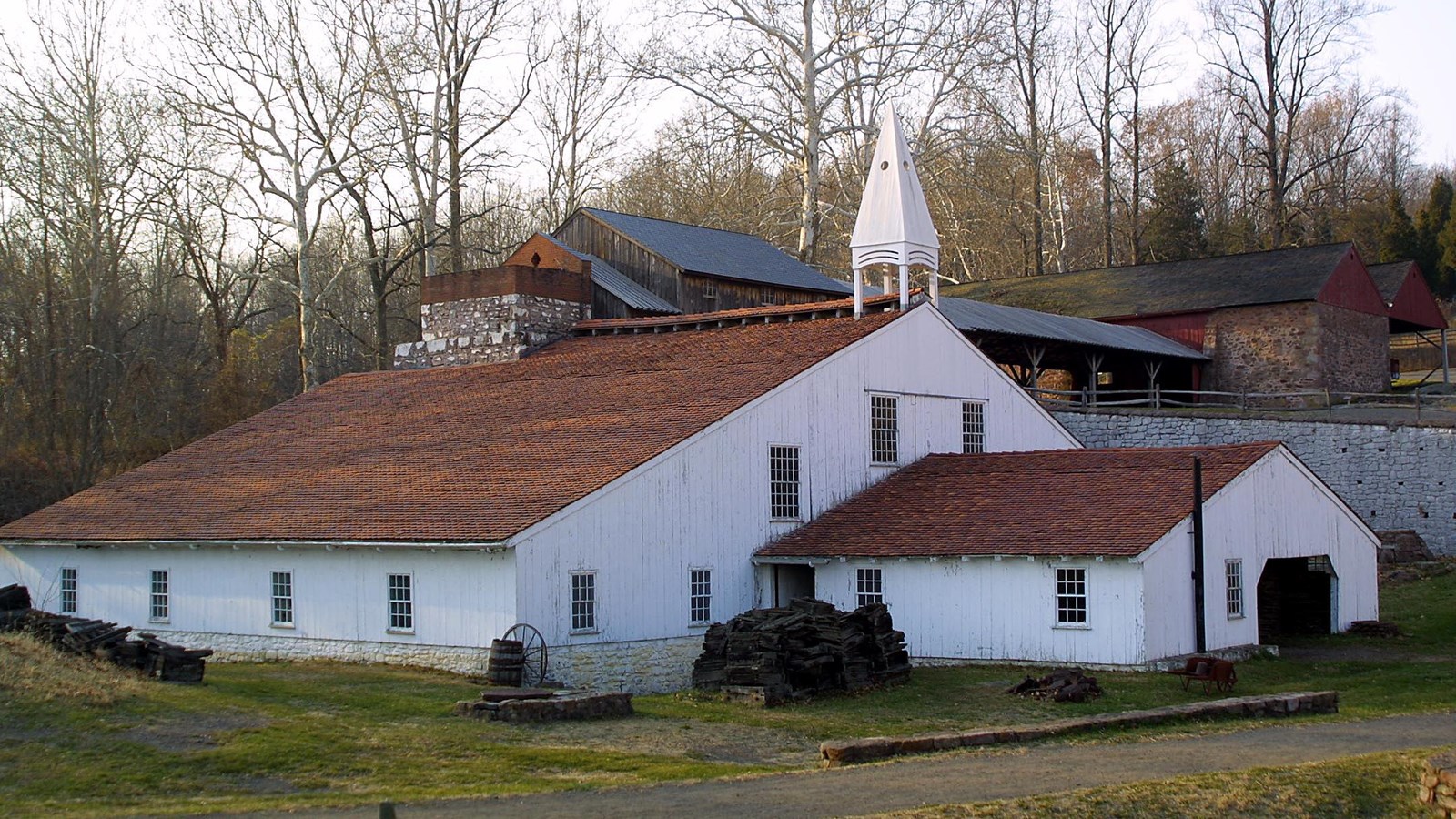
For welders and fabricators, this is a useful kind of industrial history. It shifts attention from the impressive finished object to the evidence behind it. A building can help explain earlier work without being an untouched survivor. Knowing the distinction makes a visit more interesting and gives the people who researched and rebuilt it their place in the account.
Start with the missing building
The National Park Service’s reconstruction history explains that the earlier Cast House had deteriorated away by the time archeologist Leland Abel investigated the ground around the furnace stack in 1962 and 1963. He found roof-tile fragments, foundations and stone walls. These were not a complete building waiting to be cleaned up. They were surviving evidence that had to be interpreted.
That difference matters. When you look at a finished reconstruction, it is easy to imagine a straight path from discovery to construction. The source describes something more collaborative. Archeologists, historians, architects and park staff contributed to the result. Each kind of work helped answer a different question: what remained in the ground, what written or visual records showed, and how those findings could inform a physical structure.
The lesson is not that a modern shop should treat a broken part as an archeological project. It is that observation and assumption are different things. A surviving foundation is evidence. An inference about a vanished wall needs to be identified as an inference. The finished work becomes more understandable when those distinctions remain visible.
A photograph is evidence, not a complete drawing
NPS identifies an 1887 photograph as the earliest known photograph of Hopewell Furnace. That image helped researchers understand the Cast House, but the reconstruction sought to represent its appearance around 1840. A later photograph could not, by itself, settle every detail of an earlier building.
Architect Norman Souder prepared sketches of how the structure may have appeared at different times. NPS calls them conjectural and acknowledges that some details may be inaccurate. Those are useful qualifications. They tell a reader how to use the drawings: as research-based interpretations, not photographs of moments no camera recorded.
A shop drawing, a customer photograph and an old component also answer different questions. This historic example is a reminder to ask what a record actually establishes before leaning on it. A photograph may show an arrangement but conceal a connection. A sketch may explain a proposal without proving it was built. Keeping those limits in view is a practical habit, not a lack of respect for the source.
Which version of the workplace should be rebuilt?
The Cast House changed during its working life. NPS describes evidence of an initially smaller structure that grew, and it explains the decision to reconstruct the building as it may have looked around 1840. That chosen date is important. There was not one timeless Cast House that stayed unchanged throughout every generation of work.
Choosing a period gives a reconstruction a clear purpose. It also creates an obligation to explain the choice. A visitor should not have to guess whether a building represents its first construction, its largest extent or the moment shown in the oldest photograph. Here, the park makes the intended period part of its interpretation.
For a person who enjoys tools and old industrial buildings, this changes the questions worth asking. Instead of only asking whether a place looks old, ask which period it represents and what evidence supports the features on display. A good historic site can hold your attention without pretending every uncertainty has disappeared.
The reconstruction required its own skilled work
According to the NPS account, Amish carpenters built the reconstruction under National Park Service direction. The specified framing materials included white oak, red oak and poplar pole rafters from Elverson, Pennsylvania. The account also identifies hand-made red clay roof tiles. These details keep the twentieth-century construction from becoming invisible behind the older history it interprets.
The builders were not the same workers who made iron there in the nineteenth century. Both groups nevertheless belong in the building’s story. One group used an industrial workplace; another made a researched representation of that workplace possible for later visitors. Calling the present structure a reconstruction does not diminish that later craft. It identifies what the craft accomplished.
There is a familiar temptation to value a finished object while overlooking the decisions, measurements and labor that produced it. Hopewell offers a reason to resist that temptation twice: once for the historic ironworkers, and again for the people who investigated and reconstructed their workplace.
Read the workplace as a connected process
The park’s Cast House description explains that the building enclosed the charcoal blast furnace. Moulders prepared sand molds, guttermen prepared routes for iron and slag, and the furnace founder monitored the furnace and waterwheel. This was a workplace made up of connected responsibilities, not simply a building containing one impressive machine.
That description can guide a visit without becoming a casting lesson. Look for how the interpretation connects people, materials and work areas. Ask where information and material had to move. Do not use a historic display or photograph as an operating procedure, a modern guarding example or proof that an old working practice should be copied.
Leave with better questions
A useful visit need not end with memorizing every date. It can leave you better able to distinguish a surviving artifact from a reconstruction, a documented detail from a plausible interpretation, and an attractive photograph from evidence that answers a specific question. Those distinctions help preserve the history without turning it into a story that is tidier than the record allows.
Before planning a trip, consult the park’s current visitor information rather than treating this article as a promise of demonstrations or access. This is a source-based account, not a firsthand visit or a technical assessment of the building. For welding-inspired gear and practical shop-paperwork resources, explore Arc Life.
Photo source: National Park Service, Hopewell Furnace Cast House. The present building is a reconstruction completed in 1965. No claim to original U.S. Government works. The image does not imply NPS endorsement of WSP or Arc Life.
Leave a Reply