A part that fits only after one particular worker adjusts it tells one kind of craft story. A part that can be replaced without that worker standing beside it tells another. Springfield Armory belongs to the history of that second ambition: making separate pieces answer to a shared standard. For today’s fabricator, the interesting question is not whether machines replaced skill. It is how skill became something a whole production system could use.
This is a manufacturing-history reflection, not a guide to making or repairing firearms. The surviving site and its museum interpretation offer a way to look beyond the finished object toward the people, gauges and working relationships behind it. The useful modern connection is repeatability: how work remains understandable after it leaves the hands of the person who made it.
A factory was also a place in a city
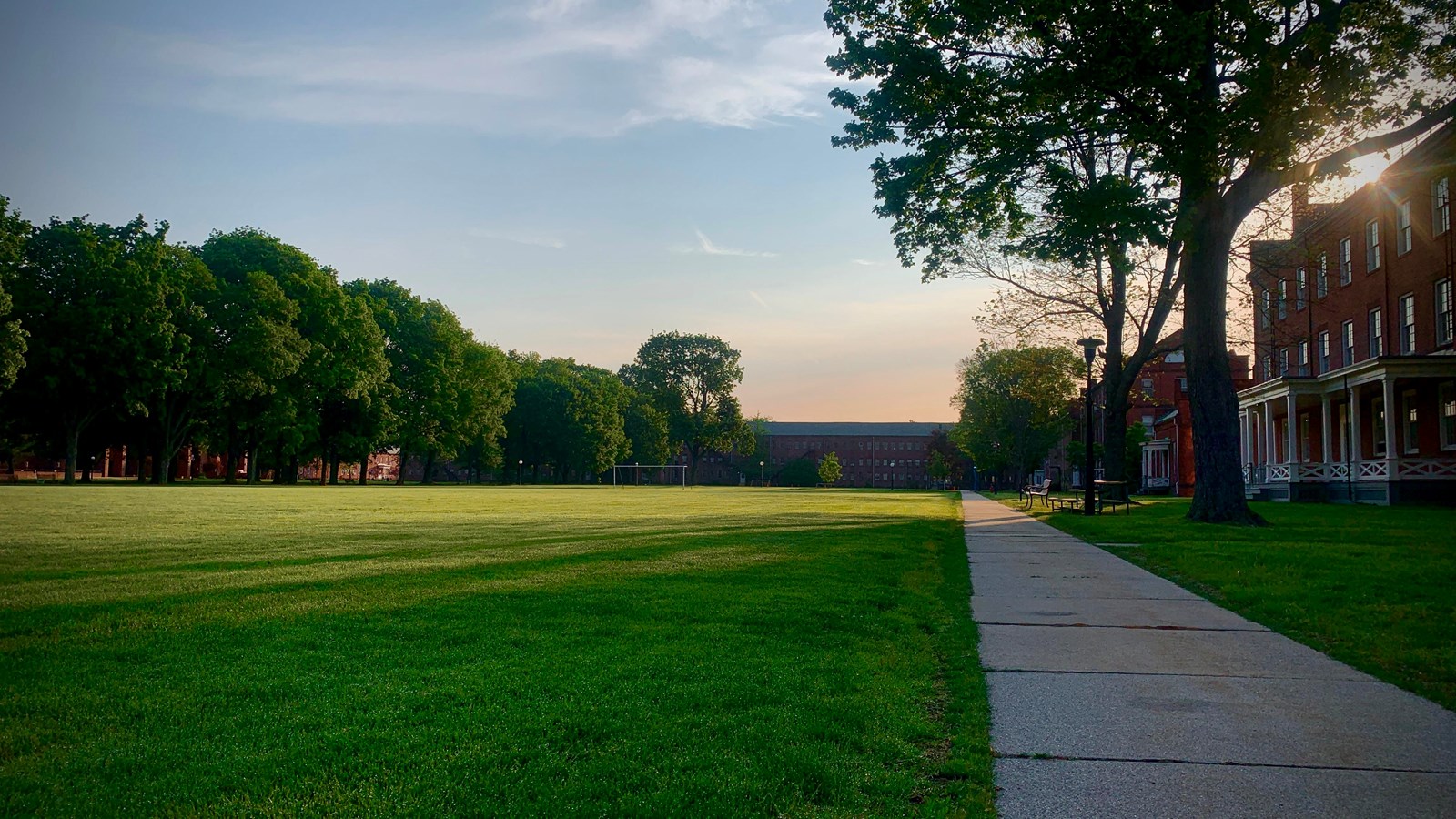
The National Park Service’s Springfield Armory overview identifies the site with the transition from hand production toward mechanization, specialization and interchangeable parts. Its grounds photograph shows a quieter scene: lawns, mature trees, walkways and brick buildings. The landscape is not a photograph of a production shift, and it should not be presented as one. It locates the history without pretending to reconstruct its sound or pace.
That distinction matters when we write about old shops. A present-day exterior can tell us what survives, but it cannot establish how an individual worker felt, how a particular day unfolded or which conversation settled a difficult job. Those details require evidence of their own. An honest account can leave them unknown and still find plenty worth considering.
The shared standard was part of the work
ASME’s engineering-landmark account recognizes Springfield as an important machining center. It credits Thomas Warner with advancing interchangeable production and describes Cyrus Buckland’s precise gauges as a contribution to manufacturing standards. It also places the Blanchard lathe in a wider industrial story, including applications beyond the armory. The account makes room for people and measuring tools alongside the famous machinery.
Our interpretation is that this changes where we look for craftsmanship. It is tempting to reserve that word for the last visible pass: the finished surface, the clean fit or the attractive joint. But a shared reference is also an act of making. Someone has to establish it, understand its limits and keep the next operation from turning it into a private approximation.
For a modern shop, that is a useful question to carry into a museum rather than a historical claim about every Springfield worker: what allows the next person to trust this piece? The answer might involve an approved drawing, inspection record or clearly identified reference. The exact system belongs to the job. The larger point is that reliability can be a group achievement, not just a personal talent.
Skill did not live in a machine alone
A machine may be the largest object in a gallery, which makes it an easy hero. The harder subject to display is the coordination around it. Who understood the intended result? How was it compared with the standard? What happened when a piece did not agree? We should ask these as research questions, not fill the gaps with an imagined conversation between unnamed masters and apprentices.
That habit improves how we talk about our own trade, too. Saying that someone is good with a machine tells only part of the story. Explaining what they check, what information they need and when they stop to ask a question gives another person something concrete to understand. It makes expertise easier to recognize without pretending that a short description can replace training.
The workers belonged to a community
The NPS account of the armory and the city describes skilled workers from varied ethnic and religious backgrounds, and the influence of the institution on surrounding community life. It also notes a later change of purpose: former workshop buildings became classrooms for Springfield Technical Community College. The place therefore carries more than the story of a product line. It also records a relationship between work, a city and education.
That is a different way to read industrial heritage from a list of inventions. Buildings can outlast the production they served. A workplace can leave traces in the skills a community values and the uses it finds for its surviving spaces. We do not need to claim an unbroken chain of instruction from one nineteenth-century bench to one current classroom to appreciate the contrast between those uses.
Three questions for your next industrial-history visit
First, separate the object from the account. Is the item original, restored, reconstructed or simply illustrative? Read the label before treating appearance as proof. Second, look for the less dramatic evidence: gauges, records, layouts and descriptions of inspection. Third, notice what the exhibit does not tell you. An unanswered question is a reason to investigate further, not permission to invent an answer.
These questions work even when you cannot visit in person. Read the museum’s own interpretation, compare it with another responsible historical source and keep your observations distinct from their claims. A photograph can be a good starting point. It should not become a substitute for the record behind it.
Springfield’s lesson for this article is modest but useful: shared standards deserve a place in the story of skilled work. The person who makes a result repeatable contributes something different from the person who rescues a one-off fit. Both stories can matter. Recognizing the first helps us see the craft that is easy to overlook because, when it works, the next person does not have to struggle.
For more about the culture surrounding the trade, explore Arc Life. Photo source: National Park Service, credited to NPS/Dani Beekman. No claim to original U.S. Government works. The historical references do not imply endorsement by NPS or ASME.
Leave a Reply