The Lincoln POWER MIG 220 AC/DC, product number K5379-1, is worth considering when your shop needs wire welding for steel and AC TIG capability for aluminum in one machine. Before buying, settle three questions: whether your electrical supply supports the output you need, whether the rated duty cycle fits your work, and whether the seller’s package includes the equipment you expect. A dual-voltage label and a long process list do not answer those questions.
This is a specification-based buying guide using Lincoln’s published documentation, not a hands-on test or a claim about weld quality. The Amazon product linked here is ASIN B0FMS7R4H9. Confirm K5379-1 on the selected offer before ordering.
As an Amazon Associate I earn from qualifying purchases.
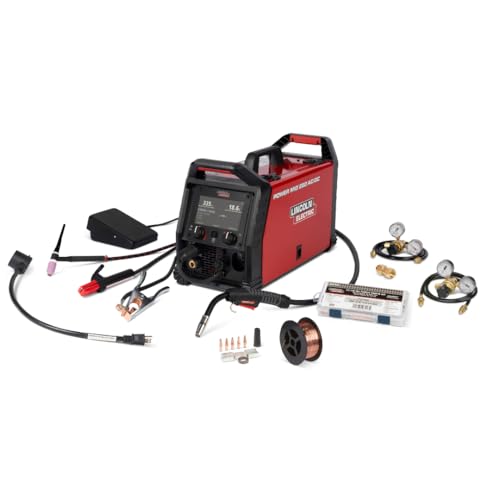
- Multi-Process Capable – Welds MIG, Flux-Cored, Stick, and AC/DC TIG.
- Dual Input Voltage – 120V and 230V inputs, allowing you to plug into any standard power supply.
- Ergonomic Case – Sleek and robust case design with multiple lift points for ease of mobility around the shop.
- Built-in TIG Solenoid and Foot Pedal Adapter – The POWER MIG 220 AC/DC welder is designed to accept a TIG torch, eliminating the need for installation.
- Robust and Reliable Wire Drive – Ensures proper and consistent feeding for optimal welding experience.
Last update on 2026-11-06 / Affiliate links / Images from Amazon Product Advertising API
Start with the work you actually need to do
Lincoln lists MIG, flux-cored, DC stick and AC/DC TIG processes. The important distinction for a mixed-material shop is AC TIG capability. If your planned work includes aluminum TIG as well as steel wire welding, this machine covers those process categories without requiring a separate TIG power source. If almost everything you do is MIG, compare the complete cost and handling of a MIG-focused machine before paying for capability you may rarely use.
Keep aluminum TIG and aluminum MIG separate on your buying list. Lincoln documents AC TIG on this machine, but aluminum MIG requires a separately sold spool gun. A TIG torch in the carton is not an aluminum wire-feeding system. Verify the spool-gun model and required connections against the current machine documentation if aluminum MIG is part of the plan.
Write down your normal material, process, joint and weld length. Then identify the occasional job that requires another process. This makes it easier to judge whether one multiprocess machine is useful or whether the feature list is distracting from your main workload. For code-controlled work, the applicable WPS and project requirements still govern.
Check 120V output before planning around a household outlet
Lincoln specifies single-phase 120V or 240V, 60Hz input. Its published specifications show substantially different output on the two supplies. Dual-voltage operation gives you another connection option; it does not preserve the same welding output.
- On 120V, the listed MIG output range is 20–125A. Rated MIG output is 95A at 40% duty cycle, or 75A at 100%.
- On 120V, the listed TIG range is 20–140A. Rated TIG output is 125A at 40%, or 90A at 100%.
- On 240V, the MIG range extends to 230A and the TIG range to 210A. The rated duty cycles still matter.
If the machine will mostly run on 120V, evaluate it as a 120V machine first. Do not choose it for the larger output figures and assume you will obtain them through the supplied voltage adapter. Before purchase, have the intended supply, receptacle, branch circuit and any extension arrangement checked against the current installation manual and local electrical requirements by a qualified person. An adapter is not an upgrade to the building’s wiring.
Compare rated output, not just the maximum number
On 240V, Lincoln lists MIG at 230A and 15% duty cycle, TIG at 210A and 20%, and stick at 200A and 15%. Its listed 100% duty-cycle outputs are lower: 120A for MIG, 130A for TIG and 120A for stick. Those figures help distinguish short intermittent work from long, repeated welds.
Use the manufacturer’s stated test conditions and duty-cycle instructions when planning work. Do not treat the maximum current as a continuous production rating or assume every process has the same limit. A machine that fits occasional repair welds may be a poor match for a shift built around sustained high-output work.
The supplied torch or gun has its own rating too. Lincoln identifies the included air-cooled TIG torch as a 150A Caliber 17. Its suitability depends on the torch’s operating conditions and duty cycle, not only the power source’s maximum output. Check both manuals rather than assuming an included torch can continuously carry every setting the machine offers.
Separate Lincoln’s standard package from the seller’s bundle
Lincoln’s POWER MIG 220 AC/DC brochure identifies the K5379-1 standard package. Use this as a comparison sheet, then get the actual seller’s included-equipment list. Marketplace descriptions may combine model information and accessory wording in confusing ways.
- Magnum PRO 175L MIG gun with a 10-foot cable.
- Caliber 17 flexible-head, air-cooled TIG torch with a 12.5-foot cable and a parts kit.
- K870 Foot Amptrol with a 25-foot cable.
- Electrode holder and lead, plus work clamp and cable, each listed at 10 feet.
- 240V-to-120V adapter, regulators and hoses.
- A sample 2-pound spool of .030-inch SuperArc L-56 wire, with listed contact tips, drive rolls and guides.
Confirm each line against the exact offer you are ordering. Do not assume a gas cylinder, cart or aluminum spool gun is included. Check the shielding-gas arrangement for each planned process, the filler and consumables needed for your material, and the cost of any missing equipment before comparing packages. A low machine price is less useful if the setup still lacks what the first job requires.
Plan for handling and replacement consumables
Lincoln lists the power source at 51 pounds and 15 inches high by 11 inches wide by 24 inches deep. Allow space for cables, airflow and any gas-cylinder handling arrangement, rather than measuring only the case. Consider how you will move the full setup, not just whether you can lift the power source once.
For replacement parts, record the machine product number, code number and serial number, plus the actual gun and torch identification. The WSP Lincoln MIG gun selection chart can help distinguish gun families, but its coverage is not a substitute for confirming this exact machine and supplied gun. Match the part family, wire diameter and cable length before ordering consumables.
For filler selection, the WSP filler-metal finder provides a starting point. Verify base metal, classification, product form, diameter, shielding gas and the governing WPS or engineering requirements. A multiprocess machine does not make different filler products interchangeable.
Use this checklist before you place the order
- Identity: the selected offer is Lincoln K5379-1, POWER MIG 220 AC/DC, not a similarly named POWER MIG model.
- Workload: your main process and normal welding demand fit the ratings on the supply you will actually use.
- Package: the seller confirms the gun, torch, pedal, leads, regulators and other included components.
- Extras: shielding gas, filler, consumables, cart and any required spool gun are accounted for.
- Seller and support: verify seller identity, manufacturer warranty eligibility, return conditions and any delivery or return-freight charges on the actual offer.
- Installation and safety: follow the current manuals, suitable PPE, ventilation and fire precautions before operation.
Choose this machine because the documented combination of processes and output fits your jobs. If you only have 120V available, need sustained high-current welding, or require an aluminum MIG setup straight out of the carton, resolve those limitations before ordering. Use the product box above to check the current offer, price and availability; this guide does not freeze marketplace prices, inventory or seller terms.
Leave a Reply