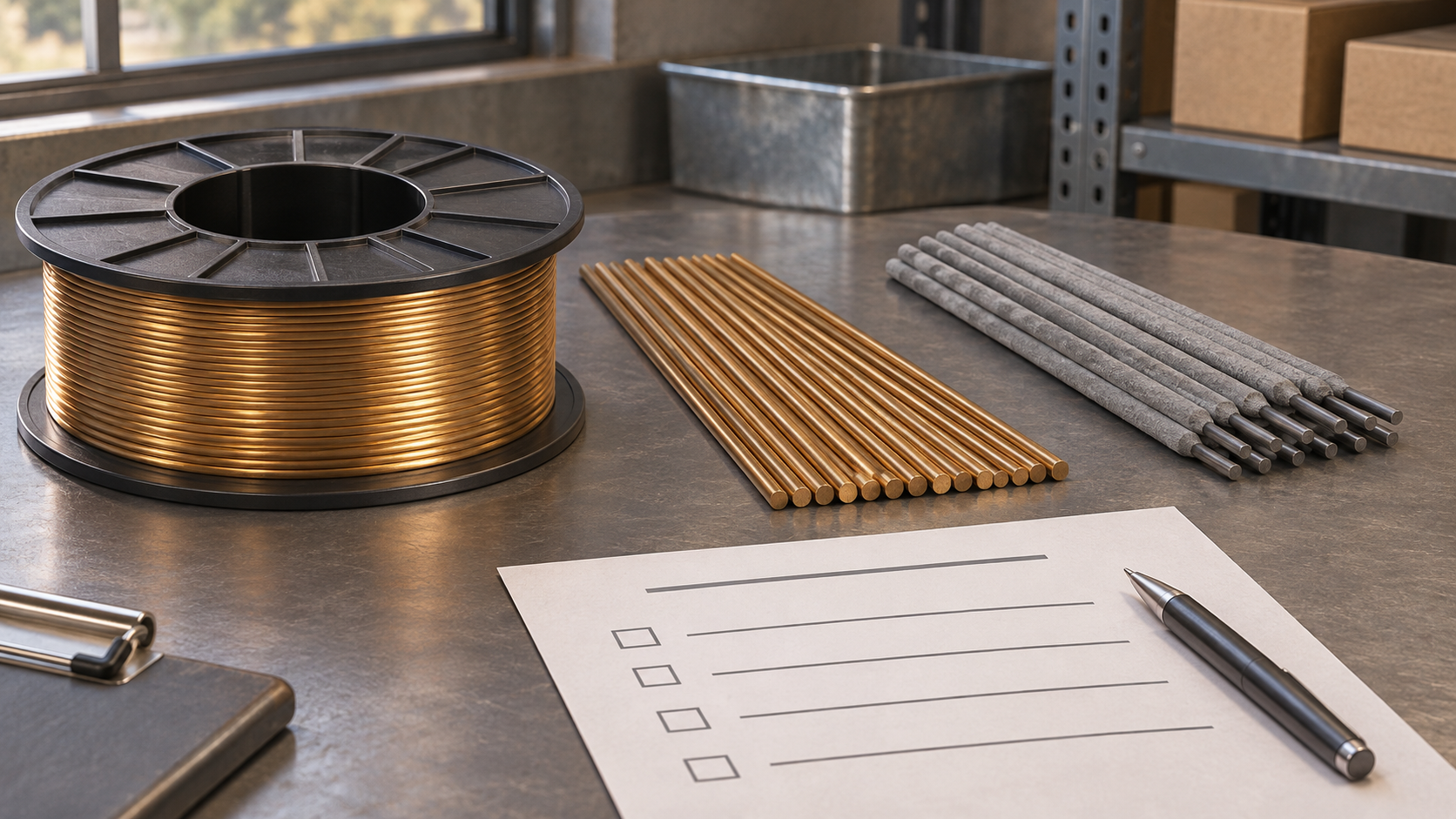
ERCuNiAl is a nickel-aluminum bronze filler classification, but the alloy name alone is not a complete purchasing specification. Before ordering, match the product form, classification, diameter and documentation to the approved job requirements. Bare wire or rod and a covered stick electrode can share a trade-name family while belonging to different AWS specifications.
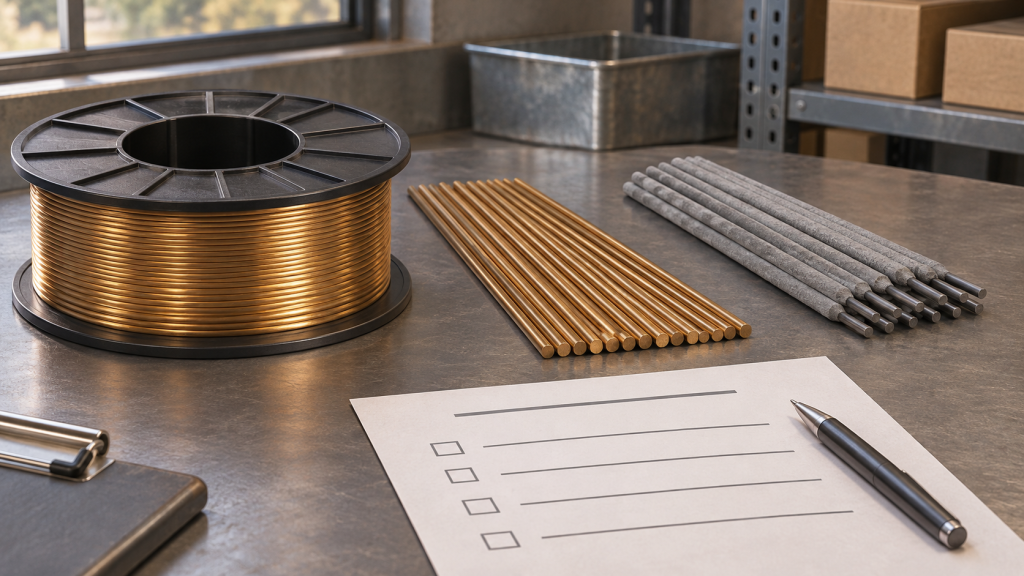
That distinction matters when a supplier offers “nickel-aluminum bronze” as a substitute. A similar description does not establish that the package suits your welding process, that its test documents cover your material, or that it is approved for the repair. This guide is a receiving and document-checking aid, not a welding procedure or permission to repair a service-critical component.
Start with the full designation and product form
The AMPCO-TRODE 46 technical data sheet separates its bare and coated products. The bare filler is identified as AWS A5.7 Class ER CuNiAl and ASME SFA 5.7 Class ER CuNiAl. The coated electrode is identified as AWS A5.6 Class E CuNiAl and ASME SFA 5.6 Class E CuNiAl. The spaces used in the manufacturer’s typography do not remove the important ER-versus-E distinction.
Aufhauser independently identifies its C632 Nickel Aluminum Bronze Electrode as AWS A5.6 ECuNiAl. Do not copy the bare-wire designation onto an electrode order simply because both products are called nickel-aluminum bronze.
Write down whether the job requires a spool of wire, straight bare rod or covered electrodes. Then record the specified diameter and package size. AMPCO’s current product page offers multiple forms and dimensions within the same product family. A correct alloy in the wrong form is still the wrong order.
Keep the base metal separate from the filler classification
AMPCO describes this family as developed for welding cast and wrought nickel-aluminum bronze and lists applications including ship propellers, valves and pump components. Those examples explain the intended product family; they do not identify an unknown casting or approve a particular repair.
Confirm the component’s material specification from its drawing, material record or other approved identification method. A bronze-colored surface, the word “marine,” or a previous repair label is not enough. Keep the base-metal designation and the filler designation as separate entries in the job record. Ask the responsible welding engineer or qualified technical authority to resolve any mismatch before releasing material for use.
Read the headings above the chemistry numbers
The AMPCO sheet labels the bare-product chemistry as filler-metal composition, while the coated-product chemistry refers to deposited weld metal. These are not interchangeable column headings. For example, that sheet lists a silicon maximum of 0.10% for the bare filler and 1.5% for the coated product’s deposited weld metal. Copying a value without its product form and measurement basis can create a misleading comparison.
Use those manufacturer values to understand the document, not to invent a universal acceptance table. Confirm the specification edition required by the purchase order and obtain the supplier’s applicable product and lot documentation. If a certificate and data sheet appear to disagree, preserve both and ask the supplier to explain the difference rather than selecting whichever number looks favorable.
Typical strength is not a repair guarantee
AMPCO labels its listed mechanical properties “nominal all-weld metal values.” A nominal tensile or hardness figure is not a promise that an unknown repaired part will achieve that result. The sheet also specifically cautions that hardness varies with weld quality and the welder’s experience.
A product data sheet therefore does not replace the applicable welding procedure specification, required procedure qualification, welder qualification or inspection plan. Use the approved job documents for preparation, process, shielding, thermal controls and acceptance requirements. This article intentionally supplies no universal amperage, preheat temperature or propeller-repair sequence.
Ask what the certificate actually certifies
Before purchase, tell the supplier what documentation the job requires. A catalog listing, safety data sheet and heat or lot test report serve different purposes. Check the document title and scope rather than treating every PDF as equivalent evidence.
The AMPCO technical sheet linked here has “2015” in its filename and includes a specific note that a weld test is required on each heat/lot to conform to the cited MIL-E-23765/3A requirement. Do not turn that historical reference into a claim that every current package has military certification. If the contract calls for such compliance, obtain written confirmation of the currently applicable requirement and the evidence for the exact material being supplied.
Use a simple receiving check
- Match the manufacturer and exact trade name to the approved purchase description.
- Compare the complete classification, specification and required edition.
- Verify bare rod, spooled wire or covered electrode, plus diameter and quantity.
- Match the package heat/lot identification to the required documentation.
- Keep the material identifiable through storage and issue to the job.
- Hold discrepancies for resolution before welding, rather than assuming a substitution is acceptable.
Finally, review the actual product’s SDS and your workplace controls. Aufhauser’s copper-alloy SDS warns that welding fumes and gases can be hazardous and calls for suitable ventilation, exhaust and protective equipment. Its broad composition ranges cover multiple alloys and must not be used as an ERCuNiAl lot analysis.
The useful habit is simple: keep the classification, physical product and evidence together. For more on the habits that support careful fabrication work, visit The Welder’s Life.
For a classification starting point, consult the WSP ERCuNiAl TIG reference, Filler Metal Finder and Alloy Support library. These selection aids do not replace the governing WPS, current manufacturer documents or the job approval process.
Leave a Reply