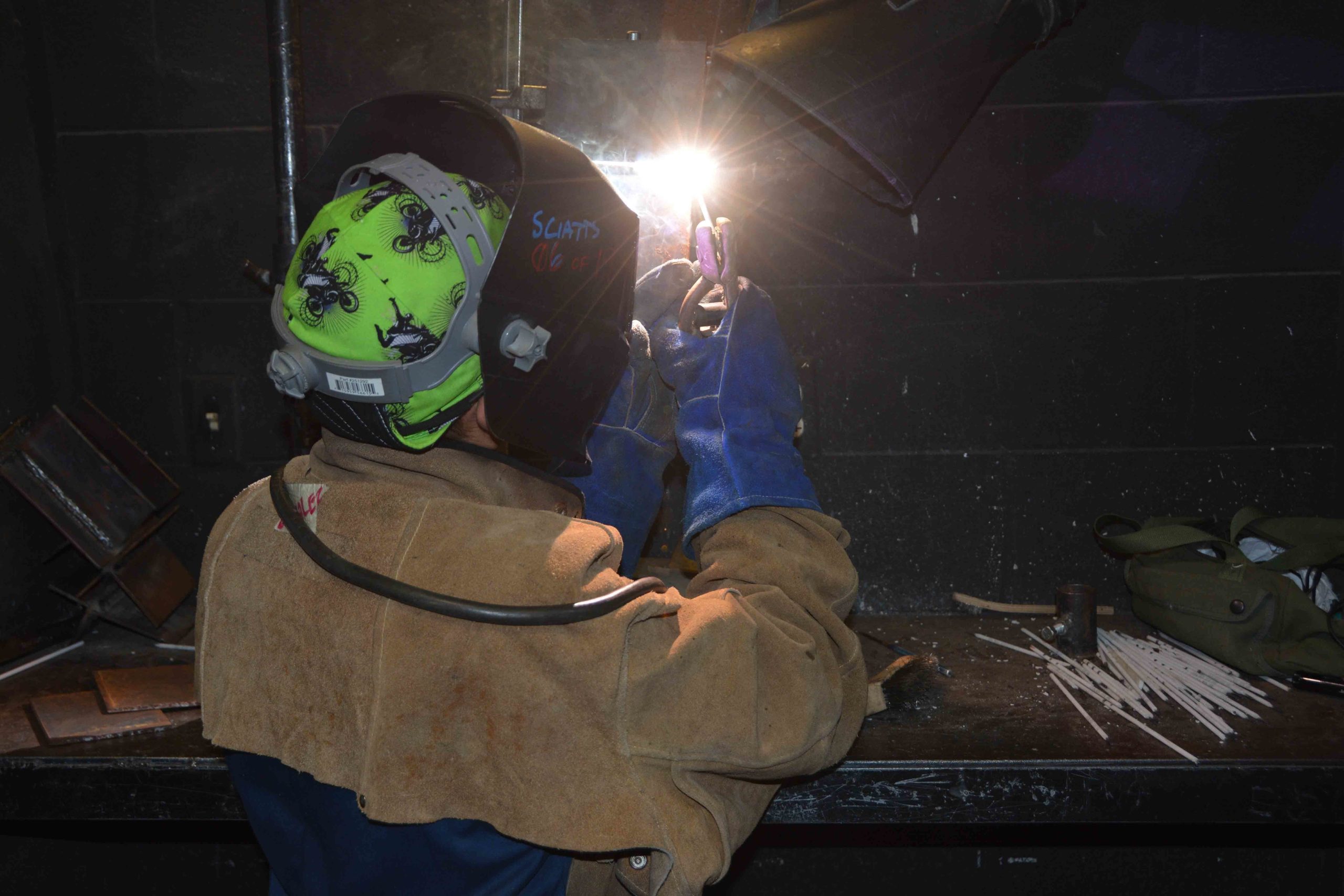
A 2016 U.S. Navy photograph from Mississippi shows a student practicing arc welding at the Naval Small Craft Instruction and Technical Training School. The image is a single training moment, not proof of the student’s eventual results. Its accompanying official caption describes something more substantial: an eight-week Technical Welding and Applied Repairs course serving people responsible for structural repairs and preventive maintenance on different materials. That is a useful window into a side of welding careers that rarely fits inside a photograph of a finished bead.
A small craft does not arrive for maintenance as a single-purpose welding exercise. Different assemblies may contain steel, aluminum and components made from other materials that require other repair methods. Training has to teach the worker what can be repaired, what documentation controls the work, and when a specialist should be involved. The lesson is as much about limits and communication as dexterity under a hood.

What the Navy caption actually establishes
The Navy identified the photographed trainee as an international student attending NAVSCIATTS’ Technical Welding and Applied Repairs course at Stennis Space Center in September 2016. Its caption states that the eight-week course covers skills for structural repair and preventive maintenance involving aluminum, steel, fiberglass and rubber, in accordance with factory technical manuals and approved doctrine. That description names the training scope; it does not mean welding is an approved repair process for fiberglass or rubber.
The image itself shows a protected welding position during a training exercise. It does not disclose the exact welding process, equipment settings, filler metal, base alloy, quality results or whether the exercise ultimately passed inspection. Those details should not be invented from a photograph, and a historical training scene should never substitute for current workplace safety instructions.
Why a repair course has to teach more than one material
An instructor can build a useful habit by starting with identification before choosing a tool. Aluminum and steel have different welding considerations, and a component that looks metallic may have coatings or internal parts requiring separate care. Fiberglass and rubber introduce entirely different work processes. The person responsible for maintenance needs to know what material is present, what manual applies, and when a repair exceeds the assigned authority.
That kind of thinking matters well beyond maritime work. A fabrication shop may repair a steel bracket next to an electrical enclosure; a maintenance crew may encounter stainless components mixed with ordinary carbon steel. In each case, the critical first question is not which machine will make a bead fastest. It is whether the particular component and service conditions permit the proposed work at all.
How good training separates a practice bead from an approved repair
A practice coupon can teach hand control, work position and recognition of visible discontinuities. A structural repair adds the drawing or manual, material identity, required process and filler, inspection criteria and recordkeeping. A clean-looking practice bead does not automatically establish fitness for service. The student must learn when to use the applicable welding procedure specification and when to obtain an engineering or supervisory decision.
The American Welding Society’s Certified Welding Educator program emphasizes both instructional methods and understanding welding theory and processes. That framework illustrates why a competent instructor needs more than the ability to demonstrate a technique. Teaching requires choosing a skill objective, explaining the acceptance criteria and making room for a student to identify what remains uncertain.
Five questions an instructor can carry into any shop
- What is the exact part and base material, and how has its identity been verified?
- Where is the governing drawing, factory repair manual, approved WPS or other responsible instruction?
- What inspection or quality evidence would show that the work meets the assigned requirement?
- What hazards or required protective controls make this operation different from a classroom exercise?
- Who is qualified to approve a change, reject a repair, or decide that the task belongs to another trade?
Those questions are an instructional framework, not a substitute for the curriculum or an approved repair procedure. They can be used in a shop discussion without instructing a novice to work on live equipment, improvise a pressure repair or disregard material-specific restrictions.
The invisible work before and after the arc
A training photograph naturally emphasizes the person welding. Off camera are less photogenic tasks: reading a technical manual, locating the correct drawing revision, checking part identification, verifying equipment condition, documenting maintenance and arranging required inspection. These tasks can prevent a repair from becoming a larger operational problem, yet they rarely receive the same attention as the weld itself.
A useful instructor asks learners to explain a decision, not just demonstrate a motion. Why was this coupon assigned? What would change if the metal were different? What makes this a training specimen rather than a service-approved component? A student who can answer those questions is building judgment that may remain useful even when the particular machine or vehicle changes.
What not to claim from the picture
The source does not provide the student’s name, a quote, an assessment grade, personal history or a later military assignment. It also does not prove the photographed student or school used any particular commercial welding machine or filler metal. The fair description is an officially documented training exercise in 2016 with an identified program and stated curriculum scope.
The official caption also does not tell a civilian reader how to execute a naval repair. Naval maintenance work is governed by its own manuals, qualified personnel and organizational controls. Shop owners can learn from the discipline of clear documentation without copying a military work method into unrelated equipment.
A practical takeaway for welding classrooms
The most transferable lesson is how much of the trade happens before a weld is started. Training can deliberately pair practice with identification, a written procedure and a documented decision about the next step. Learners should be able to distinguish what they know from what a qualified supervisor or engineer must verify. That combination supports both pride in workmanship and an appropriate respect for safety and quality boundaries.
For another view of welding careers and the people behind the work, explore Arc Life. It is a welding lifestyle destination, not a source of protective equipment or maintenance authorization. The WSP welding portfolio guide offers a related habit: record what the work represents instead of showing a photo without context. WSP’s bend-test article further distinguishes visible appearance from the evidence required in qualification.
Photograph and official training references
- U.S. Navy photograph, Leah Tolbert, September 2016, via Wikimedia Commons; identified as an official-duty U.S. government image in the public domain.
- Original Navy/DVIDS image record, including the eight-week course description and stated repair-material scope.
- American Welding Society Certified Welding Educator program for the relationship between instruction, welding theory and practical qualification.
Leave a Reply