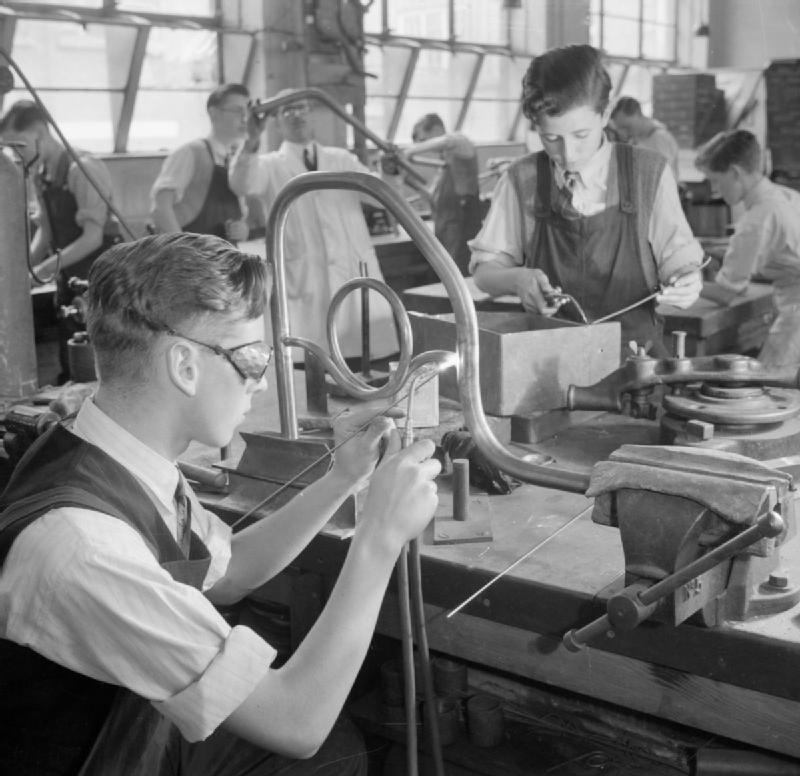
A photograph taken at Tottenham Polytechnic in England in 1944 shows students working with metaljoining tools in a crowded training room. One young learner concentrates on a piece of copper tube while others work at neighboring benches. An instructor appears in the background. The photograph does not tell us what any student learned that day, but it offers a useful starting point for a modern welding class: what must a craftsperson notice before someone can approve the finished work?
For a U.S. welding student today, the answer cannot be copied directly from the clothing or equipment in an eighty-year-old image. Modern safety requirements, training methods and welding technologies must be established from current instructions. What the image can reveal is the importance of physical practice, observation, supervision and the transfer of judgment between generations.

Read the photograph as evidence, not a complete story
The Imperial War Museums identifies the picture as Technical School: Training at Tottenham Polytechnic, 1944, from the Ministry of Information collection. Its catalog description identifies welding, soldering and an instructor reviewing work. It is not a documentation of the entire curriculum, student achievement, certification, protective-equipment standard or production outcome. All of those details remain Unknown from the photo alone.
A single picture is also a reminder to check context. We can describe visible benches and tools; we cannot safely infer an individual student’s identity, how long the task took or whether the work met a standard. For a classroom conversation, distinguishing visible evidence from assumption is itself a valuable technical habit.
The first lesson is to ask what is being joined
Before a student starts a new exercise, the instructor can ask what material is in the joint, what process the station is set up for, what the exercise is intended to demonstrate, and what evidence will show it was done correctly. Those are more useful questions than making the surface look impressive. A visually neat bead cannot, on its own, establish complete penetration, acceptance or appropriate material selection.
Today’s welding classes may use drawings, procedure sheets, digital records and visual demonstrations. None eliminates the importance of watching an experienced person identify fit-up, material, equipment limitations and the agreed stop point. An instructor’s explanation can prevent a novice from treating an unfamiliar joint as though it were yesterday’s practice sample.
Teaching the next decision, not just the next motion
A useful demonstration includes the reasons for a setup, not just its sequence. Why is this surface a reference? Which measurement matters after joining? Which changes are permitted to the operator, and which need the welding lead or instructor? The WSP machinist-to-welder handoff article explores a related cross-trade question, while the relative-zero fit-up guide shows why an easy instrument reference is not always the one the drawing calls for.
Students benefit when the instructor separates demonstrable facts from approximations. If a tool is uncalibrated or a drawing is missing, label that limitation instead of pretending the measurement is validated. If material identification is uncertain, do not make a certification claim. The lesson becomes an accountable decision process, not simply a collection of motions.
Photographs can teach a safety question too
The 1944 photo should be treated as historical context, not as an example of modern PPE or safe operating arrangement. Requirements for radiation protection, fumes, fire prevention, machine guarding, electrical isolation and supervision must come from current regulations and equipment manuals. The OSHA welding, cutting and brazing resources are a current starting point for U.S. workplaces, with job-specific provisions still requiring review.
A comparison exercise could ask students to identify what is not visible: extraction effectiveness, eye and face protection ratings, electrical controls, supervision boundaries or materials being joined. Absence from the photograph is not proof that no controls existed. It means the photo cannot establish them. That observation avoids both romanticizing old shop practices and making unwarranted accusations about a different era.
The role of a test has evolved, but evidence remains essential
The American Welding Society’s Certified Welder program illustrates the distinction between practicing a skill and demonstrating performance against a defined procedure and evaluation requirement. A successful classroom demonstration need not automatically qualify a welder for every process or application. Training objectives, test conditions and credentials have separate meanings.
The WSP welding portfolio checklist is useful here: a photograph of a weld is stronger when it sits alongside the material, process, drawing or WPS reference, exercise objective and known inspection limitations. Documentation gives a supervisor the ability to distinguish an observed result from an unsupported claim.
An instructor can preserve craft without preserving every old habit
Every trade contains useful inherited habits and practices that need updating. Demonstrating how to organize the bench, recognize a missing part, protect a drawing reference or ask a precise question can be valuable. Copying an unsupported safety shortcut because ‘that’s how it used to be done’ is not. The right inheritance is the ability to notice, explain and verify, with current controls in place.
For a beginner, a short reflection after practice can be more useful than a broad statement of confidence: What was the intended task? What could actually be observed? Which measurements were taken? What remains unknown? What is the next agreed exercise? Questions like these invite feedback without confusing a practice coupon with a certified production weld.
What modern students can carry from a 1944 classroom
- Observe the work and record only what the evidence actually supports.
- Identify material, process, equipment and approved instruction before drawing conclusions.
- Ask for the reason behind a reference surface or setup, not just a repeatable motion.
- Use current safety and machine-specific controls rather than copying historical protective practices.
- Preserve an accurate record of questions, measurements and evaluation criteria for the next person.
The enduring lesson from the archival image is modest but meaningful: trade skills develop in rooms where tools, people, questions and accountability meet. How those rooms are equipped must change with current technology and safety knowledge. The habit of learning from another worker’s observation remains useful. For more stories about welding people and craft, explore Arc Life; it is a lifestyle resource, not a source of welding procedure approval or protective-equipment guidance.
The photograph gives us a moment in time, not a complete account. A useful modern teaching activity is to start with that limitation, then build a more complete and safer record of an actual practice task under qualified supervision.
Leave a Reply