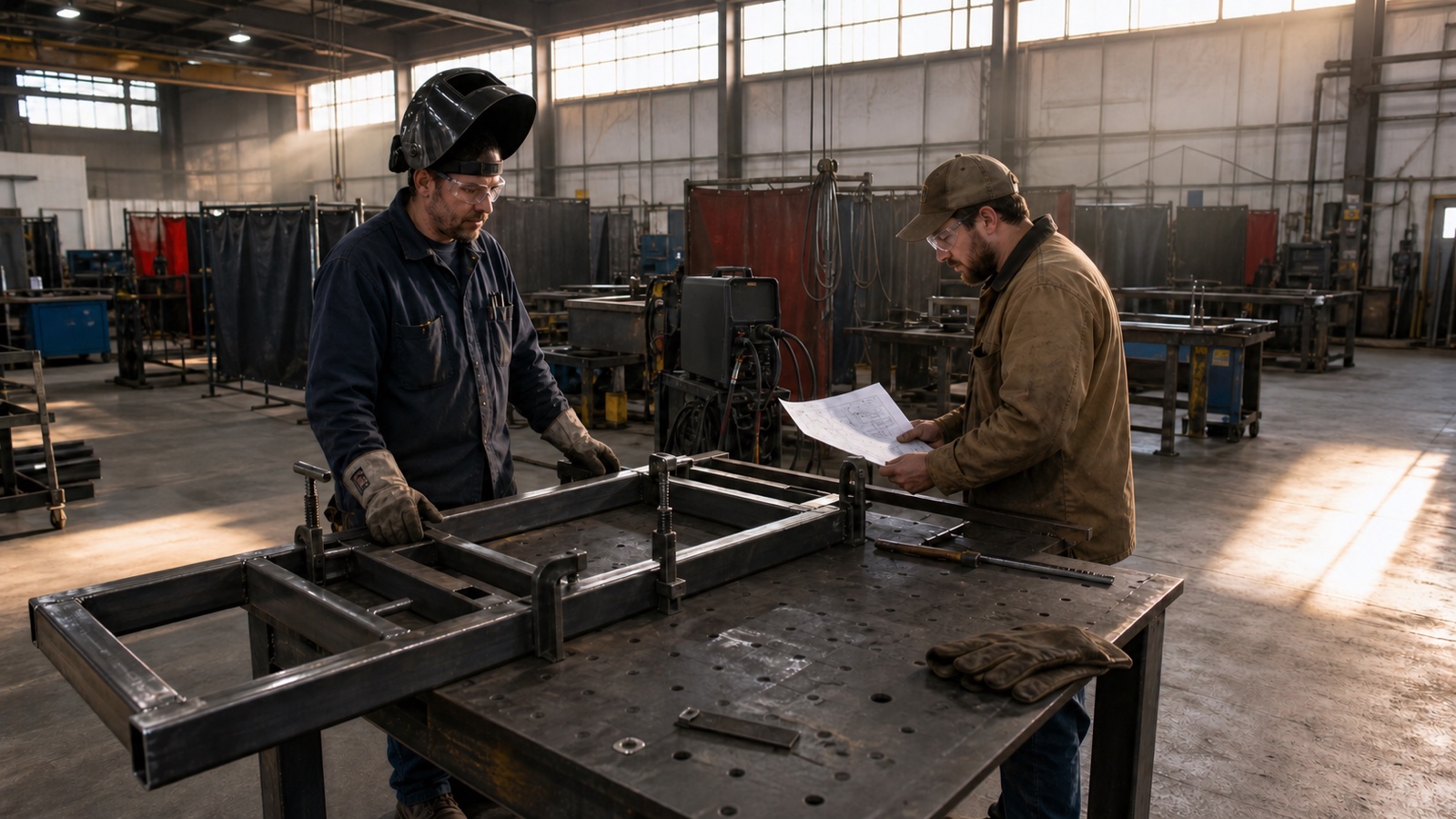
Featured image: contextual fabrication-shop planning; the Strong Hand PG114V is not pictured.
Tube fit-up gets frustrating when the pieces are ready but there is no convenient way to hold them while checking the joint. Strong Hand's PG114V pipe pliers are worth considering for that narrow job: gripping suitable round or square tubing during butt-weld fit-up.
The important buying questions are the working size, the space around the joint, and the support the assembly needs. Check those before choosing a clamp by its overall length or product photo.
Know the exact model
The PG114V is the 11-inch version with fixed top and bottom V-pads. Strong Hand's model table lists a 3.5-inch throat depth, a 1.5–2.5-inch clamping range, an M10 thread, and a weight of 2.8 pounds. Other pliers on the same manufacturer page have different pad arrangements and capacities, so keep the complete model number attached to the specifications. Strong Hand pipe-plier specifications
The manufacturer's PG114V kit page also confirms that the individual pliers are intended to hold round or square tubing for butt-welding. It describes a crank handle for adjusting pressure and a one-hand release. The kit contains three pliers; the Arc Weld listing discussed here is for one PG114V. Strong Hand PG114V kit details
That distinction matters when planning a fixture. Buying one tool does not provide every support or clamping point an assembly may require.
Measure the material you need to hold
Measure the actual outside dimension at the intended clamping location. A verbal description such as “two-inch pipe” is not enough to establish how a particular workpiece sits in the jaws.
Compare the measured workpiece with the manufacturer's range, then look at the shape. A straight section of round tubing offers a different seating situation from a bend, a transition, or a joint close to a flange. If the geometry leaves the pads only partly supported, ask about the fit before ordering.
The published range is also not a promise that every part within those dimensions can be clamped without damage. Wall thickness, condition, surface finish, and how much pressure the assembly needs all affect the practical choice. For delicate work, trial the setup on suitable scrap or obtain advice for the actual material.
Avoid solving a mismatch by adding loose scraps between the pads and the work. Select workholding that fits the job and stays stable through the planned operation.
Check the room around the joint
The pliers must fit in the available space as well as around the tube. Before ordering, consider where the body, crank, and release handle will sit when the tool is closed.
A useful fit check is to mark the intended clamp location on a simple sketch of the assembly. Note nearby bends, brackets, flanges, and the bench or fixture surface. Allow room to operate the release without reaching through the joint area.
Also plan the access needed for inspection and tack placement. Workholding that blocks every useful approach to the joint can turn a quick setup into repeated repositioning. If the assembly is crowded, a different style or arrangement of clamps may be more convenient.
The published throat depth helps narrow the choice, but a dimension on a product page cannot resolve every clearance question in an assembled project.
Support the assembly before adjusting the joint
Set long or awkward pieces on appropriate supports so their weight is controlled independently. Use the pliers to help hold the fit-up, and verify that releasing them will not allow a part to fall or rotate unexpectedly.
This article does not establish a lifting or load-support rating for the PG114V. Do not treat it as a substitute for rated lifting equipment or a fully designed fixture.
Once the work is supported, check the joint against the drawing and applicable welding procedure. Confirm alignment, the required gap, and access around the circumference or perimeter. The clamp can hold the position you set; it does not inspect the joint or decide what acceptance criteria apply.
That distinction is especially important when the work has a code, customer specification, or pressure-service requirement. Use the approved procedure and qualified inspection appropriate to that work.
Use a repeatable fit-up checklist
Before the first tack, work through the same checks each time:
- The correct pieces and material are identified
- The ends have been prepared for the specified joint
- The work is supported and stable
- The pads seat properly on the intended surfaces
- Clamp pressure holds the position without visible distortion
- Alignment and gap have been checked
- The torch and operator have adequate access
- There is a safe plan for repositioning or releasing the clamp
After tacking, inspect the fit again before proceeding. Follow the welding procedure for tack placement, sequence, and any required removal or dressing. Buying a clamp does not remove those process decisions.
For repeat work, record the successful support and clamp locations. A short setup note or sketch makes the next assembly easier to repeat than relying on memory.
Keep variant claims out of the purchase decision
The PG114V should not be confused with versions that have an adjustable top pad or a magnetic lower pad. Strong Hand lists those features by model in its selection table. Nor does the ordinary PG114V listing establish a stainless-steel-contact or contamination-free qualification. Strong Hand model comparison
If an accessory or material-contact requirement matters to the job, get confirmation for PG114V specifically. A feature described elsewhere in the product family is not enough to establish compatibility.
Buying the PG114V from Arc Weld
Arc Weld lists the single Strong Hand PG114V, 11-inch pipe pliers with large V-pads. Review the current listing and confirm any unusual fit-up before ordering. View the PG114V at Arc Weld.
For a supported assembly within the specified working range, this is a focused tool for holding tube fit-up. Its value depends on matching the pads, capacity, and access to the work you actually do.
Leave a Reply