The Evolution S14MCS deserves a closer look when repeated miter cuts in metal are slowing down your fabrication work. Its buying case is the way the saw changes cutting angle, not simply the size of its motor or blade. Before ordering, match the exact saw and blade to your material, confirm capacity at the angles you actually cut, and plan the complete stock-support station.
This is a document-based buying guide for the S14MCS Gen2, not a hands-on test. The Amazon listing identified during research is ASIN B0FH5J1RTN. The U.S. manufacturer product code is 102-0004A. Check those identifiers when comparing listings; similar model names are not proof of an identical package.
When the Evolution S14MCS solves the right problem
Evolution describes a mitering base that adjusts up to 46 degrees left or right without requiring the workpiece to be repositioned to set the angle. Its S14MCS product page also identifies dual sliding front clamps, a top clamp, and a three-position cutting head. Those are relevant features for a shop evaluating an angled-cut station rather than another general-purpose saw.
Start with a recent cut list. How many pieces needed miters? How much time went into arranging long stock, changing the setup, and checking the first piece? If that is the recurring bottleneck, this design is worth investigating. If most work consists of occasional square cuts, a mitering mechanism may be solving a problem you rarely have.
A new saw does not replace dimensional inspection. Keep the drawing, angle convention, length reference, and acceptance tolerance clear. WSP’s guide to relative zero versus level explains why the reference behind an angle measurement matters.
As an Amazon Associate I earn from qualifying purchases.

Last update on 2026-09-29 / Affiliate links / Images from Amazon Product Advertising API
The included blade is not an all-metal permission slip
The manufacturer’s package includes an EVOMAX14ST blade. Evolution’s separate EVOMAX14ST specification identifies a 14-inch, 80-tooth mild-steel cermet blade with a 1-inch arbor. Crucially, the same page excludes galvanized, hardened, and high-carbon steel from this blade’s intended use. Do not turn a broad metal-cutting-saw description into approval for every metal on the rack.
For a stainless, aluminum, coated, or unidentified workpiece, stop the purchasing decision until the machine-and-blade combination is confirmed for that material. A blade diameter and bore that physically fit are not a complete compatibility check. Do not substitute an abrasive wheel or a woodworking blade based only on those dimensions.
Keep the intended material on the purchase request alongside the saw model. Otherwise, a buyer can order the correct machine and still receive an unsuitable ready-to-use setup for the first job. Compare replacement-blade availability and cost for the actual material before committing to a new cutting platform.
Verify capacity at your miter angle, not just at 90 degrees
Capacity needs clarification for near-limit work. During this review, the manufacturer’s web page and its linked S14MCS instruction manual did not agree on every angled-tube capacity entry. This guide therefore does not promise a maximum angled cut or choose the larger number as the correct one.
Send Evolution the U.S. product code, material grade, section shape, outside dimensions, wall thickness, required angle, and left/right miter direction. Ask for confirmation that the section can be cut and properly clamped in that configuration. A simple sketch showing which face sits on the table is more useful than a request to cut a certain width of tubing.
If your production depends on one large angled section, make that confirmation a condition of purchase. Do not assume a straight-cut headline capacity also applies to round stock, rectangular stock, or both miter directions. This is a verification gap to resolve before spending money, not a reason to experiment beyond the documented limits.
Check U.S. power and plan the whole station
Evolution lists the U.S. machine at 120 V, 60 Hz, 15 A, with 1,100 rpm no-load speed. It includes soft start and an electronic blade brake. These features do not establish that an existing shop circuit or extension lead is suitable. Match the nameplate and electrical installation to the manual instead of buying a foreign-voltage listing because its photograph looks the same.
The MCSSTAND is separately listed equipment. Do not assume a stand pictured in a demonstration is in the Amazon package. A stand decision should include mounting, working height, stability, stock-support positions, storage, and how the complete setup will be moved.
Lay out the longest incoming stock and the finished-piece area before selecting the saw’s location. Consider the aisle, neighboring workstations, and the operator’s access to the clamps. A compact-looking machine can still need considerable working space once the material is included.
Cold cutting still requires guards, clamping, and safe support
The operating manual requires secure clamping rather than freehand cutting, appropriate support for long work, and waiting for the blade to stop before removing cutoffs. It warns against using a person as a substitute for proper support and against trapping the cutoff against the blade with a length stop. Disconnect power before adjustments, blade changes, or clearing a jam.
Do not read cold-cut marketing as dust-free or hazard-free operation. Follow the manual’s guarding, eye-protection, hearing-protection, and dust precautions. This buying guide is not an operating procedure. Also keep saw-cut appearance separate from weld preparation: a cut that looks clean does not establish that coatings, oils, or other contaminants have been addressed.
Judge the upgrade by completed parts, not advertised blade life
Build a short cost comparison using your own work. Include the saw, any stand and stock supports, the correct blade, replacement blades, delivery, and the time needed to establish the station. Then compare setup time, inspection time, rejected parts, and downstream fitting work. Manufacturer blade-life demonstrations are not a guaranteed cost per cut in your material mix.
For a shop making repeat frames, the strongest justification may be a more convenient miter setup. For a shop with a functioning saw and few angle changes, the same purchase may be difficult to justify. WSP’s story about the saw station’s role in fabrication puts the decision in context: evaluate the handoff to fit-up, not the machine in isolation.
Before-you-order checklist
- Identity: S14MCS Gen2, U.S. product code 102-0004A; confirm the selected Amazon variation.
- Material: identify the stock and verify the supplied or proposed blade is approved for it.
- Capacity: resolve the exact section, orientation, clamping arrangement, and required miter direction with the manufacturer.
- Station: verify power, mounting, long-stock support, guarding, and working space.
- Package and support: check included equipment, optional stand, replacement blades, seller terms, and the applicable warranty before payment.
Bottom line: shortlist the S14MCS for a real miter-cutting workflow, not merely because it is a substantial tool. Confirm material and capacity first, then decide whether the complete station earns its place in the shop.
References and image note
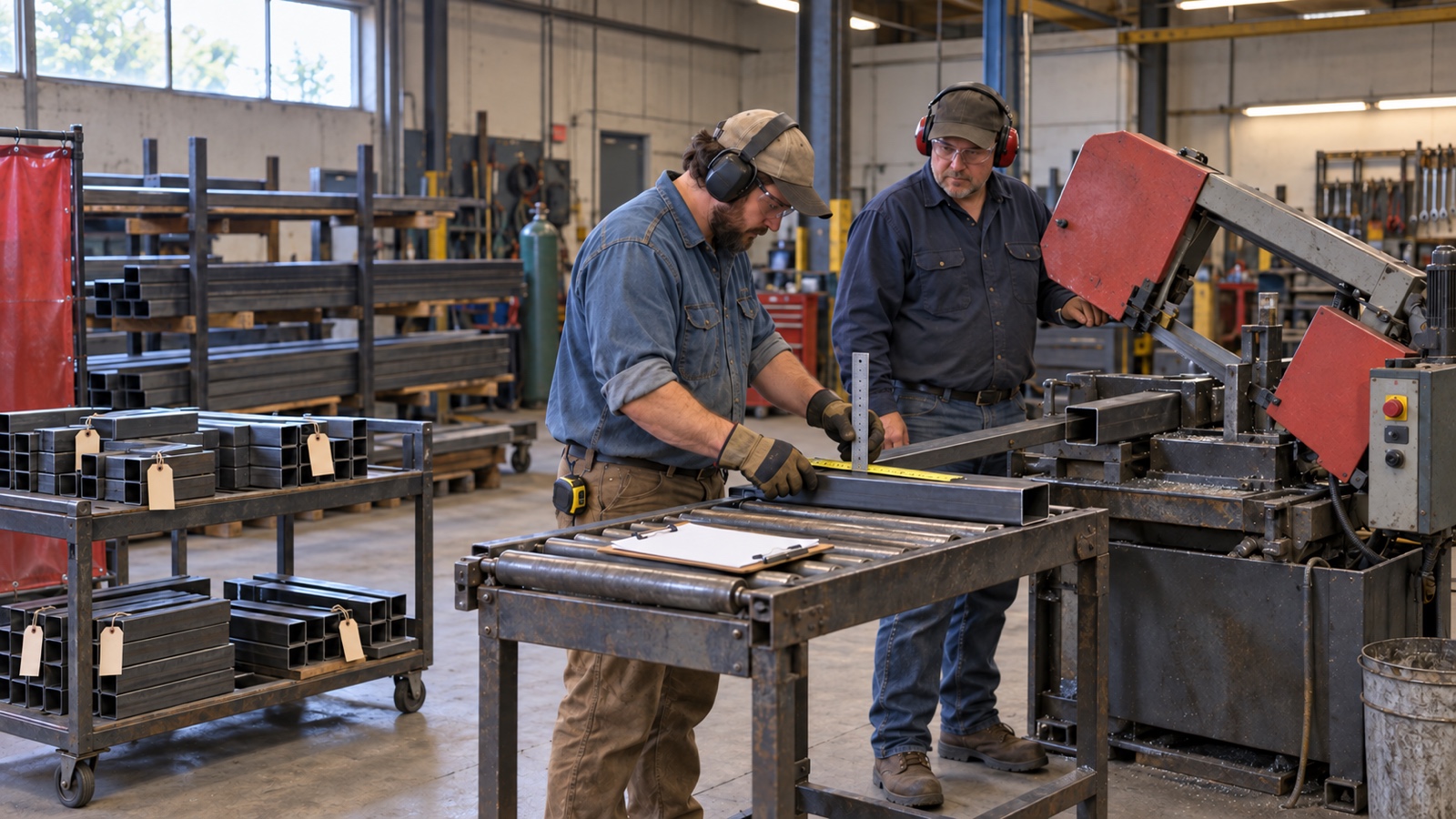
References checked September 29, 2026: Evolution’s S14MCS product page, U.S. 102-0004A instruction manual, EVOMAX14ST blade page, and MCSSTAND page linked above. The capacity disagreement is explicitly retained as a purchase-verification issue. The featured WSP saw-station image is contextual and does not depict the S14MCS; the Amazon box supplies the named product imagery.

Leave a Reply