Some children walk past a construction site and see a hole in the ground. Others stop for the excavator.
They notice the bucket curling through dirt, the truck waiting for a load and the worker signaling where the next move should go. At home, they may turn a cardboard box into a service truck, line up toy tools on the floor or ask why the bridge does not fall down.
That curiosity deserves better than a vague answer about “construction.” The built world comes from specific people using specific tools in a sequence that rewards attention, teamwork and patience.
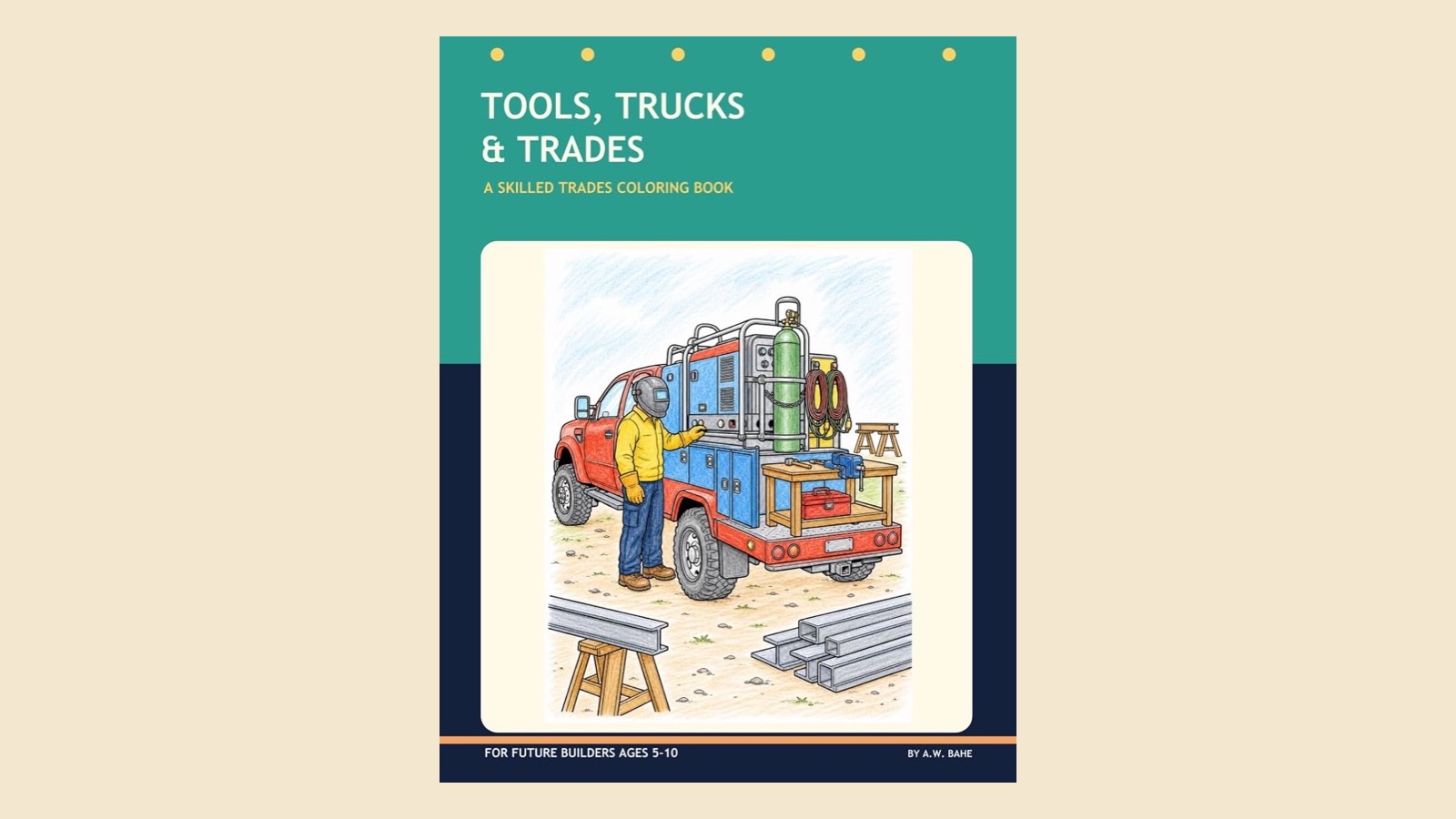
That idea sits behind a new independently published coloring book, Tools, Trucks & Trades: A Skilled Trades Coloring Book for Future Builders by A.W. Bahe.
Let the work be interesting
Children do not need a career lecture disguised as an activity book. They need a picture worth studying.
A welding rig has cabinets, reels, cylinders, leads and a work surface. A crane makes sense only when the child can see what it is lifting. A carpenter’s tools belong near the thing being measured and assembled. A mechanic, machinist or fabricator is more interesting when the scene shows the relationship between the person, the equipment and the job.
That is the strength of a trades-centered coloring book. Coloring slows the eye down. A child has time to notice where the outriggers sit, why material rests on stands, what a forklift carries or how a finished steel building is made from smaller pieces.
The activity does not have to turn every detail into a lesson. The picture can do quiet work on its own.
More than one version of “the trades”
The live Amazon listing describes 40 original, brand-neutral scenes spanning work trucks, construction equipment, welding, carpentry, mechanics, machining and fabrication. It includes dump trucks, excavators, cranes, forklifts, hand tools, bridges, decks and steel buildings.
That range matters. Adults sometimes talk about skilled work as if it were one narrow path. Children usually understand variety more naturally. One may be fascinated by large equipment; another wants to know how a machine works inside; another likes measuring, drawing or assembling small parts.
The scenes give those interests room to exist beside one another. The welder is part of the same world as the carpenter. The mechanic belongs beside the equipment operator. The finished project depends on many kinds of attention.
That is closer to how real work gets done.
Built for an actual coloring session
The book is a paperback with 84 pages in an 8.5-by-11-inch format. Amazon currently lists the reading age as 6–10. Its product description says the line art uses large spaces with moderate detail and places one coloring picture on each right-hand page with a blank reverse.
Those choices make sense for a child who wants recognizable equipment without a page becoming a maze. They also leave room for the way kids actually color: sometimes carefully, sometimes quickly, and sometimes with a completely unexpected idea about what color an excavator ought to be.
There is one practical limitation worth stating plainly. The listing notes that print-on-demand paper is not marker-proof and recommends placing a spare sheet behind the page when markers are used. Colored pencils or crayons avoid much of that concern; marker users should follow the extra-sheet precaution.
That kind of detail is more useful than pretending every material works perfectly in every book.
A conversation starter for trade families
For a welder, fabricator, mechanic, operator or carpenter, the best part may happen before the coloring begins.
A child points to a machine and asks what it does. A parent or grandparent explains which tool they use at work. An instructor keeps a copy in the classroom for visiting families. A tradesperson can talk about the finished bridge, truck or building without turning the conversation into a technical manual.
The pages can also make unfamiliar work less abstract. Many children see the result of skilled labor every day but rarely see the sequence behind it. They ride across bridges, enter steel buildings and watch service trucks pass without knowing how many decisions and hands stand between raw material and finished work.
Giving that work a visible place in a child’s creative world is a modest thing. Modest things can still last.
The point is recognition, not recruitment
No coloring book can tell a child what job will fit years from now, and it should not try. Childhood interests change. The kid who colors every crane may become an engineer, a teacher, a welder, a designer or something nobody at the kitchen table has imagined yet.
The useful outcome is simpler: the child learns that built things have authors.
Somebody planned the lift. Somebody measured the cut. Somebody maintained the truck. Somebody made the joint, checked the work and handed the project to the next person. Skill is visible when we choose to show it.
That recognition is part of Arc Life’s larger mission too. Welding culture is not only the finished bead or the machine in the booth. It includes families, teachers, curious kids and the first moment someone realizes that making things can be a serious and satisfying life.
Take a look inside the world of work
Tools, Trucks & Trades is available as a paperback through Amazon. The canonical listing currently shows the book by A.W. Bahe, publication date September 18, 2026, ASIN B0HKF7H8KV and ISBN-13 979-8194421381.
See Tools, Trucks & Trades on Amazon.
As an Amazon Associate, we may earn from qualifying purchases.
The Arc Life question is for the trade families: Which tool, truck or job first caught your attention as a kid—and who took the time to explain it to you?
Share that story with the young builder in your life, and visit Arc Life for more stories and tools rooted in the people who make, repair and build.

Leave a Reply