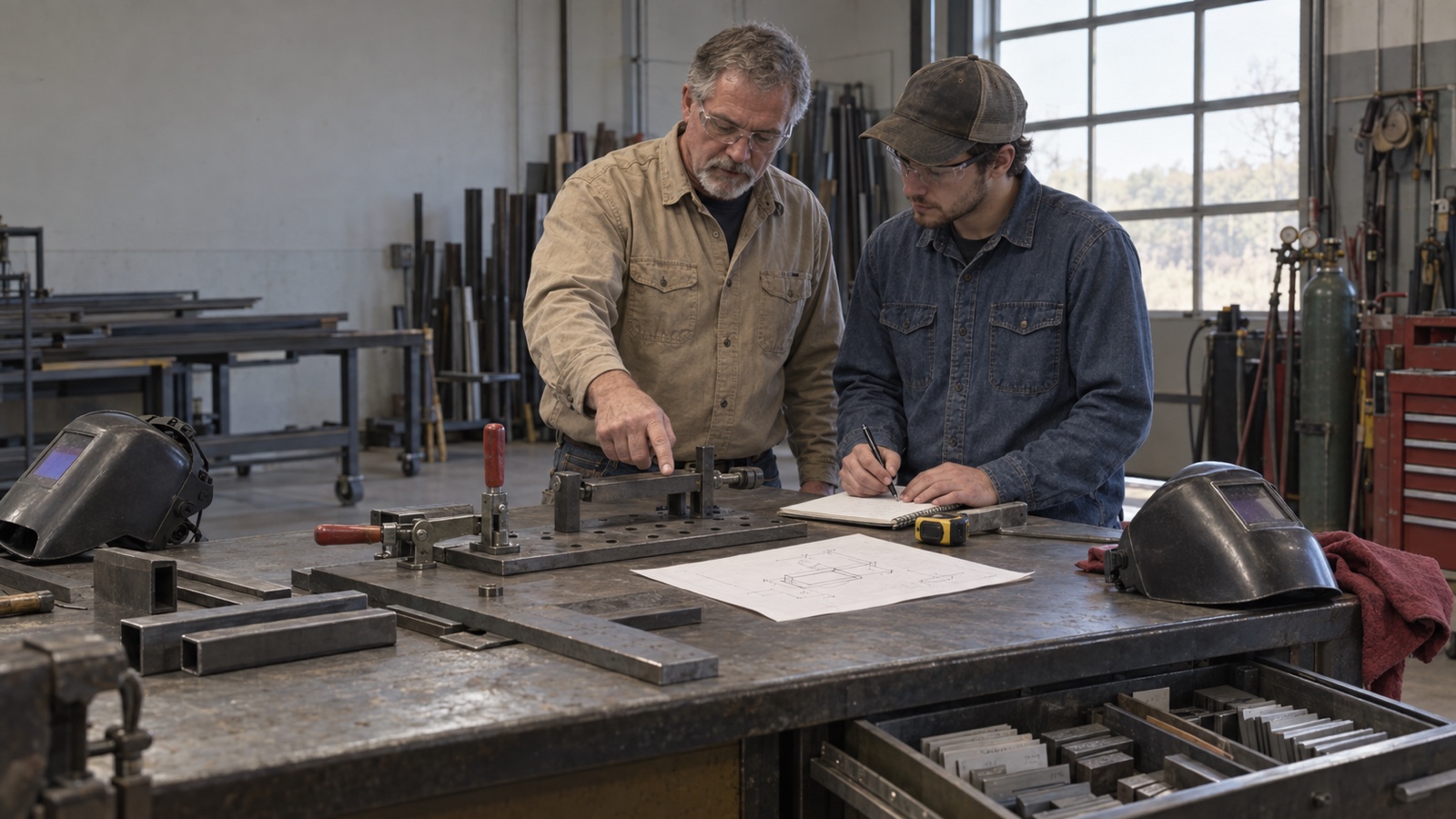
There is a certain kind of shop drawer that does not appear on any inventory sheet. It sticks halfway open. Inside are a few shims, a dog-eared setup sketch, maybe a sample coupon with an arrow in soapstone. To a visitor, it looks like leftovers. To the crew, it may be the shortest route to getting a difficult repeat job right.
That drawer is not a substitute for a drawing, a current procedure or an inspection plan. It holds something different: the memory of how the work actually behaves.
Every welding shop has knowledge like that. It lives in the order a fixture gets tightened, the place a long assembly wants to pull, the sound that says a worn positioner needs attention, and the customer detail that never seems to make it onto the print. Much of it was earned through rework, long afternoons and the occasional part that taught a lesson the expensive way.
The risk is obvious. People change shifts, change employers and retire. If the only copy of that knowledge is in one person’s head, the shop loses more than a pair of hands when that person leaves.
The drawing is the beginning, not the whole conversation
Welding is often described as a hands-on trade, but the hands are making decisions all day. The U.S. Department of Labor’s O*NET description of welding work includes reading drawings and specifications, aligning parts in fixtures, checking work for conformance, detecting defective equipment or material, and monitoring for distortion. Those responsibilities meet on the floor, where the information on paper has to survive heat, fit-up, handling and production pressure.
A drawing can define the required result. A qualified procedure can define how a weld must be made. Neither one automatically tells a new crew member that the left stop on an old fixture has a few thousandths of wear, or that a particular assembly is easier to control when the clamps come off in a certain sequence. That is not permission to freelance around requirements. It is a reason to capture practical setup knowledge alongside the controlled documents that govern the job.
The best shop notes respect that boundary. They do not say, “This is how Joe does it.” They say what was observed: which stop was used, where the first check was taken, what moved, what was adjusted and who approved the change. A useful note can be challenged, corrected and updated. A legend cannot.
Good handoffs happen beside the work
Knowledge transfer becomes awkward when it is treated as a farewell project. Someone who has spent 25 years solving problems is handed a blank form two weeks before leaving and asked to write down everything important. That usually produces either a mountain of detail or a page of general advice.
The better moment is an ordinary repeat job.
Pair the experienced hand with the person who will likely run it next. Start with the current drawing, procedure and inspection requirements. Then watch the setup. Ask simple questions while the physical evidence is still in front of both people: Why is that stop set there? Which dimension gets checked before the part comes out? What tends to move? What changed the last time the fixture was repaired?
The newer worker should do more than take notes. Let that person run the next setup and explain it back. If the explanation falls apart, the gap is visible while there is still time to close it. A five-minute phone video of the fixture, a photograph of the clamp order, or a marked-up setup sheet can help—but only if it is stored where the next shift can find it and dated so no one mistakes an old workaround for current direction.
This is not nostalgia for the way things used to be. It is how a shop makes experience available to people who were not present when the lesson was learned.
Write down the exceptions, then fix what should not be exceptional
Experienced welders often become human routing systems. A question comes up and everyone knows which person to ask. That is flattering until the person is absent and the job stops.
One practical way to find vulnerable knowledge is to listen for the same questions:
- Which fixture does this revision use?
- Where is the known-good sample?
- Who knows the customer-specific finish detail?
- What do we check before welding the second side?
- Why does this machine get set up differently?
The answers do not all belong in the same place. Some require a drawing revision. Some belong in a controlled work instruction or maintenance ticket. Some are best captured as a clearly labeled fixture note. A few may reveal that the shop has been leaning on an unofficial workaround that needs engineering, quality or safety review.
That sorting step matters. Documentation should remove ambiguity, not preserve it forever.
Passing it down is skilled work too
The need is not theoretical. The Bureau of Labor Statistics projects about 40,300 welding-related openings per year, on average, from 2025 through 2035. Most are expected to come from workers moving to other occupations or leaving the labor force, including retirement. Each opening is a hiring problem. It can also be a knowledge-transfer problem.
The National Institute of Standards and Technology’s Manufacturing Extension Partnership emphasizes structured onboarding, technical training and consistent instruction as parts of workforce development. The principle fits the shop floor: repeatable teaching is not bureaucracy for its own sake. It gives the next person a fair starting point.
There is respect in that. The experienced worker’s hard-won judgment becomes part of the shop instead of disappearing with a final timecard. The newer worker receives more than a list of motions; they get the reasons behind the sequence and enough context to notice when conditions have changed.
And the shop gets something stronger than a single expert. It gets a crew that can carry the work together.
So open the drawer. Keep the useful shim. Photograph the fixture. Move the approved lesson into the right document. Throw away the note that no longer applies. Then ask the question that tells you where to look next:
What is one piece of shop knowledge your crew would lose if the most experienced person left tomorrow?
Arc Life is built around the people, habits and small lessons that give the trade its character. Follow more stories from the welding life and bring your own shop perspective to the conversation.

Leave a Reply