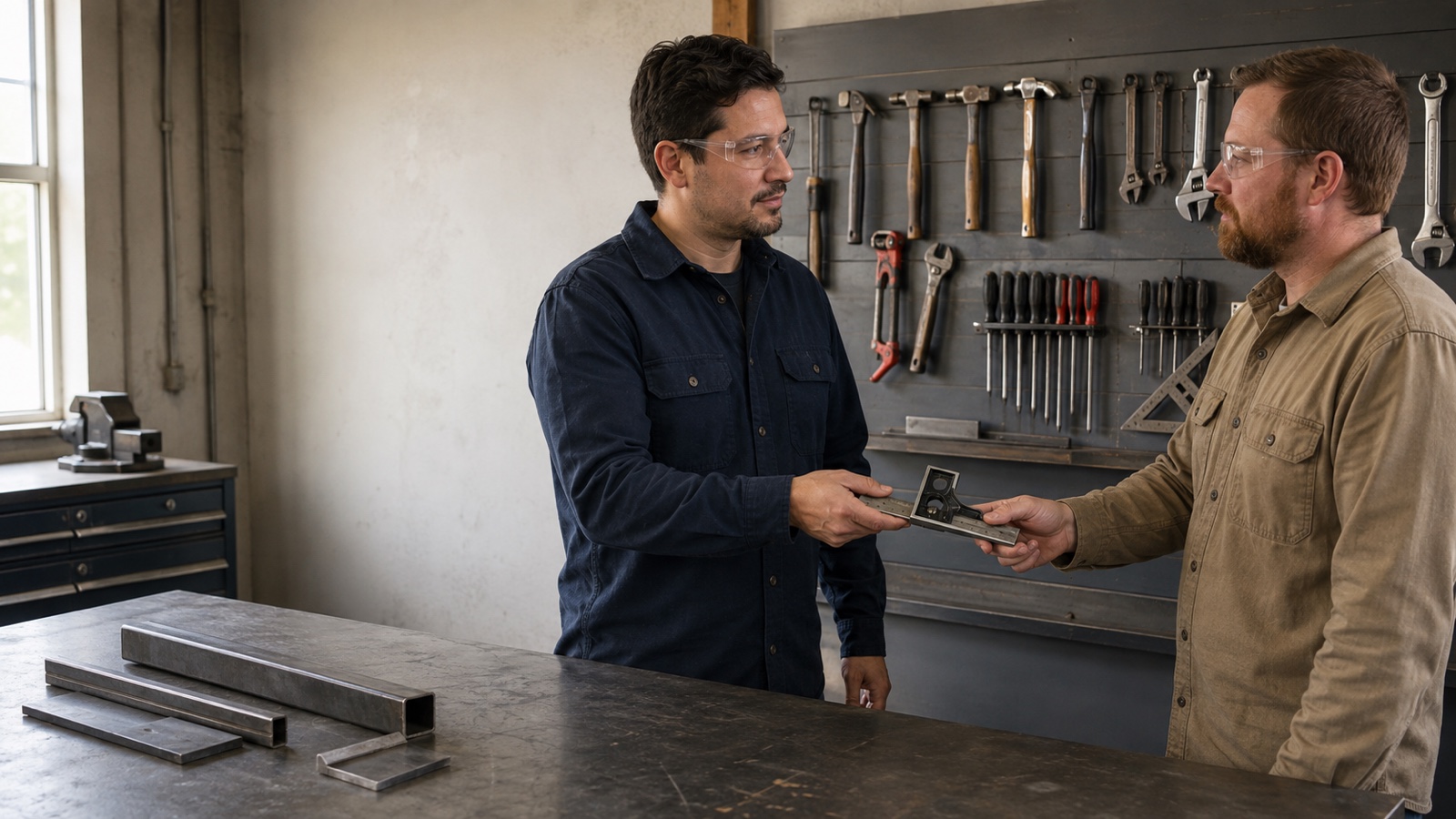
A missing combination square rarely shuts down a welding shop. It does something more irritating. A fitter checks the table, opens the same drawer twice and looks beneath a stack of prints. Someone walks to the saw. Someone else checks the inspection bench. The job has not stopped, exactly, but useful minutes are leaking out of it.
Then comes the question every shop recognizes: “Who had it last?”
The answer matters less than what happens next. A tool returned to its place says the next person’s time counts. A borrowed grinder brought back with a worn wheel and no warning says the opposite. Long before a crew talks about trust in a meeting, it measures trust through hundreds of exchanges this small.
Borrowing Is Part of the Work
Welding is not one tool and one motion. The federal O*NET description for welders includes recognizing and operating hand and power tools, aligning work with squares and clamps, positioning pieces in fixtures or vises, detecting faulty equipment and maintaining cooperative working relationships. That list sounds formal. On the floor, it often looks like one person asking, “Can I use that for a minute?”
Good shops make room for that exchange because fabrication is fluid. The right clamp may be at the next table. A tape gets left beside a layout. The socket needed to adjust a fixture belongs to the person working two bays over. Nobody can carry an entire tool crib on a belt.
Borrowing is not the problem. Uncertainty is.
If a tool has a known home, a known condition and a known route back, the exchange is almost invisible. If any of those are missing, the next task begins with a search. That search is not just an inconvenience. It interrupts concentration, makes people improvise and turns a shared resource into a private mystery.
The Unwritten Rule Has Several Parts
“Put it back” is the short version. The real shop rule is more exact.
Ask before taking a personal tool. Return it to the place it came from, not to the nearest open surface. If it is dull, damaged, empty or behaving differently, say so. Do not quietly replace someone’s carefully chosen setup with the version you prefer. A precision tool, specialty clamp or modified fixture deserves more care than an anonymous shop broom.
The rule also changes with ownership. A company tool crib, a shared fabrication cell and a road welder’s personal box are not the same system. Some shops use shadow boards and sign-out tags. Others depend on labeled drawers and a crew that has worked together long enough to know where everything lives. New people should not be expected to guess. The shop has to make the boundary visible.
There is a useful limit to the old advice about returning a tool cleaner than you found it. Basic cleanup is courtesy. Unapproved sharpening, adjustment or calibration is not. If a tool appears unsafe or damaged, the responsible move is to take it out of use according to the workplace process and report the condition—not perform a mystery repair and slide it back into the drawer.
Courtesy Cannot Carry the Whole System
It is tempting to treat missing tools as a character problem. Sometimes they are a systems problem wearing a familiar face.
If six people share one square, the square will travel. If damaged tools have no marked holding area, they drift back into circulation. If replacements require a week of signatures, people protect worn equipment because it feels irreplaceable. If every flat surface becomes temporary storage, “I left it right there” stops meaning anything.
The federal rules draw a harder boundary than shop etiquette. Under 29 CFR 1910.242, employers are responsible for the safe condition of tools and equipment used by employees. The housekeeping requirements in 29 CFR 1910.22 call for work areas to be maintained in a clean, orderly and sanitary condition. Those obligations do not disappear because a crew has strong unwritten rules.
A dependable shop supports the courtesy rule with a visible system: clear homes for shared tools, a place for damaged equipment, a simple replacement path and enough common tools for the work being asked of the crew. That is not bureaucracy for its own sake. It keeps a small problem from becoming a hunt, an argument or an unsafe shortcut.
What the Habit Says About a Person
The most trusted person in a shop is not always the fastest welder or the one with the fullest box. Often, it is the person whose movements leave the next job ready.
They return the square. They wind the lead without trapping a kink. They tell the owner that the clamp screw felt wrong. If they moved a fixture, they explain why. None of this is glamorous enough for a highlight reel. It is still part of professional craft.
For a new welder, this is good news. Reliability does not begin after years of experience. It begins with observable habits. Ask. Use the tool for its intended work. Notice its condition. Bring it back. Speak up if something changed.
For experienced hands, the same rule carries another responsibility: make it possible for the new person to succeed. Point out which tools are shared, which are personal and where questionable equipment goes. A shop cannot demand an unwritten rule from someone who has never been shown the map.
That is how a borrowed tool becomes more than a borrowed tool. It becomes a small test of how the crew treats time, equipment and one another as shared concerns.
What is the borrowed-tool rule in your shop—and which tool is always the one nobody can find?
For more stories about the habits, humor and people that shape the trade, visit Arc Life.

Leave a Reply