Series: Under the Hood
The hood comes up, the arc goes quiet, and the weld gets its first honest look. In a lot of welding photographs, that is where the story ends.
On the floor, it may only be the point where the next craft begins.
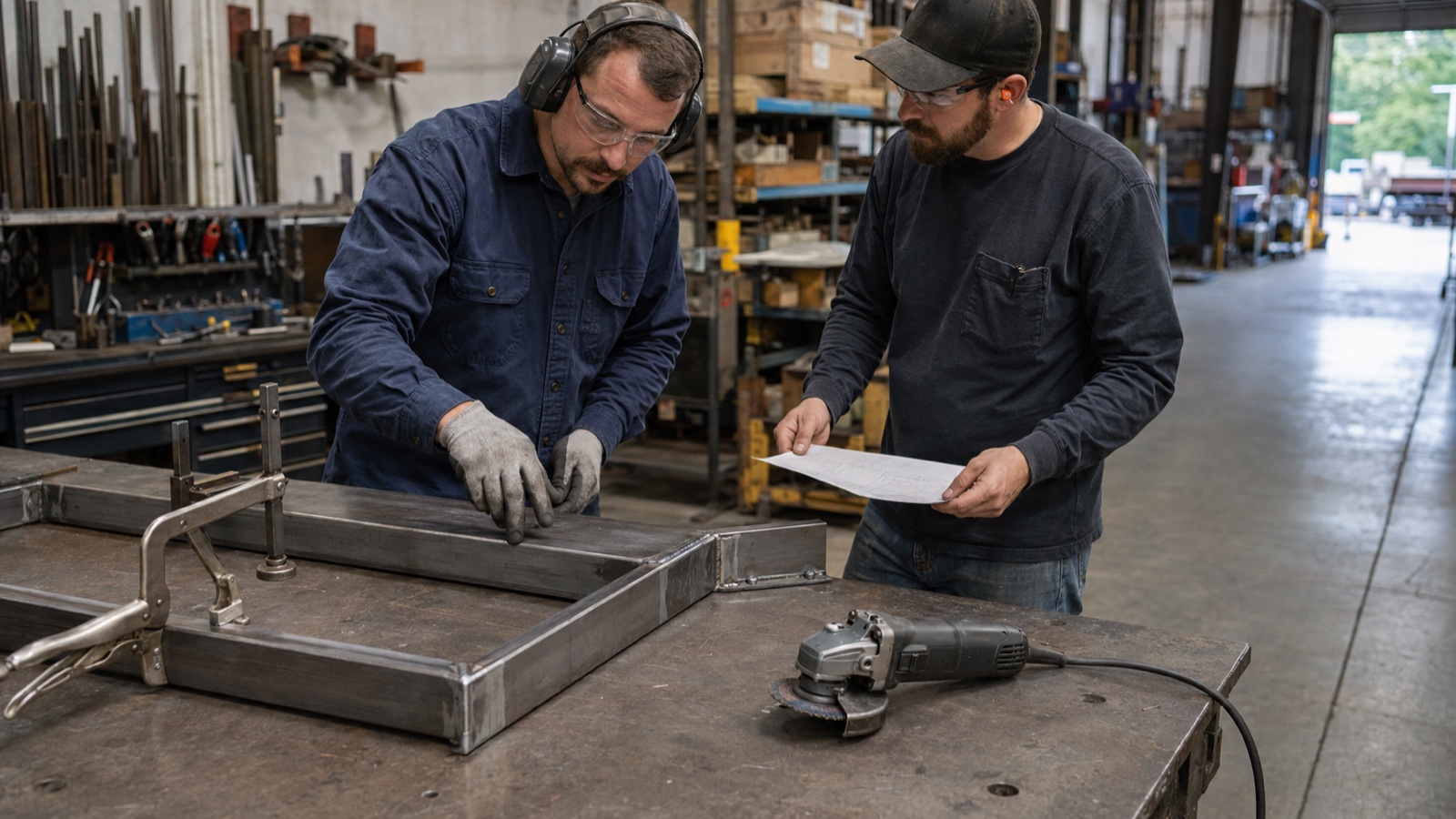
A nearby grinder is waiting. So are a scraper, a file, a wire brush, a deburring tool or a finishing station farther down the line. The part may need spatter removed, an edge eased, a corner blended or a surface prepared for what happens next. Another job may call for the weld to remain exactly as deposited. The difference is not a matter of which finish photographs better. It belongs to the drawing, the service, the shop process and the people responsible for accepting the work.
That is why finishing deserves more respect than the old joke gives it. The grinder is not simply an eraser for the welder. Used with judgment, it is one of the tools that carries fabricated work from “joined” to “ready.”
The trade does not divide neatly at the last ripple
Welding and finishing are often spoken about as separate steps, but the work overlaps in both directions. Edges may be ground so pieces fit before welding. Slag or spatter may be removed afterward. A surface may be cleaned before another operation can begin.
The current O*NET profile for welders makes that overlap plain. Its core tasks include grinding, cutting, buffing or bending edges to help workpieces fit, as well as chipping or grinding excess weld, slag or spatter. The federal occupation profile is useful because it describes the job people actually recognize on the floor: measuring, fitting, welding, checking and finishing are connected pieces of fabrication, not isolated job titles living in separate rooms.
The Bureau of Labor Statistics likewise describes welders as workers who read specifications, measure parts, inspect material, join or cut metal and maintain equipment. The arc is central, but it is surrounded by decisions before and after heat enters the part.
In a small shop, one person may make every one of those decisions. In a production plant, a part may move from fitter to welder to finisher to inspector to coating. Either way, the finished object remembers the handoffs.
A grinder is not an alibi
Every shop knows some version of the line about a grinder and paint making a welder what they are not. It survives because everybody has seen grinding used to disguise hurried work.
The joke misses the harder truth: good finishing is controlled work in its own right.
Removing metal is a decision. So is leaving it alone. A person finishing a visible rail, a painted frame, a repaired machine component or a stainless counter may be aiming at very different conditions. The correct result cannot be guessed from personal taste. A polished transition may be right on one job and an unauthorized change on another.
That puts restraint at the center of the craft. A strong finisher knows where the tool belongs, how the surface is changing and when the job has reached the required condition. They also know when the next move is not another pass, but a question for the lead, drawing, procedure or inspector.
That last choice matters. Speed can hide uncertainty for a few minutes. Steel keeps the evidence much longer.
The work is read through the hands
Finishing has its own kind of attention. The sound changes as the tool crosses an edge. Resistance shifts when it leaves weld metal and reaches the surrounding surface. Reflected light makes a low spot or an uneven blend visible. A gloved hand can follow the shape after the tool is stopped and the part is safe to handle under the shop’s process.
None of those signals replaces the job requirements or a proper inspection. They are the close-range feedback of a person learning how material responds.
That learning is easy to underestimate because a finished surface can look simple. The best work often removes the signs of effort along with the sharp edges and tool marks. A customer sees a clean corner. The crew remembers the awkward access, the sequence that kept the frame square and the patient minutes that made the transition feel intentional.
This is one reason experienced fabricators notice finishers. They understand how quickly an aggressive pass can create a new problem, how long a careless scratch can travel through polishing, and how much discipline it takes to make several surfaces look like one decision.
Familiar tools still demand full respect
Grinding is so common that it can disappear into the background noise of a shop. The hazards do not disappear with familiarity.
A CDC/NIOSH abrasive-wheel safety checklist points shops toward required guards on portable grinders and eye protection for abrasive-wheel operators. It also calls for checking wheel fit and the machine’s spindle speed before use. The exact tool, abrasive, guarding, clothing and protection belong to the manufacturer’s instructions, the workplace hazard assessment and the applicable rules—not to a photograph or a habit carried over from a different job.
There is a cultural point inside that safety language. Respect for finishing includes respect for the energy in the tool. A good crew does not treat removed guards, questionable abrasives, poor positioning or a shower of sparks aimed across a shared aisle as proof that somebody is tough. It treats the setup as part of the work.
The best finish is a good handoff
The welder helps the finisher by leaving honest work and clear information. The finisher helps inspection by knowing which condition must be seen before it changes. Inspection helps the next operation by settling the requirement instead of leaving the crew to argue from memory. Coating, assembly and installation all benefit when the surface arrives in the condition the job actually calls for.
That chain is not glamorous, but it is where a shop builds trust. Nobody has to pretend that every weld should remain untouched. Nobody has to pretend that grinding can rescue any decision. The crew can treat finishing for what it is: a skilled step with limits, consequences and a visible effect on the final object.
The bead may be the moment people photograph. The part still has somewhere to go.
Shop question: What finishing job taught you the most about restraint—and what do new welders usually misunderstand about grinder work?
Arc Life tells the stories around the arc: the people, habits and overlooked skills that make the trade whole. Visit Arc Life for more welding culture and shop-life stories.

Leave a Reply