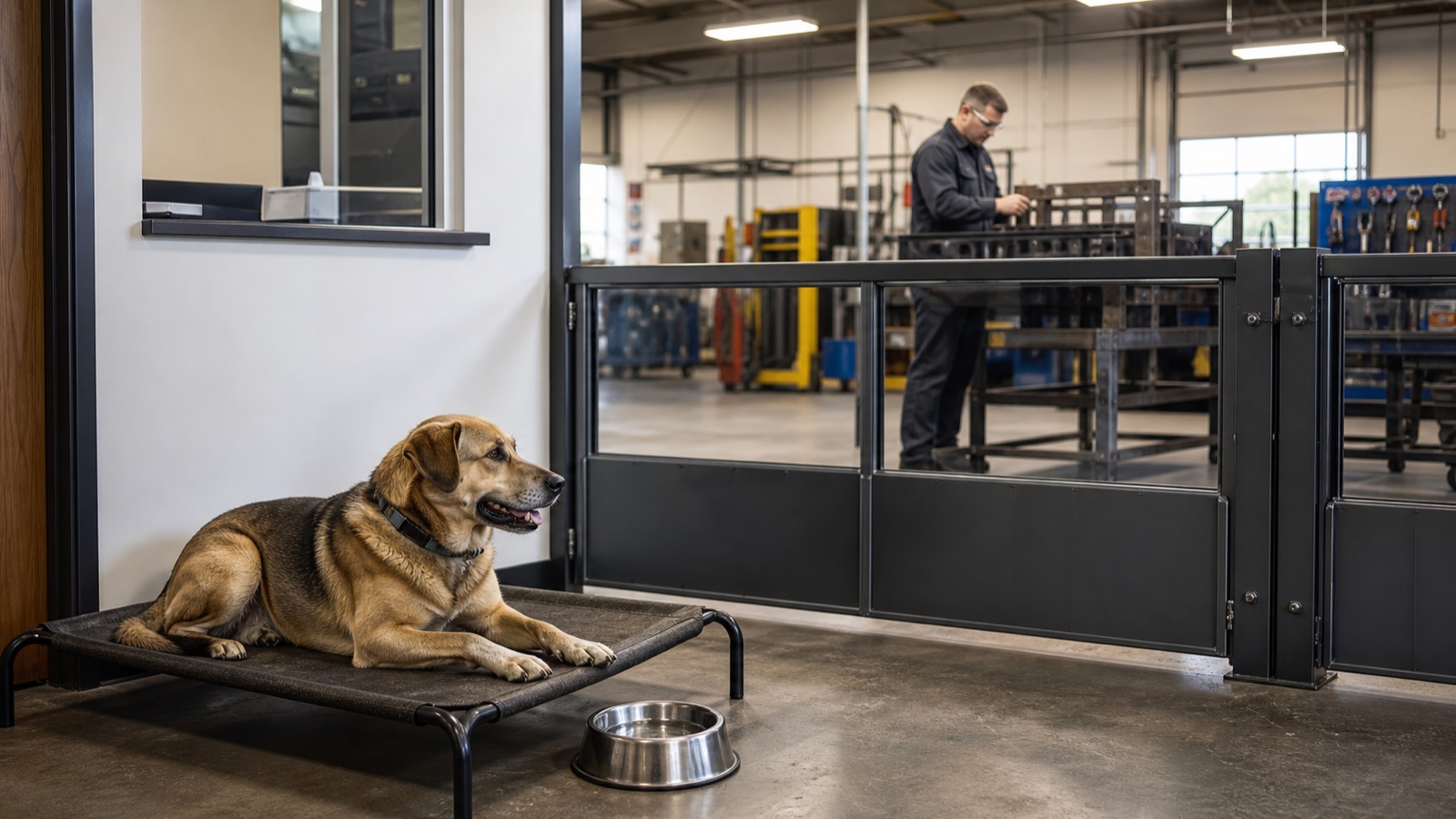
The social-media version of a shop dog is almost too easy to picture: paws stretched under a welding table, sparks in the background, a battered water bowl beside the toolbox. It looks warm, loyal, and unmistakably blue collar.
It is also the wrong picture.
A dog can be part of a shop’s personality without roaming through its active work area. In fact, the clearest sign that a crew truly cares about its unofficial four-legged member is not a good photo. It is a boring, consistent boundary.
That feels worth saying on August 26. National Dog Day, founded in 2004, celebrates dogs of all breeds and calls attention to dogs that need rescue. The day’s official site also honors family dogs and working dogs. Welding shops have their own familiar version: the dog that recognizes the morning trucks, knows who drops food at lunch, and appears when the office door opens.
The best place for that dog is still on the safe side of the door.
The photo and the shop are not the same thing
The shop-dog image works because it softens an industrial place. A dog can make an office feel less corporate, give the first person through the door a familiar greeting, and become part of the routine customers remember. None of that requires the animal to share space with hot work.
The Occupational Safety and Health Administration lists metal fumes and ultraviolet radiation among the health hazards of welding, cutting, and brazing. Its safety-hazard list includes burns, eye damage, electrical shock, cuts, and crushed toes and fingers. OSHA also points to noise exposure, personal protective equipment, ventilation, and fire controls as parts of managing that environment.
Those rules and resources are written to protect people at work. They are not a pet policy. Still, the logic is hard to miss: if trained workers need barriers, PPE, ventilation, and controlled work practices, an animal without those protections should not be inside the active area.
This is not about treating every fabrication shop as the same. It is about recognizing that a dog cannot read a hot-work permit, understand why a plate is still hot, or know that a lead stretched across an aisle is attached to a live job.
If people need PPE, the dog needs distance
Human workers can be trained to stop at a screen, wear the right lens, recognize a lift route, and stay clear of a grinder. A dog moves by sound, smell, habit, curiosity, and the location of its favorite person. That unpredictability does not belong near a process where one quick step can cross a cable, enter a forklift path, or reach fresh-cut steel.
Noise deserves the same clear thinking. OSHA’s general-industry standard requires a hearing-conservation program when employee exposure reaches an eight-hour time-weighted average of 85 decibels. That does not establish a pet limit, and it should not be borrowed as one. It does show that industrial noise is measured and managed—not dismissed as atmosphere.
The right response is not a novelty pair of dog earmuffs and a good caption. It is separation from grinding, air-arc work, hammering, plasma cutting, and other loud operations. Pet-specific health questions belong with a veterinarian; shop access belongs in the shop’s safety plan.
Floor conditions matter, too. OSHA requires walking-working surfaces to stay orderly and free of hazards such as sharp or protruding objects. A well-kept floor protects employees. It also removes fewer chances for a paw to find a sharp drop, a sliver, or spilled material—but housekeeping alone does not turn a production floor into a pet area.
Good shop-dog culture is boring on purpose
A responsible setup does not need to be complicated. The dog has a defined place in the front office, enclosed yard, or another separated area. The barrier closes. Water and bedding stay away from chemicals, oily rags, metal debris, and traffic. Deliveries do not depend on somebody remembering to grab a collar at the last second.
The rule stays the same on slow days. That is important. A dog that is allowed onto the floor while the machines are quiet cannot understand why the same doorway becomes off-limits when the first grinder starts. Consistency is kinder than a rule that changes with the workload.
The crew also resists staging the animal for a dramatic photo near sparks or an open arc. Welding culture already has enough imagery that turns hazards into decoration. A shop dog does not need to be made into another prop.
Some facilities cannot support a dog at all. Customer rules, lease terms, allergies, sanitation requirements, insurance, traffic, or the layout may settle the question before the crew does. “No shop dog” is not anti-dog. Sometimes it is the most honest answer the building can give.
Part of the crew means worthy of a rule
The value of a shop dog is not productivity. The dog is there because people spend a large part of their lives at work, and a familiar animal can make that place feel more human. It can mark the difference between the production floor and the small community gathered around it.
That community owes the dog more than affection. It owes the dog a boundary that does not disappear for a photo, a visitor, or a quiet afternoon.
There is something deeply consistent about that idea. Welders already understand controlled zones. They know the difference between an active booth and a clear aisle, between hot metal and finished work, between a barrier that is inconvenient and one that prevents a bad day. Extending that discipline to a dog is not overthinking the culture. It is taking the culture seriously.
Does your shop have a dog, and what rule keeps it safe? Office only? Fenced yard? Home before hot work starts? Tell us the boundary that actually works—not just the picture that looks good.
Arc Life pays attention to the people, routines, and off-the-clock details that make welding culture recognizable. You can also visit the Arc Life collection, but today’s best piece of shop gear is a closed gate between the dog and the work.
Leave a Reply