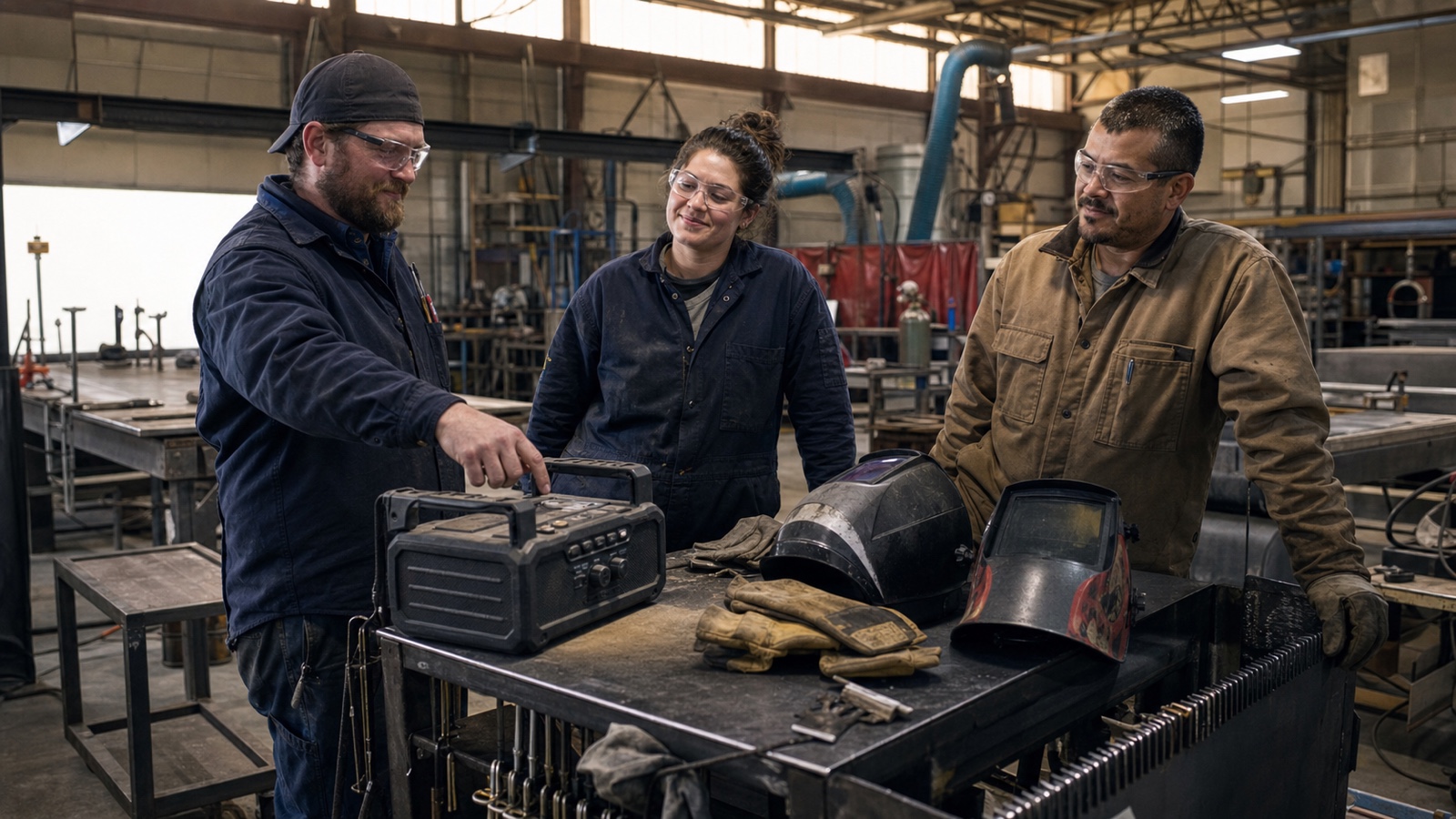
Before the first helmet goes down, somebody usually settles one of the day’s smaller questions: what are we listening to?
The answer might be country before breakfast, old rock after the first break, or a station nobody loves enough to defend. A phone connects. A speaker crackles awake. Somebody asks for one song and gets an entire afternoon of somebody else’s playlist.
The shop radio looks like background noise. It rarely stays that simple. In a shared workspace, music becomes a daily test of judgment: how loud is too loud, who gets a turn, which songs do not belong, and when the radio needs to disappear behind the work.
That is why the person holding the phone is not just picking music. For a little while, they are reading the room.
One Speaker, a Dozen Opinions
A welding crew can agree on a fit-up and disagree completely on the next song.
That disagreement is part of the fun when the crew handles it well. The radio gives people something harmless to argue about between real decisions. Somebody knows every word. Somebody groans at the opening riff. The newest person discovers that one unlikely song can get three generations singing the same chorus.
Nobody has to share a taste in music to share a shift. The better rule is rotation without ceremony. The person who connected first does not own the speaker until clock-out. The loudest opinion does not automatically win. A request is not a challenge to the entire identity of whoever built the playlist.
This is basic give-and-take, but small habits reveal a lot. A shop that can pass control of the radio without turning it into a contest has usually learned something useful about sharing space.
Music Gives the Shift Its Edges
Shop work has its own sounds before the radio joins in: ventilation moving air, a grinder starting and stopping, clamps hitting a table, carts crossing seams in the floor, and short conversations rising above it all.
Music sits inside that rhythm. It marks the quiet setup at the beginning of the day, the middle hours when everybody settles into their work, and the cleanup stretch when tools start finding their way home. A familiar song can make a long repetitive task feel less solitary. A bad selection can make three minutes seem impressively long.
The radio does not make difficult work easy, and it does not create a good crew by itself. It gives the day edges. Years later, a song can bring back a particular shop more quickly than a photograph: the light, the smell of steel dust, the bench you worked at, and the people who were there.
That connection is worth something. So is knowing when nostalgia should stay at a reasonable volume.
The Operator Is Not the Owner
The fairest shop-radio rules are rarely posted. They are demonstrated.
The person running the playlist watches for reactions instead of assuming silence means approval. They skip the song that clearly changes the room. They do not treat every request like an interruption. They understand that lyrics booming across a shared workplace land differently than the same song played alone in a truck.
They also leave room for the coworker who wants less sound, not more. Some people concentrate better without music. Others may be carrying a headache, learning a new task, listening for instructions, or simply tired of the same twenty songs. A respectful crew does not make somebody present a courtroom case to get the volume turned down.
The practical standard is simple: the radio belongs to the room. Whoever touches the controls is taking a turn, not claiming territory.
There Are Times the Radio Loses
The best song of the day still comes second to a job briefing, a handoff, an alarm, a spotter, or a coworker trying to warn somebody. Site rules come first. Required hearing protection stays in place. Personal audio does not get to isolate somebody from the signals and communication the job depends on.
This is not just an etiquette question. The Occupational Safety and Health Administration says employers in general industry must implement a hearing-conservation program when worker exposure reaches an eight-hour time-weighted average of 85 dBA. OSHA points employers toward measuring workplace sound and controlling exposure; guessing by the position of a volume knob is not a noise assessment.
A radio may be the least powerful sound source in the room, but it is still part of the sound environment. If music has to fight the shop to be heard, turning it higher is not proof that the mix is working. It may be proof that the radio has already lost.
Good crews know how to enjoy music without asking it to overpower the work. They turn it down before the conversation becomes a shouting match. They shut it off when clarity matters. Then, when the moment passes, somebody reaches for play again.
Small Rules Build a Shared Place
Shop culture is often described through the big things: standards, output, skill, safety, and the way a crew handles pressure. Those matter most. The smaller customs show how that culture feels on an ordinary Tuesday.
Who gets the radio is one of those customs. The answer says something about seniority, hospitality, patience, and how much room a crew makes for different people. A good setup does not require identical taste. It requires enough awareness to keep the music from becoming another machine one person operates and everybody else endures.
The radio is at its best when it stays in the background but still belongs to the memory of the shift. It carries a little personality through a hard room. It gives people a reason to laugh, complain, request a track, and discover that the quietest welder in the bay knows every word.
So here is the Arc Life shop question: what is the unwritten radio rule where you work—and who actually gets the final pick?
Arc Life covers the habits, personalities, and shared details that make welding more than a process. Read the story behind the community on About Arc Life, or explore the current Arc Life collection.

Leave a Reply