If your MIG wire feed “slips” (you hear clicking, the rolls spin but wire stalls, or the arc keeps cutting out), you’re not dealing with a settings problem first—you’re dealing with a wire-path problem. This guide walks you through a fast diagnosis and a clean troubleshooting path that fixes most slipping feeds in minutes.
You’ll start with the highest-failure consumables and only adjust tension/settings after you’ve confirmed the wire can physically move through the gun.
Where to Buy (Quick Fix Parts)
Most “slipping” wire feed problems trace back to a restriction at the end of the gun or inside the liner, which makes the drive rolls lose traction. The three most likely failed components are:
- Contact tip (burnt, oversized, spattered, or wrong size for wire)
- Gun liner (dirty, kinked, wrong length, worn)
- Drive rolls (wrong groove/type for wire, worn, misaligned)
Top Pick (Primary Fix)
If you need the fastest, highest-probability replacement: start with a fresh contact tip in the correct wire size.

Last update on 2026-10-05 / Affiliate links / Images from Amazon Product Advertising API
Disclosure: As an Amazon Associate, I earn from qualifying purchases.
Backup / Consumable Option
If the problem returns quickly (or gets worse when you straighten the gun lead), the liner is usually the next failure point.
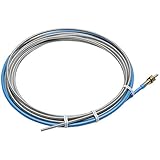
Last update on 2026-10-05 / Affiliate links / Images from Amazon Product Advertising API
Key Takeaways
- Slipping wire feed is usually friction or restriction, not voltage/WFS.
- Replace the contact tip first if there’s any burnback, spatter clogging, or wrong size.
- If the gun lead position changes the symptom, suspect the liner (kink/contamination/wear).
- Set drive-roll tension to the minimum that feeds reliably—too tight causes deformation and adds drag.
- If it’s not fixed in 2–3 minutes, replace the consumable instead of over-adjusting.
Symptoms (Fast Diagnosis)
- Drive rolls spin but wire stalls or surges
- You hear clicking/chattering at the feeder
- Arc cuts in/out like the wire is “skipping”
- Wire shaves or gets flat spots (drive-roll marks)
- Wire feeds fine straight, but slips when the gun lead is curved
- Burnback events increase (wire melts to tip) after feed starts slipping
Root Causes (Mapped to Symptoms)
- Slips worse when the gun lead is bent/looped → liner kinked, dirty, wrong length, or wrong type
- Clicking at feeder + wire shavings → drive-roll tension too high, wrong groove, worn rolls, or misalignment
- Wire stalls at the tip / arc stutters → contact tip clogged, wrong size, or burnback damage
- Feeds fine with tip removed → restriction is at the tip/nozzle area (tip, diffuser, spatter, nozzle blockage)
- Slips more at higher WFS → spool brake too tight, liner friction, or drive-roll traction issue
Quick Fix (Do This First)
Do these in order—fast, high-probability, and low-risk:
- Replace the contact tip (correct size for your wire).
- Clip wire clean and re-thread with the gun lead as straight as possible.
- Back drive-roll tension off, then increase only until it feeds without slipping.
Last update on 2026-10-05 / Affiliate links / Images from Amazon Product Advertising API
Step-by-Step Fix
- Stop and make it safe
- Turn the machine off before opening the feeder or handling the drive rolls.
- Wear gloves and eye protection (ANSI Z87.1 safety glasses under your hood).
- Rule out tip/nozzle restriction (fastest test)
- Remove the nozzle.
- Remove the contact tip.
- Try feeding wire with the gun lead straight.
- If it feeds smoothly with the tip removed, your restriction is likely the tip/nozzle/diffuser area.
- Replace the contact tip (don’t “clean it and hope”)
- If there’s burnback, ovaling, heavy spatter, or the wrong size tip: replace it.
- Unknown (Verify): exact tip-to-wire fit guidance varies by manufacturer—confirm with your gun manual.
- Check drive-roll type and groove
- Solid wire typically wants a V-groove.
- Flux-core often wants a knurled roll (varies by wire type—verify wire manufacturer guidance).
- Make sure the roll matches your wire diameter (e.g., 0.030 in / 0.035 in).
- Set drive-roll tension correctly (minimum effective tension)
- Start low.
- Increase tension only until wire feeds consistently without slipping.
- Too much tension can deform wire, increase liner drag, and create a “feeds bad everywhere” problem.
- Check spool brake / hub tension
- If the spool is hard to pull and the wire “snaps” tight when you stop feeding, the brake may be too tight.
- Set it so the spool doesn’t overrun, but also doesn’t fight the drive system.
- Suspect the liner if the symptom changes with lead position
- If it slips when the lead is curved but feeds when straight, the liner is likely dirty, kinked, worn, or cut wrong.
Parts That Actually Fix This
Liner
Replace when:
- Feed changes dramatically with gun lead position
- You see wire shavings/dust inside the gun
- You’ve had repeated birdnesting or burnback events
Adjust/clean when:
- The liner is new and you suspect contamination from wire dust (blow out per manufacturer guidance; avoid unsafe practices)
Contact tips
Replace when:
- Any burnback, ovaling, heavy spatter clogging, or erratic arc starts
- Wire feels “sticky” through the tip even with the gun straight
Adjust when:
- Tip is correct size and clean, and restriction is clearly elsewhere
Drive rolls
Replace when:
- Groove is worn smooth, chipped, or misaligned
- Correct groove/type still slips at reasonable tension
Adjust when:
- Wrong groove selected or tension is clearly excessive/insufficient
Diffuser / nozzle (when relevant)
Replace when:
- Spatter buildup blocks gas flow and physically crowds the tip area
- Threads are damaged or the tip won’t seat correctly
Replace vs Adjust (Fast Decision Table)
| Problem | Adjust First | Replace |
|---|---|---|
| Wire slips only when gun lead is bent | Straighten lead, reduce drive-roll tension | Liner |
| Clicking at feeder + wire shavings | Reduce tension, confirm correct roll groove/type | Drive rolls (if worn) |
| Arc stutters and wire feels tight at the tip | Remove nozzle/tip and test feed | Contact tip |
| Slips worse at higher wire speed | Reduce spool brake tension, confirm roll traction | Liner (if friction-related) |
Copy table
Rule: If not fixed in 2–3 minutes → replace the consumable.
Prevention Tips
- Keep wire clean and covered; wire dust increases liner drag over time.
- Don’t crank drive-roll tension “just to make it feed”—set the minimum that works.
- Store consumables (tips/liners) dry and organized by wire size to avoid mix-ups.
- Replace tips proactively if you’re doing frequent starts/stops or running hot (burnback risk increases).
- Avoid tight loops in the gun lead during welding; tight bends increase friction and accelerate liner wear.
FAQ
Why does my MIG wire feed slip but not birdnest?
Birdnesting is usually the feeder pushing wire into a restriction until it tangles. Slipping can happen earlier—when the rolls can’t maintain traction due to friction, wrong rolls, or low tension.
How do I know if it’s the liner or the contact tip?
Quick test: remove the contact tip and feed wire with the lead straight. If it feeds smoothly, suspect the tip/nozzle area. If it still struggles—especially when the lead is bent—suspect the liner.
Can drive-roll tension being too tight cause slipping?
Yes. Too much tension can deform wire, increase drag through the liner, and create inconsistent feeding that looks like slipping or surging.
Should I change voltage or wire speed to fix slipping?
Not first. Fix the mechanical feed path (tip, liner, rolls, spool brake) before touching settings. Settings changes can mask the real issue and waste time.
Internal Linking (Add These)
- Read the complete MIG wire feed troubleshooting guide: https://blog.weldsupportparts.com/tag/mig-troubleshooting/
- If you’re getting tangles too, see birdnesting causes and fixes: https://blog.weldsupportparts.com/2026/03/25/why-does-my-mig-wire-keep-birdnesting-fast-fix-in-10-minutes-2/
- If the wire keeps melting to the tip, use the burnback troubleshooting guide: https://blog.weldsupportparts.com/tag/burnback/
- Related symptom: wire feed stuttering fix: https://blog.weldsupportparts.com/2026/03/29/mig-wire-feed-stuttering-fix/

Leave a Reply