Look at a steel arch bridge from the riverbank and the shape seems inevitable. The finished curve has a kind of calm authority. The harder question is how anyone got a collection of individual pieces to meet in that shape before the bridge existed. The Eads Bridge in St. Louis is a lesson in the difference between making a part and making an assembly.
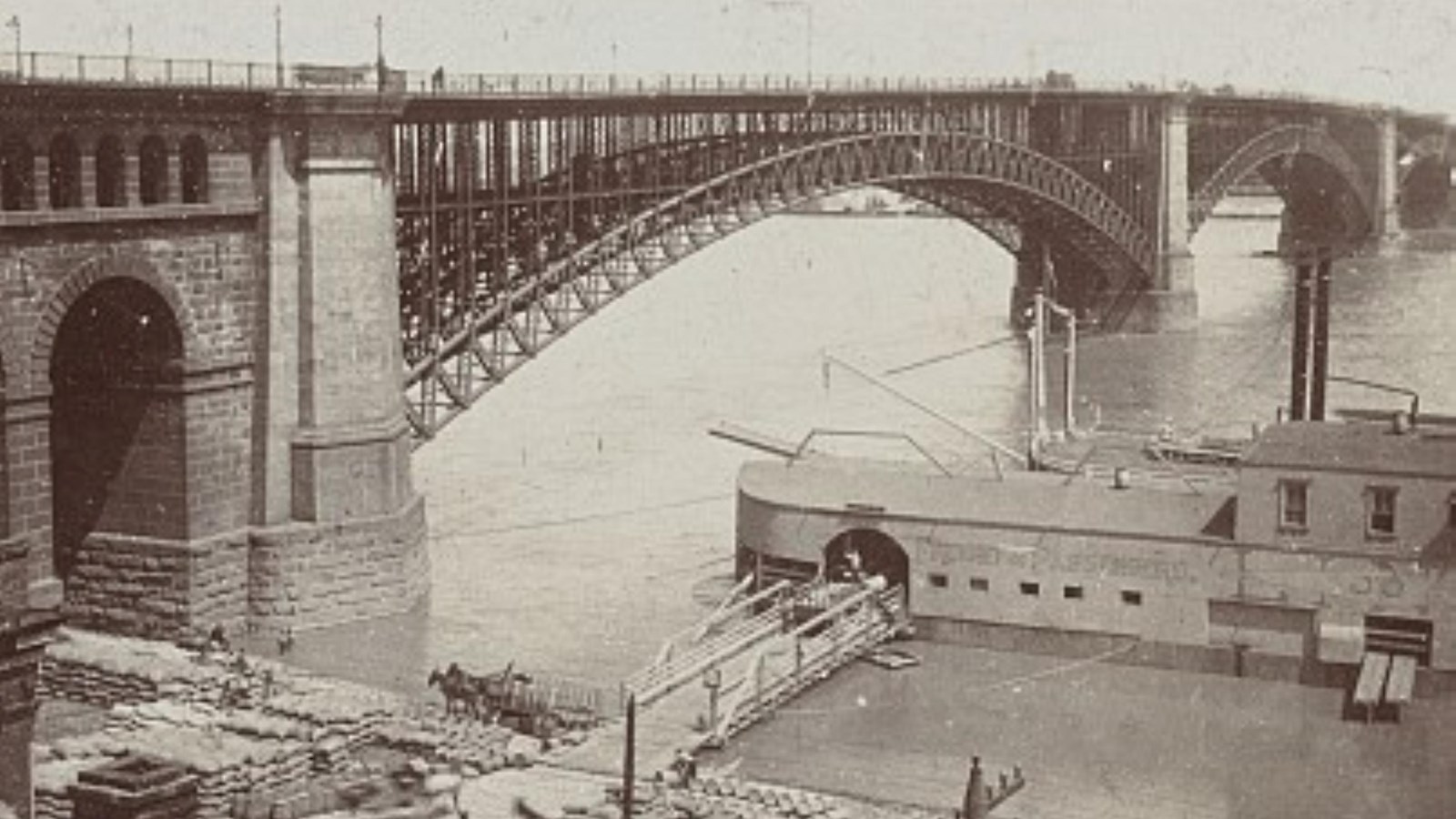
The National Park Service history of the Eads Bridge dates its completion to 1874. James Buchanan Eads was already familiar with the Mississippi from his earlier river work, but building a bridge of this scale was a very different challenge. The project connected two sides of a river and also helped establish an important place for steel in major American structures. It was not a modern welded bridge. The story belongs to a broader history of metalworking, structural engineering, careful fabrication and skilled assembly.
A finished curve starts with separate decisions
The historic National Register nomination, sections 7 and 8, describes three ribbed arches made from steel tubes with wrought-iron bracing. The center and side spans exceeded 500 feet. The arches were erected outward from the piers with temporary supports, and the ends had to meet in the middle. A special threaded connection helped close the arches.
There is a useful lesson in that sequence even for people who never work on a bridge. A piece can be right by itself and wrong in the finished assembly. A part that passes a local dimension check may still be the wrong part, facing the wrong way, or measured from a different reference than the mating component. What makes the assembly work is the relationship between pieces. That requires common drawings, a shared datum, and people who communicate changes while those changes are still manageable.
The parts that disappear below the work
The beautiful arches are what a visitor notices first. Far less visible are the foundations that made them possible. The National Park Service records describe Eads’s determination to place the supports on bedrock and the use of pneumatic caissons for the river foundations. The work was difficult and dangerous. The historic nomination documents serious illness and fatalities associated with work in compressed air.
That part of the story should not be romanticized. A completed landmark cannot compensate for workers who lost their lives. Modern shop practice should never use historic construction methods as a substitute for current safety requirements. People should be able to stop work when a hazardous condition exists, and planning should account for the difficult stages rather than treating them as obstacles to get through at any cost.
The quiet work of quality
A National Park Service 150th anniversary program explained that the decision to use steel encouraged changes in manufacturing and quality control. That connection between design and material supply is familiar to a fabrication shop. A drawing cannot establish that the material sitting on a rack is the material ordered. A promising certificate does not identify an anonymous offcut. A supplier’s label needs to stay connected to the correct stock and job records.
Quality is not only the final inspection. It is a series of smaller decisions made before the final inspection has anything to inspect. The person receiving the metal, the person preparing the job, the person making the part and the person checking the work all contribute. In a well-run shop, the handoff does not rely on the next person guessing the previous person’s intention.
A better way to look at the fit-up table
Think of an ordinary fabrication job: a frame, a bracket, a repair assembly or a fixture. Nobody needs to compare it to the scale of a river bridge to recognize the same problem. If the first two pieces are checked against one datum and the third against a different one, the discrepancy may not appear until the assembly is almost complete. The time saved by skipping an early question can become a long session of rework later.
Good handoffs can be simple. Keep the current approved print with the work. Make sure the part identity and revision are legible. Record a discrepancy instead of silently assuming it will be corrected at the next operation. If a measurement or requirement is unclear, identify who can resolve it. These steps are not a substitute for the engineered procedure; they help people carry it out.
What the bridge leaves us
The Eads Bridge is a reminder that the most impressive objects in the built environment are rarely the product of one dramatic moment. They are the accumulated results of decisions, checks, records, materials and human effort. The completed arches hide most of those decisions from view, but the relationship between the pieces remains visible. When we take the trouble to understand why something fits, rather than simply celebrating that it fits, we learn something about craft.
For more resources that celebrate shop work and help organize the everyday details, explore Arc Life. The best shop story is often the one behind a reliable finished job: a clear plan, people who know the next step, and work that can be handed over with confidence.
Leave a Reply