
This Evolution S355CPSL buying guide starts with the listing variation: ASIN B083Y544ZX is the S355CPSL Gen 1 selection, not the S14CPS Gen 2 or cordless option shown in the same Amazon product family. After confirming the model, compare the saw’s capacity for your stock shape and cutting angle. A 14-inch blade diameter alone does not answer whether the job fits.
The useful purchase question is whether a fixed metal-cutting station fits your work. This is a documentation-based guide, not a hands-on test or a claim that the saw pays for itself. No current price, rating, sales rank or commission estimate is used to justify the recommendation.
Confirm the U.S. saw and the selected generation
Evolution’s U.S. S355CPSL page specifies 120 V, 60 Hz, 15 A and a 1,450 rpm no-load speed. Its blade specification is 14 inches with a 1-inch arbor. Use the U.S. documentation for this U.S. buying decision; do not combine a regional model’s electrical data with a different listing.
The checked Amazon family offers separately labeled generation choices. A change in the selected style can change the product being ordered even when the overall page still looks familiar. Recheck the chosen model, ASIN and package before checkout. This article addresses the Gen 1 S355CPSL only; it does not claim the newer or cordless models have identical specifications.
Read capacity by shape and angle
Evolution lists square-tube capacity of 4-3/4 by 4-3/4 inches at 90 degrees and 3-1/2 by 3-1/2 inches at 45 degrees. The listed round-tube capacities are 5-1/8 inches at 90 degrees and 4-1/8 inches at 45 degrees. Rectangular capacity at 90 degrees is 3-3/4 by 7-1/8 inches. Check the manufacturer’s full chart for the actual shape and orientation.
For an illustrative buying check, a job involving 4-inch square tubing at 45 degrees is not answered by the larger 90-degree capacity. Compare the angled-cut limit instead. Do not plan to overcome a published limit by removing guards, changing the intended holding arrangement or inventing a workaround.
Make a short list of your routine stock before shopping: shape, outside dimensions, wall or section thickness, material and required angle. Include the awkward job that occurs regularly, not only the smallest piece on the bench. A saw that fits most of the cut list but misses a recurring critical item may need to be a secondary tool rather than the main cutting station.
The blade is part of the purchase
The manufacturer lists an included 66-tooth mild-steel TCT blade, an 8 mm hex key and a V-block. Confirm the current seller’s package. Do not assume that the included mild-steel blade establishes suitability for every other material a seller mentions in a product-family listing.
Before buying, identify the correct replacement blade for the actual material, the saw and the manufacturer’s speed requirements. Diameter and arbor are only part of that check. Keep a record of the approved blade designation so the next reorder does not become a guess based on a similar-looking photograph.
Also decide who is responsible for blade inspection and replacement. A purchase budget should account for the consumables and support items the job really needs, without inventing a blade-life estimate. This guide makes no claim about cuts per blade, operating cost per cut or measured finish quality.
A stationary saw needs a planned station
Consider where the stock will approach the saw and where the finished pieces will go. Long material needs suitable support, and a busy aisle is not a substitute for a planned cutting area. Think through handling and workholding using the machine instructions before assuming the saw can simply replace whatever currently occupies the bench.
The station also needs an inspection routine. The cut piece may still need dimensional checking, edge finishing or preparation for welding. A buying claim about clean cutting should never become permission to skip the drawing’s requirements. Compare the complete route from stock rack to accepted part rather than the cutting motion alone.
When this format deserves a close look
- Your material can be brought to a fixed cutting station and held as the manufacturer requires.
- The routine shapes and angles fall within the published capacity chart.
- The appropriate blade system is available for the materials you actually cut.
- You can provide the required electrical supply and a suitable work area.
- The purchase solves a documented workflow need rather than duplicating a tool that already handles the job.
When to compare another cutting method
Installed material, field work and stock that cannot be brought to the station raise a different buying question. A portable saw or another properly selected cutting process may better match the access problem. Material that exceeds the stated capacity likewise calls for a suitable machine or process, not a more optimistic reading of the blade diameter.
For a format comparison, the WSP guides to the DEWALT D28715 abrasive chop saw and DCS374B portable band saw address different blade systems and workflows. Those guides are comparison resources, not evidence that one machine is universally superior.
Check support before the order is placed
Verify the seller, return conditions, applicable manufacturer warranty and availability of the correct manual and replacement parts. Keep purchase documentation and the machine identification. Do not assume every seller, region or refurbished package receives the same support simply because the listing contains the same brand name.
Confirm package contents separately from optional accessories. A photograph may show a work setup rather than every item supplied. Resolve questions about stands, spare blades and other equipment with the current seller before ordering; this guide only identifies the manufacturer-listed items above.
Exact Amazon listing
As an Amazon Associate I earn from qualifying purchases.
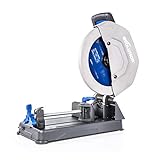
- Metal Cutting Saw – Equipped with a 15 Amp motor and a lightweight pressed steel base, the S355CPSL is designed for portability. The integrated chip deflector directs debris away from the operator for easier cleanup.
- Dry-Cut Technology for Cool, Burr-Free Cuts – Featuring a premium tungsten carbide-tipped blade, this chop saw cuts mild steel efficiently with minimal heat and sparks, leaving a smooth, instantly workable finish. Ideal for professional, clean metal cuts.
- Adjustable Miter Saw with 0-45° Angle Cuts – Easily make precise angled cuts with the cast steel vise and fence. The quick-release mechanism securely clamps workpieces for fast, accurate results, enhancing cutting precision.
- Versatile Blades for Multiple Materials – Optimize your cuts with Evolution’s range of saw blades, including options for mild steel, thin steel, aluminum, and stainless steel, tailored for high-volume and continuous use.
- 3-Year Warranty & US-Based Support – Built to last, this heavy-duty metal cutting saw is backed by a 3-year warranty and reliable US-based customer service, ensuring peace of mind with every purchase.

Last update on 2026-10-12 / Affiliate links / Images from Amazon Product Advertising API
Bottom line: buy the S355CPSL only after the Gen 1 listing, U.S. electrical specification, actual stock shapes, blade choice and station requirements line up. Arc Weld’s current catalog search did not return this exact model, so this guide uses the verified Amazon buying path rather than an unrelated Arc Weld substitute.
Featured photograph: a garage exhibit by Elmer Cañas via Unsplash. It is contextual workshop imagery and does not show the Evolution S355CPSL or a tested cutting setup.
Leave a Reply