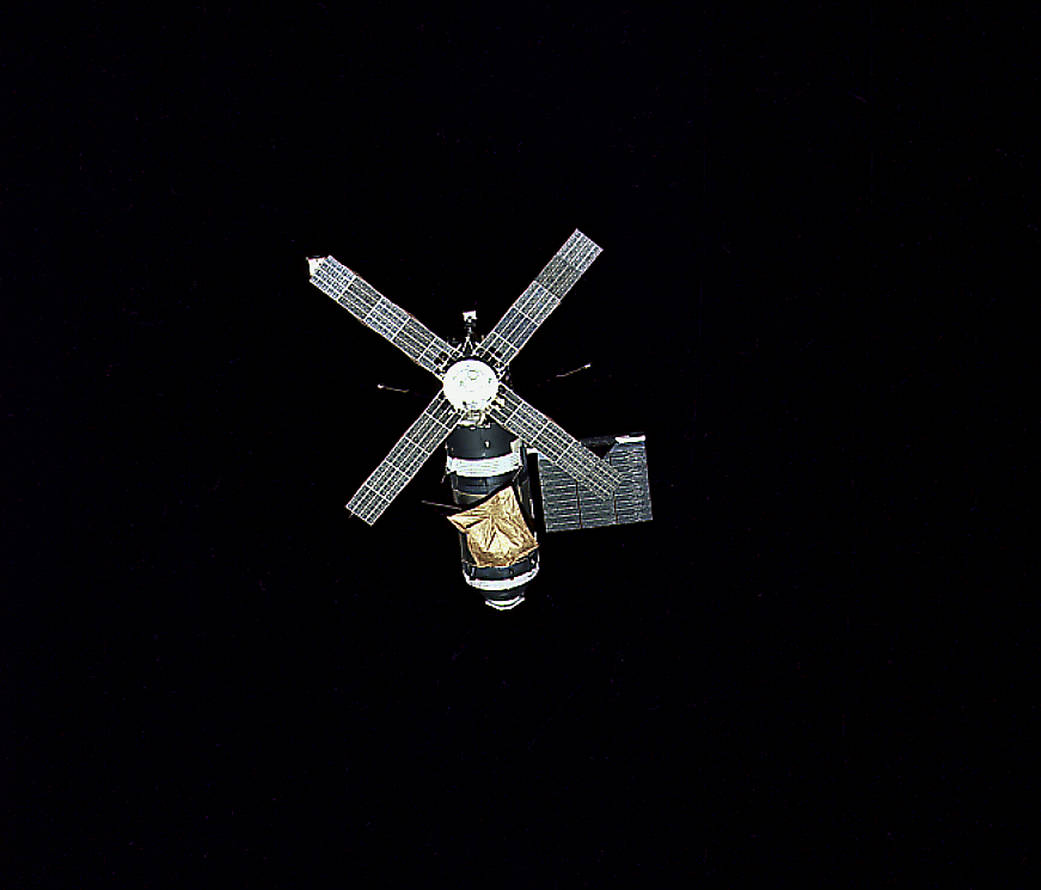
Featured photo: Skylab in orbit in June 1973. The station hosted early orbital metal-melting and welding experiments. Image: NASA/MSFC. This exterior view does not show welding taking place. Photo source.
What happens to a weld pool when gravity no longer pulls it downward the way it does in a shop? Can an operator handle a welding tool outside a spacecraft? And how do you prove a joint-making process is dependable when another repair trip may be impossible?
Those questions have occupied welding researchers for decades. The early experiments were small compared with the space structures people imagined building. Their importance came from what they tested: whether familiar manufacturing processes would still behave predictably in an unfamiliar environment.
For welders, this history offers something more useful than a collection of space firsts. It shows how careful preparation, controlled trials, and close examination of the finished metal help turn an ambitious idea into a process someone can trust.
1969: Take the experiment into orbit
NASA's historical account of the October 1969 Soyuz missions describes a specific task for Valeri Kubasov aboard Soyuz 6: operating the Vulkan apparatus to conduct vacuum-welding experiments inside the spacecraft's orbital compartment. Soyuz 6 launched on October 11 as part of a series involving three crewed spacecraft. NASA's Soyuz mission history places the welding work within that larger flight program.
A later NASA technical report on space welding explains that Vulkan was an automatic apparatus used to compare electron-beam, low-pressure plasma, and consumable-electrode processes. It was an experiment with selected methods and specimens, rather than an astronaut taking an ordinary shop welder outside and improvising a repair.
That distinction matters. Testing the process was the work. Before welding could become a construction or maintenance tool in orbit, researchers needed evidence about which methods deserved further development.
1973: Skylab studied the metal itself
The United States followed with welding and related materials-processing experiments aboard Skylab in 1973. The M551 Metals Melting Experiment used an electron beam and a chamber in the M512 apparatus to process rotating metal discs of varying thickness.
The original NASA M551 report identifies aluminum 2219-T87, 304 stainless steel, and pure tantalum as the three materials. Researchers wanted to observe molten-metal behavior, compare solidification in low gravity with results on Earth, and investigate whether metals could be joined in space.
One concern was that the electron beam could push the molten metal away when gravity was no longer holding it in place. The experiments showed the importance of surface tension in keeping the molten material together. They also revealed differences in grain structure between some flight and ground specimens.
A small disc could therefore answer a large question. The researchers did not need to assemble a complete space station to begin learning whether the weld pool would cooperate.
The work continued after the metal cooled
The flight experiment was only part of the job. A 1973 NASA contractor report on the M551 discs describes visual examination, nondestructive examination, metallography, and post-test measurements used to compare the space and ground samples.
That sequence is familiar to anyone who has waited for a test coupon to be cut, prepared, and evaluated. Making the weld creates the specimen. Examination establishes what happened to it.
Space-welding history is easy to tell as a string of dramatic moments: a launch, a glowing joint, a person outside a spacecraft. The less visible work is just as important. Samples must be organized, measurements interpreted, and apparent successes tested against the original question. A convincing photograph cannot provide all of that evidence.
1984: Put the tool in an operator's hand
The next major step brought the human operator outside. NASA's 1984 astronautics chronology records Svetlana Savitskaya performing welding and soldering during her July 25 spacewalk, when she became the first woman to walk in space.
The technical challenge extended beyond producing heat. NASA's space-welding development report describes the Universal Hand Tool used at Salyut 7 as a hand-held electron-beam gun connected to a power-control module. The activity involved welding, cutting, brazing, and coating tasks. The report says preparation required approximately three months of crew training.
For the welding community, that preparation is a meaningful part of the story. A capable tool still needs an operator who can work with it under the conditions of the job. Reach, visibility, movement, and the sequence of tasks become part of the process, especially when a spacesuit and spacecraft replace a welding booth.
Why the story did not become routine space construction
Successful demonstrations did not immediately create an everyday orbital welding trade. NASA's 2023 review of space welding describes a long slowdown in further in-space demonstrations, with much of the subsequent microgravity research moving to drop towers and parabolic aircraft flights.
The review also explains why the environment keeps demanding attention. Gravity, pressure, and temperature vary across orbital, lunar, and planetary settings. Evidence from one test configuration needs to be understood within those conditions before it can support another application.
This is a useful way to read any impressive welding milestone. A demonstration can establish that something is possible while leaving reliability, inspection, operating limits, and practical deployment for later work. Each step has value without needing to be presented as a finished production system.
New research follows a familiar pattern
In August 2024, NASA and Ohio State researchers performed high-powered laser-welding experiments aboard an aircraft flying reduced-gravity maneuvers. NASA's account of the collaboration describes a portable vacuum chamber, instrumentation, computer modeling, and a team that included students, professors, and NASA engineers.
These were aircraft experiments simulating aspects of space conditions, not welds made in orbit. Keeping that distinction clear makes the progress easier to understand.
A June 2026 NASA research summary describes further work on thermal-vacuum testing, robotic laser welding, fit-up, autonomous operation, and inspection. The problems have become more detailed, but the approach remains recognizable: define the joint and environment, develop the equipment, test it, inspect the result, and improve the process.
A place for practical curiosity
The lasting appeal of orbital welding is that it connects an extraordinary setting with recognizable craft. Someone still has to ask whether the parts fit, whether the equipment behaves as expected, and whether the metal did what the team needed it to do.
You do not have to work on a spacecraft to appreciate that discipline. It belongs in the habit of asking a better question, making a useful test, and paying attention to the result. For another connection to the trade beyond the workbench, visit Arc Life.
Leave a Reply