As an Amazon Associate, we earn from qualifying purchases.
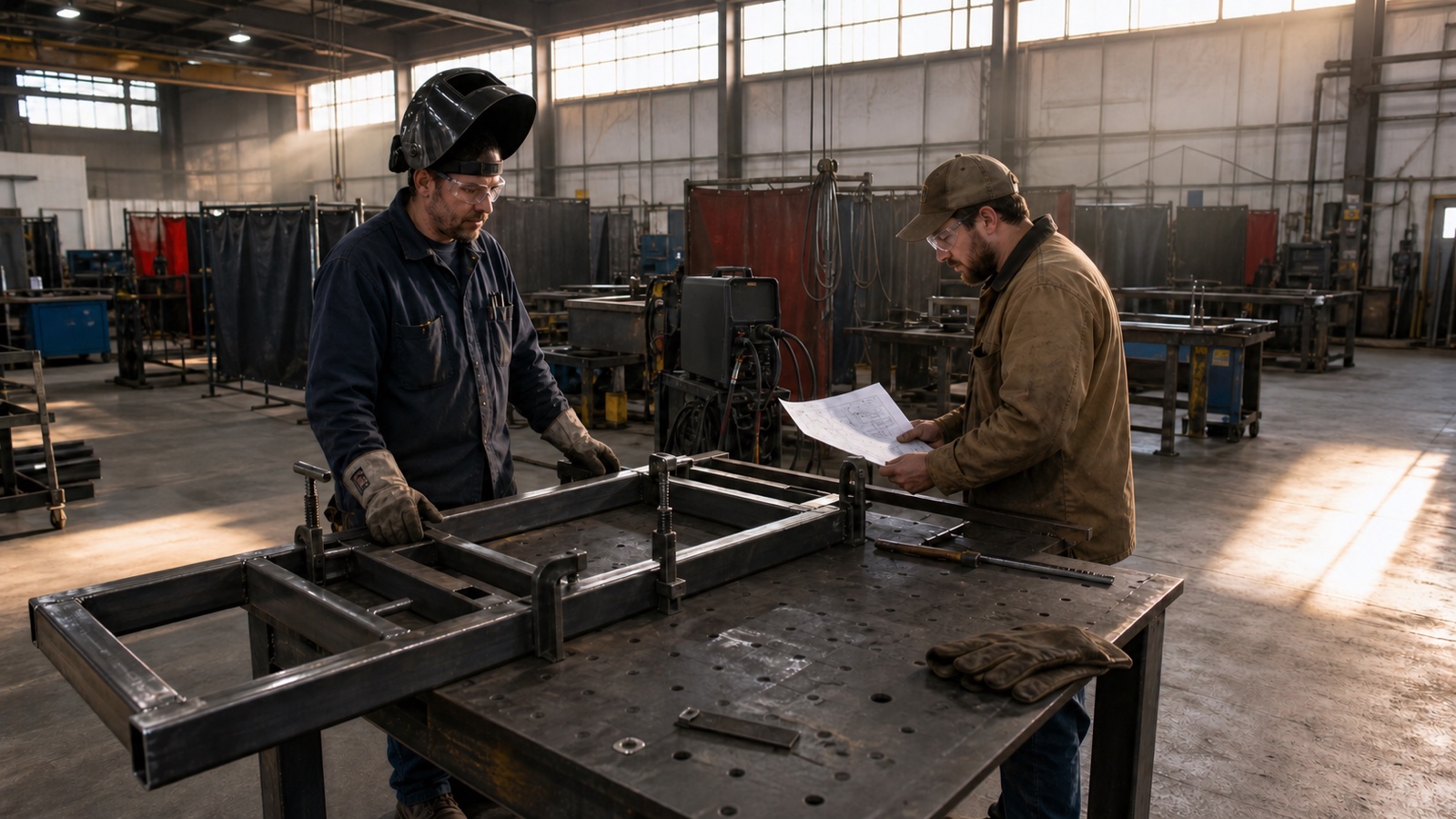
Featured image: contextual fabrication-shop planning. The JET J-41002 is not pictured.
The JET J-41002 is worth a closer look when small metal parts repeatedly need edge cleanup, shaping, or finishing at the bench. It combines a 2-by-42-inch abrasive belt with an 8-inch disc, giving a fabrication shop two working surfaces in one machine.
The important buying question is whether that arrangement fits your parts and workflow. This source-based guide uses JET's specifications, its operating manual, and the matching Amazon listing. It does not claim hands-on testing, measured removal rates, or a guaranteed production improvement.
Identify the machine before comparing offers
The model is J-41002, historically stock number 577004 and currently identified by JET as JT9-577004. The matching Amazon ASIN is B003J69ET0. Amazon identifies the machine as the 3/4-horsepower, single-phase 115-volt version, with manufacturer part number 577004.
That matters because JET sells several similarly named belt-and-disc machines. Confirm the complete model and belt size rather than ordering from a brand name or a thumbnail alone.

- Cast iron construction and heavy-duty steel base
- Deluxe miter gauge turns and locks for common angles, 45 degrees both left and right
- Abrasive belt removes material and finishes at the same time, allowing the operator to get into small openings
- Removable platen allows for sanding, grinding, or finishing of outside curves or odd shaped work pieces on the belt
- Adjustable dust deflector and dust chute
Last update on 2026-10-11 / Affiliate links / Images from Amazon Product Advertising API
The specifications that affect the buying decision
JET lists these specifications for the J-41002:
- Belt: 2 inches wide by 42 inches long
- Belt speed: 3,100 surface feet per minute
- Disc: 8 inches in diameter, running at 3,450 rpm
- Motor: 3/4 horsepower, 115 volts, single-phase, 6.2 amps
- Belt table: 10 by 6 inches
- Disc table: 10-3/4 by 7-1/2 inches
- Assembled dimensions: 20-1/2 by 22-3/4 by 20 inches
These figures come from JET's product specifications. They describe the machine, not a universal maximum workpiece size. Part shape, support, access, and the operator's ability to control the work still matter.
When a bench machine is a useful upgrade
Consider the J-41002 when you can bring the workpiece comfortably to the machine and when a table-supported operation suits the part. Small fabricated components are a more natural starting point for evaluating this format than a large welded assembly that must remain on the floor.
Our buying recommendation is to gather three representative parts before choosing any bench sander: the item you finish most often, the most awkward shape, and the part with the strictest dimensional requirement. Think through how each would be supported and where your hands would be throughout the operation.
That exercise is more useful than deciding solely from horsepower. A machine can have adequate power and still be inconvenient because a flange obstructs access or the part cannot rest securely on the available table.
Fixed speed is an important tradeoff
JET specifies one belt speed for this model; the documented machine does not offer a user-adjustable speed control. Treat that as a selection constraint if your work depends on slowing the abrasive for delicate edges or heat-sensitive materials.
Norton explains that belt speed, grinding pressure, available horsepower, and abrasive choice all affect the result. Speed influences heat, cutting behavior, and finish; increased pressure also affects heat and surface quality. Norton's belt-grinding technical guidance
The practical implication is to match the machine to the process you need. Do not assume a finer belt provides the same control as variable speed. If adjustable speed is a requirement on your job list, compare machines with that capability before committing to the J-41002.
What the listed package includes
Amazon's product information lists one belt/disc sander, a miter gauge, dust-chute hardware, three hex wrenches, a 100-grit abrasive belt, and a 100-grit abrasive disc. That is the identified package for ASIN B003J69ET0; do not assume a stand, dust collector, or assortment of additional abrasives is included.
JET's manual describes assembly and setup, including fitting the tables and checking alignment. Budget time for this before the first job. A delivered machine is not the same as a fully prepared workstation. J-41002 operating manual
Choose abrasives for the actual material
The supplied grit should not determine every job you put through the machine. Identify the material, the amount of stock to remove, and the finish required, then select compatible abrasives.
Norton's fabrication guide distinguishes coated-belt choices by application. It identifies aluminum oxide for general-use and maintenance work, with other formulations suited to demanding alloys and particular grinding conditions. That supports a material-specific purchasing approach rather than assuming one belt type is best for all metalwork. Norton abrasive-selection guide
For your budget, include replacement belts and discs in the dimensions this machine requires. Compare the cost of finishing an acceptable part, including changes and rework, instead of comparing only the price of an individual abrasive.
Plan dust control before bringing it into the shop
JET explicitly warns that combining wood dust with metal filings can create a fire hazard. Its manual also requires appropriate protective equipment, guards, and safe work practices. It prohibits gloves during operation and directs users to unplug the machine for adjustments and maintenance. Use the downward-moving side of the disc and maintain the manual's maximum 1/16-inch table-to-abrasive gap. JET safety and setup instructions
Dust collection requires more thought than finding a hose that fits. OSHA documents combustible-metal-dust hazards in grinding and deburring work, including an installation that required equipment specifically designed for the metal dust involved. Get suitable guidance for your material and collection system; do not infer that an ordinary woodworking collector is appropriate. OSHA's metal-dust case study
Check the total setup, then decide
Before ordering, account for the machine, suitable bench space, abrasives, dust control, and any setup supplies you need. Check the current seller and return conditions, and confirm warranty details for the actual offer. JET lists a two-year warranty for this model, subject to its terms.
Our recommendation is conditional: put the J-41002 on your shortlist for table-supported small-part work when its fixed-speed format and footprint fit the shop. For frequent speed changes, awkward large assemblies, or a process requiring different support, keep comparing. The best purchase is the machine that fits the work you repeatedly do.
Leave a Reply