WorldSkills welding competition results get attention because they come with medals. The bigger story is the system behind the medal: standards, coaching, repeated practice, time pressure, inspection, and the willingness to have skilled work measured in public. At the 48th WorldSkills Competition in Shanghai, held September 22–27, 2026, U.S. welding competitor Mikala Sposito earned bronze.
Sposito’s path also marked a milestone. The American Welding Society and SkillsUSA announced in April that she was the first woman selected to represent the United States in Welding at WorldSkills. Her result is worth recognizing, but the useful lesson for the wider trade is not limited to one competitor. Skills competitions show how a developing welder can move through a visible ladder of training, feedback, and higher expectations.
The path starts before the international stage
AWS describes a five-stage route from SkillsUSA competition toward WorldSkills selection. The details of a competition environment differ from production work, but the development model is familiar to any strong shop or training program: define the task, establish the standard, practice under realistic constraints, inspect the result, correct weaknesses, and repeat.
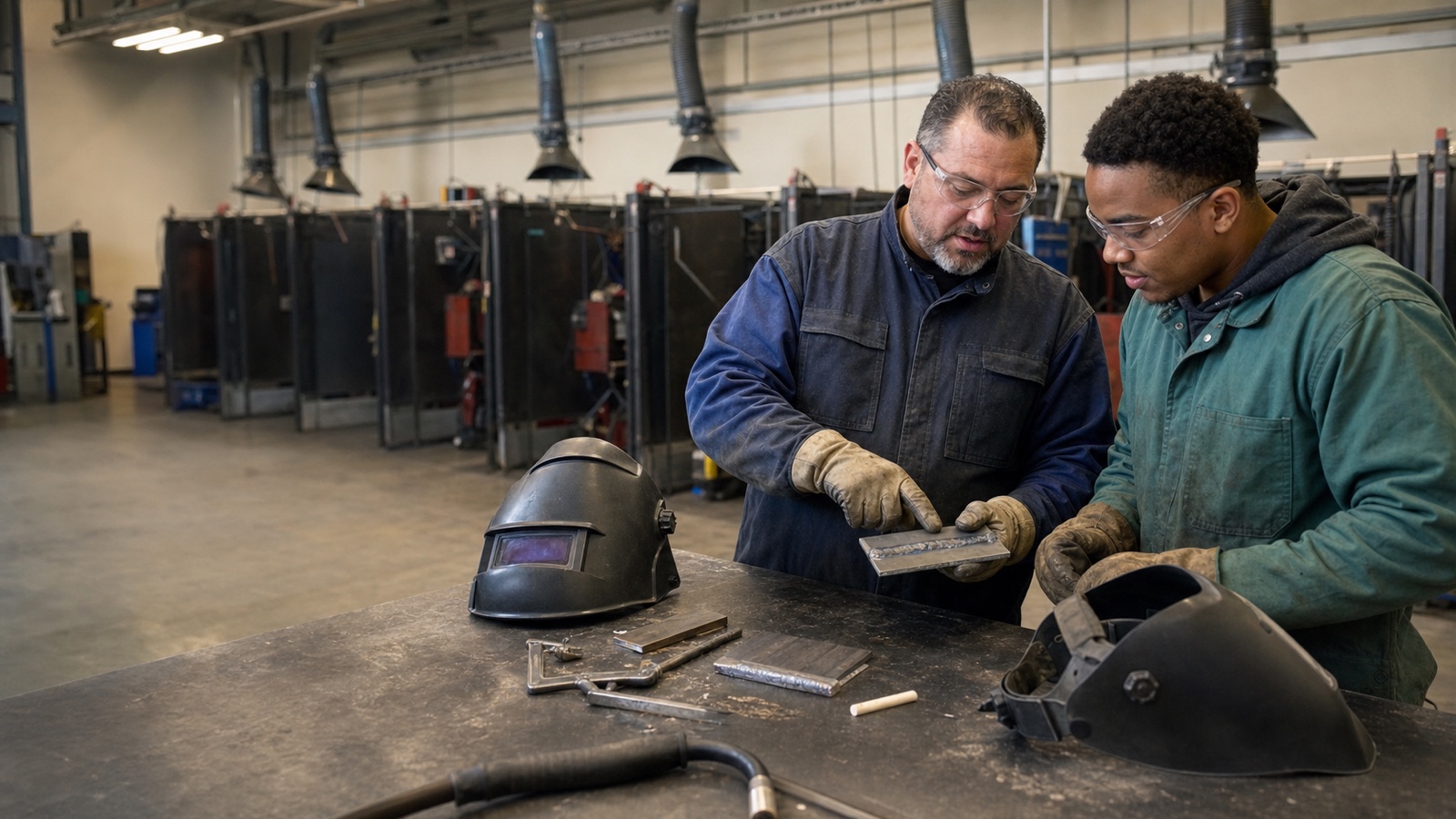
That process matters because welding feedback can become vague very quickly. “Looks good” or “needs work” does not tell a student what to change on the next attempt. A scored task forces the criteria into the open. Fit-up, dimensions, process control, workmanship, sequencing, time management, and consistency can all become specific coaching points.
Deliberate practice is different from simply burning rod
AWS’s 2026 Global Skills Challenge in Alabama was built around WorldSkills preparation. The program described guided equipment familiarization, approximately 18 hours of structured timed simulations, skills evaluation aligned with WorldSkills expectations, and individualized performance feedback. The point was not merely to accumulate arc time. It was to connect repetition to measurement and correction.
A school lab or fab shop can borrow that idea without turning every day into a contest. One practice session might focus on starts and stops. Another might measure fit-up and distortion. A third might require the welder to plan setup, consumables, joint access, and inspection before the arc starts. The work improves faster when each repetition has a purpose.
Competition habits can become shop habits
The strongest competition habits are ordinary professional habits under pressure. Read the requirements before starting. Prepare equipment instead of improvising halfway through. Keep the work area organized. Accept inspection. Make a correction without hiding the mistake. Finish within the available time without skipping safety or quality checks.
Those habits transfer because a good production shop also depends on repeatability. A welder may never stand on a WorldSkills podium, but the ability to produce work against a known standard, explain a setup decision, and respond to inspection is useful almost anywhere the trade is practiced.
Visible pathways matter for the next generation
SkillsUSA and WorldSkills give young tradespeople a visible next step. A student can see that welding connects to instructors, industry mentors, state and national programs, international standards, employers, inspection, engineering, automation, and long-term technical careers. That is a stronger message than treating welding education as a short path from a practice booth directly to a job opening.
Sposito’s 2026 selection and bronze medal also make the pathway visible to people who may not have pictured themselves at the highest levels of welding competition. Representation matters most when it is attached to real work, real standards, and a real route into the craft.
What instructors and shops can borrow now
- Give learners a written standard for the task instead of relying only on verbal feedback.
- Use timed practice occasionally to expose setup and decision-making problems, not just travel-speed problems.
- Inspect finished work against the stated criteria and explain why each correction matters.
- Have experienced welders demonstrate how they plan the job before they strike an arc.
- Track improvement across attempts so progress is visible.
- Treat safe setup, housekeeping, documentation, and inspection as parts of welding skill rather than extras around it.
The craft is bigger than the podium
A WorldSkills bronze medal is a major achievement. The more durable lesson is the structure that makes high-level performance possible: standards, coaching, repetition, feedback, and a clear next step. Those are the same ingredients that help a new welder become dependable in a school lab, apprenticeship, maintenance department, or fabrication shop.
That is also the side of welding culture we want to keep documenting through The Welders Life: not only finished beads and finished products, but the people, mentors, practice routines, and milestones that keep the craft moving forward.

Leave a Reply