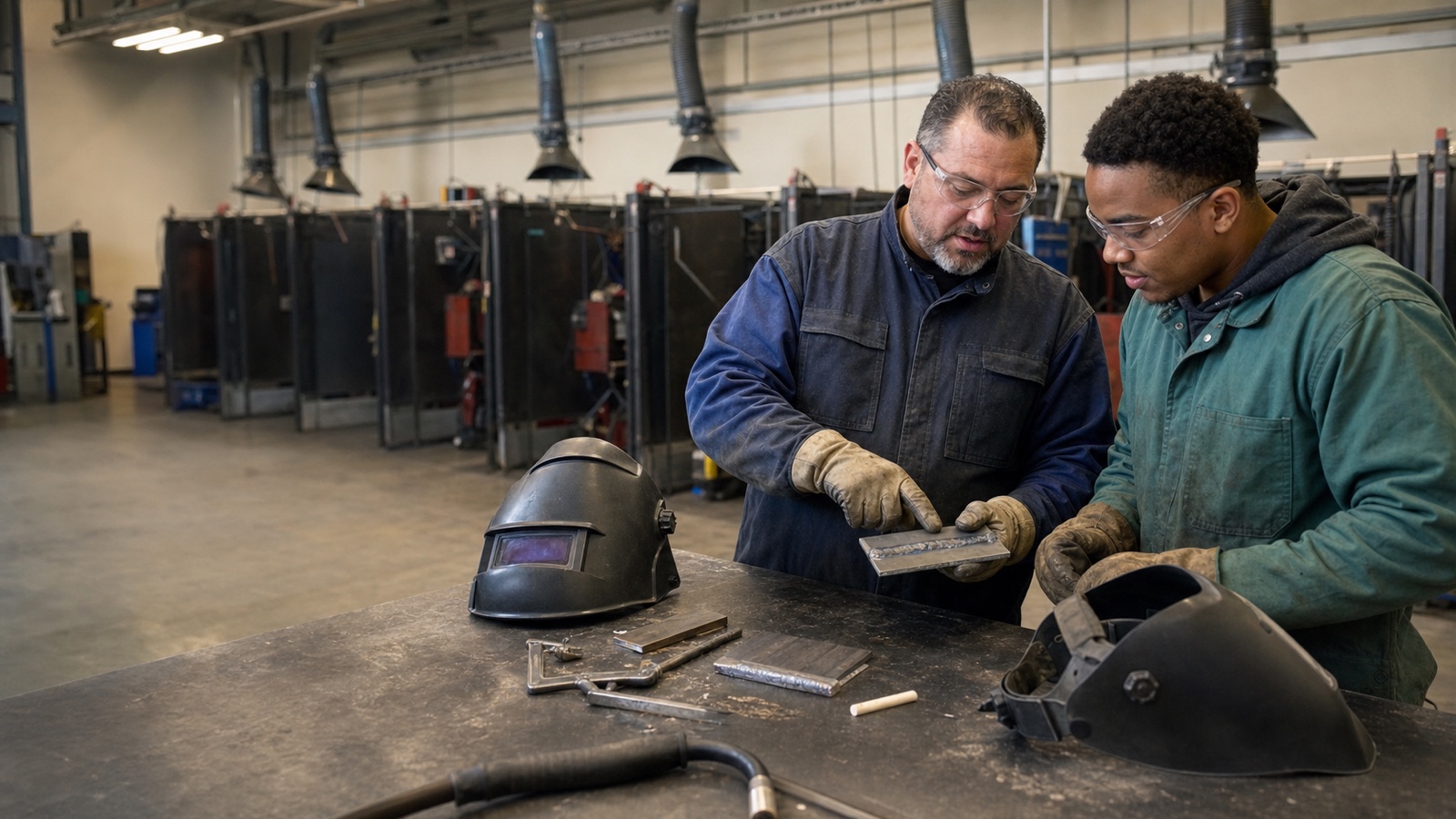
A welding apprenticeship fits the trade for a simple reason: welding skill is built by connecting instruction to repeated work under real constraints. A person can learn theory in a classroom and practice beads in a booth, but the trade also demands fit-up, sequencing, material handling, drawings, equipment care, safety habits, communication, and the judgment to know when something is outside the procedure. Registered apprenticeship is designed around that combination of paid work and structured learning.
What a Registered Apprenticeship actually is
The U.S. Department of Labor describes apprenticeship as an industry-driven career pathway that combines paid work experience, classroom instruction, and a portable, nationally recognized credential. A Registered Apprenticeship Program is a program validated by the Department of Labor or a State Apprenticeship Agency and built around defined standards for the occupation.
That structure matters because “learning on the job” can mean very different things from one shop to another. In a registered program, the employer or program sponsor is not simply hoping a new worker picks things up by watching. The program is expected to connect work experience with related instruction and progression toward occupational competence.
Why welding benefits from learning in context
Welding is full of details that make more sense when they are attached to an actual job. A drawing symbol stops being abstract when it changes which side of a joint gets welded. Electrode storage matters differently when a low-hydrogen procedure is controlling a real repair. Distortion becomes more than a textbook topic when the assembly no longer fits after the first passes. The same is true for joint preparation, consumable identification, shielding gas, preheat, interpass control, inspection, and rework.
A good apprenticeship does not replace theory with “the way we have always done it.” It gives theory a place to land. The apprentice sees why a procedure exists, then repeats the work until the setup and checks become deliberate habits rather than memorized steps.
Paid work changes the learning relationship
The paid-work component is one of the defining features of apprenticeship. The apprentice is not only a student observing a trade; the person is becoming part of the production system while still developing skill. That creates a different kind of responsibility. Time, quality, material, safety, and communication all matter because the work has consequences beyond a classroom exercise.
It also gives employers a reason to build training around the work they actually perform. A structural shop, pipe contractor, maintenance department, shipyard, production facility, or specialty fabrication business will not all need the same sequence of experience. The apprenticeship model can connect a common framework for skill development to the realities of the sponsor’s work.
Mentorship is strongest when the standard is visible
Welding culture has always relied on experienced people showing less-experienced people how work gets done. The best version of that tradition is not “copy me because I have been here longer.” It is an experienced welder explaining what to look for, tying the lesson to a drawing, WPS, code requirement, manufacturer instruction, or shop standard, and then letting the learner perform the work.
That approach preserves the valuable part of shop knowledge—judgment earned through repetition—without turning personal habit into an undocumented rule. It also gives the apprentice a way to ask better questions. “Why are we doing this?” becomes answerable with something more useful than “because that is how I was taught.”
Apprenticeship and welding certification are not the same thing
One common point of confusion is treating training, apprenticeship, and welder certification as interchangeable. They are not. The American Welding Society Certified Welder program is performance-based. AWS says candidates perform a welder qualification test at an Accredited Test Facility using a specific welding procedure, and the resulting credential documents demonstrated ability within the tested process, material, position, and applicable requirements.
An apprenticeship is broader. It is a pathway for developing occupational skill over time. A welder qualification test verifies performance for a defined welding qualification. A strong career can involve both: apprenticeship or other structured training to build the skill set, and performance qualifications or certifications to document specific capabilities required by employers and projects.
The trade still depends on repetition
No program structure eliminates the need to spend time under the hood. Welding has a physical component that has to be learned through repetition: travel speed, work angle, arc length, puddle recognition, starts and stops, body position, visibility, and the ability to make adjustments without losing the joint. The same is true for fitting, grinding, measuring, cutting, tack sequence, and inspection habits.
The value of structured apprenticeship is that repetition is connected to progression. The learner is not just running more beads; the work is supposed to become more demanding as competence grows. That creates a path from basic shop habits to independent work rather than leaving advancement to chance.
What shops pass down beyond the weld itself
Some of the most durable trade knowledge is not visible in a finished bead. It is how to stage the job before striking an arc. It is checking the material before cutting it, protecting a machined surface, keeping consumables identifiable, noticing a drawing revision, cleaning a work area before the next operation, and telling the next person what changed.
Those habits are part of craftsmanship because they make the entire job more reliable. They are also the kinds of habits that are easiest to learn in a functioning shop where experienced workers, supervisors, inspectors, and other trades all interact with the same work.
A career path should make the next step visible
For someone entering welding, the useful question is not only “How do I learn to weld?” It is “What skills will I be expected to build next?” Registered apprenticeship is one answer because the pathway is designed to connect work experience, instruction, and a recognized completion credential. Other routes—technical school, employer training, military experience, or direct on-the-job development—can also build strong welders. AWS itself notes that candidates for Certified Welder testing may arrive through several different training paths.
The important part is that the path has standards, feedback, practice, and a way to verify progress. Welding rewards people who can keep learning because the work changes with process, material, code, equipment, and industry.
The culture behind the credential
Credentials matter, but the trade is sustained by people who teach the next person how to work carefully, check the details, and take responsibility for what leaves the shop. Apprenticeship formalizes part of that handoff. The culture is what makes it useful day to day.
For more stories and tools built around welding work, shop life, and the people behind the trade, visit Arc Life at TheWeldersLife.com.
Sources checked
U.S. Department of Labor — Apprenticeship; Apprenticeship.gov — What is a Registered Apprenticeship Program?; American Welding Society — Certified Welder Program.

Leave a Reply