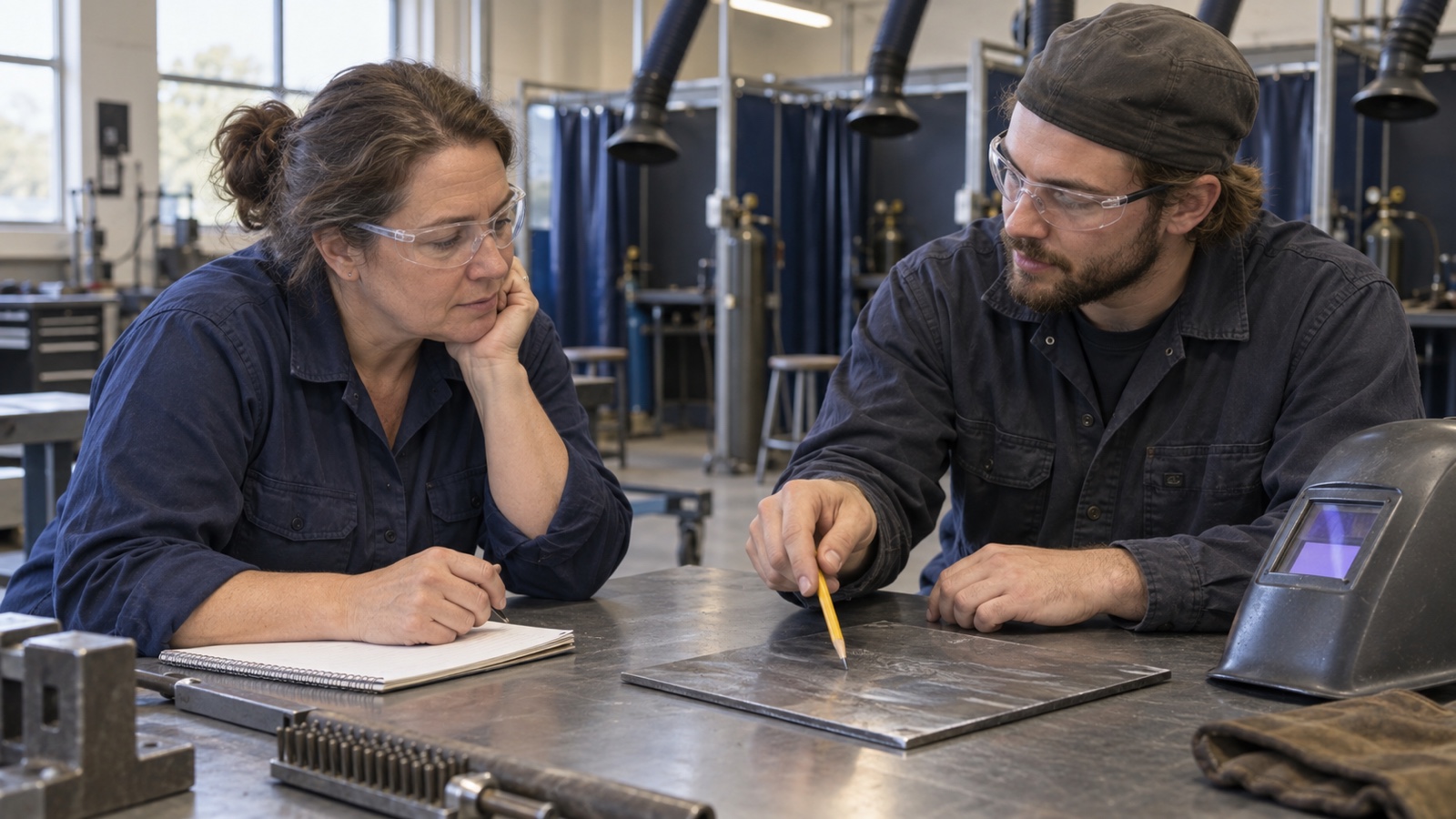
There is a particular discomfort in needing help with something simple when you are used to being the person other people ask.
You might know how to settle a difficult customer call, organize a delivery route or keep a department moving through a bad week. Then you enter a welding class and have to ask where to stand for the demonstration. The vocabulary is unfamiliar. The instructor may be younger than you. A classmate seems to understand a correction before you have finished thinking through it.
For an adult learning welding after another line of work, that change in position can feel as demanding as the new physical skill. Years of competence are still there, but they do not immediately show up on the practice plate.
That is a useful distinction to keep in mind. You can be an experienced worker and a beginning welder at the same time. Neither description cancels the other.
Your previous work comes with you
Starting a new trade does not empty out everything you learned before arriving.
Perhaps a warehouse job taught you to check a label before moving material. Customer service may have taught you how to ask a question without making a frustrated person more frustrated. Running a household may have made you good at preparing for the next day when the current one is already full.
Those examples are possibilities, not a promise that every previous job transfers neatly to welding. The point is to look for specific habits you can use. Being on time, writing down an instruction and admitting when you have not understood something are useful contributions before you produce a weld you want to show anyone.
The harder adjustment is recognizing where experience stops helping. A method that worked in another workplace may have no place in this one. Being comfortable with tools does not mean you already know the equipment, material or procedure in front of you. Let the instructor establish those foundations without having to negotiate around your résumé.
You do not need to tell the room what you used to manage. Over time, dependable behavior will make that experience visible in a more useful way.
Let the correction be about the work
An instruction can sound surprisingly personal when you have spent years knowing your job.
Slow down. Look again. Try that from the beginning. In a familiar role, those words might suggest that something has gone wrong. In a training booth, they may simply describe the next exercise.
Try turning a broad feeling of failure into a question the instructor can answer. Which part changed? What should you watch on the next attempt? Can they show the movement again before you repeat it? A specific question gives both people something to work with.
It also helps to separate understanding an explanation from being able to carry it out. You may be able to describe the task clearly and still need practice to perform it. That gap does not make the explanation useless or the attempt embarrassing. It gives the next lesson a purpose.
For instructors and experienced coworkers, the same principle works in reverse. Correct the action without making the learner’s age the subject. A new student does not need surprise that they are starting now. They need a clear demonstration, an honest assessment and room to ask the next question.
Find a route that fits your actual life
The Bureau of Labor Statistics describes several routes into welding, including technical programs, employer training and apprenticeships. It also notes that formally trained entry-level workers continue learning on the job. That supports a realistic expectation: a class can be part of a longer learning process, rather than the end of it.
Before committing to a particular program, ask about the schedule, supervised practice time, prerequisites and what students are expected to demonstrate by completion. Find out what equipment and supplies you must provide. Ask how the program’s training relates to the kind of work you are considering. A clear answer is more useful than a broad promise about opportunity.
For an adult with an existing job or family commitments, the calendar needs close attention. A class that technically fits after work may still leave no time for travel, meals or the responsibilities waiting at home. Look at a normal difficult week, not just the unusually clear week in which you decided to enroll.
If your goal is personal fabrication rather than a career change, say that too. The instruction still deserves care, but you do not have to borrow somebody else’s definition of success. Make the goal clear enough that you and the instructor can discuss whether the course is appropriate.
Measure progress against a useful starting point
Comparing yourself with the quickest person in the room tells you surprisingly little. You may not know what they have already practiced, where they learned it or what they are struggling with outside the exercise you can see.
Use your own questions as part of the record. On the first day, you might need help naming the equipment. Later, you can describe what you attempted and where it changed. Eventually, your question becomes narrower because you can identify more of the work yourself.
That is progress even before the result looks impressive in a photograph.
A brief note after class can help: what was the correction, what did you try and what do you need to ask next time? Keep it specific enough to be useful a week later. Follow the school’s rules on photographs and retaining practice pieces; a written note can do the job without taking anything home.
Give credit to the classmate who helps you, including the one who is younger. You may have something useful to offer in return, but it does not need to be an immediate exchange. Being able to learn from each other makes the room easier to work in.
There is no need to turn a later start into a heroic reinvention story. Some days it is simply a person finishing work, getting to class and trying an exercise again. That is enough to take seriously.
Did you begin learning welding after another job or career? What helped you get comfortable being a beginner again?
For welding-inspired gear and practical shop tools, explore Arc Life. Wherever you started, your route into the trade belongs in the conversation.

Leave a Reply