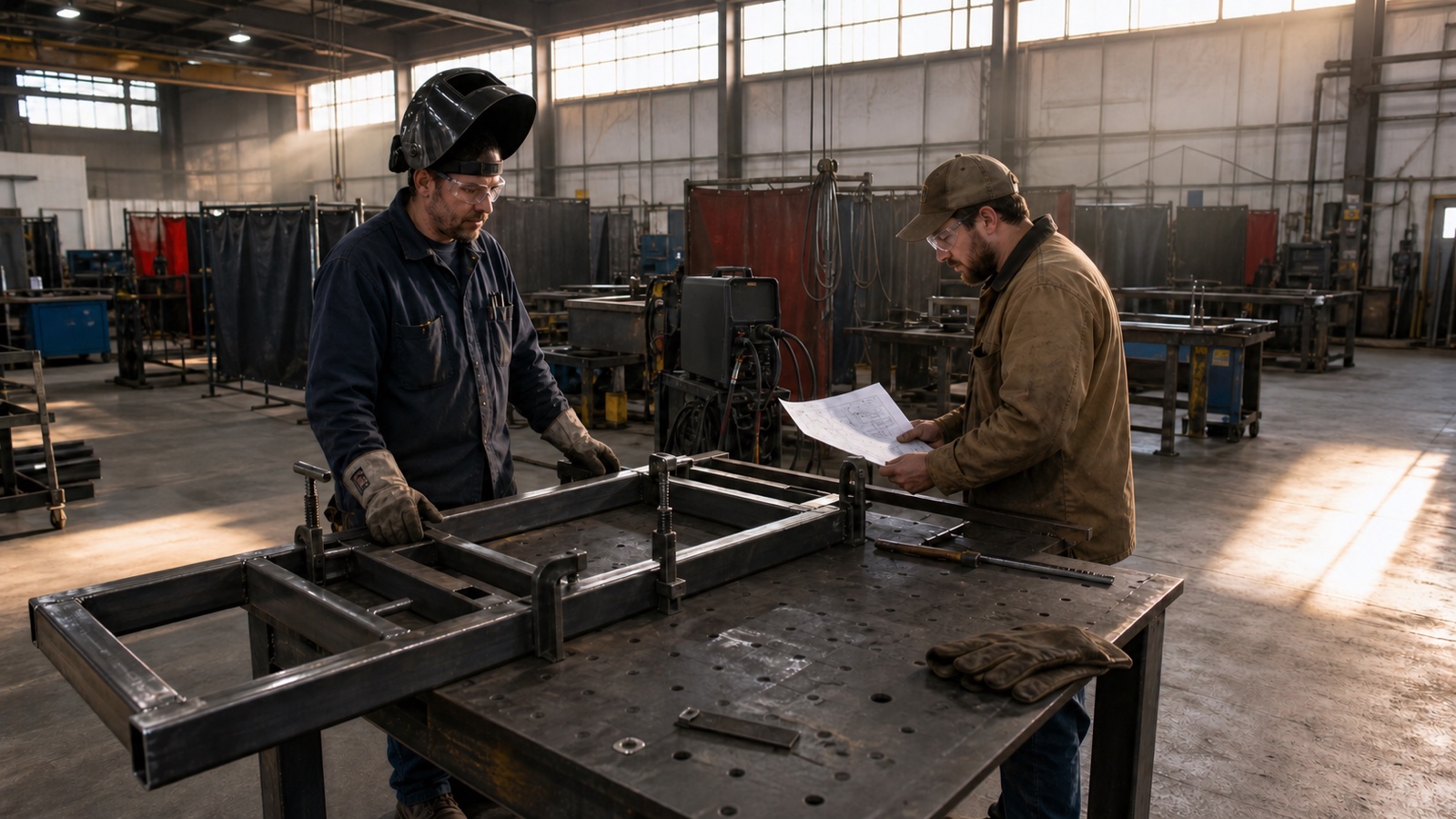
On a Saturday morning, a fabrication shop can feel twice as large as it did Friday afternoon.
The same machines sit in the same bays. The same steel waits on the same racks. Yet the building sounds different. A saw starts at one end, and everybody knows exactly who started it. A cart crossing the floor has room around it. Conversations do not have to fight their way through a full production day.
Saturday work means different things in different operations. It may be a regular production shift, voluntary overtime, a catch-up day, an installation window, or the only quiet stretch available for a one-off job. In some shops, weekend work is routine. In others, it appears only when the schedule gets tight.
The details change. The feeling is recognizable: fewer people, more space, and less cover for anybody’s habits.
The shop gets smaller without moving a wall
A weekday shop has layers. Material arrives. Supervisors move between jobs. Quality, maintenance, shipping, and production cross paths. Questions can travel through several people before the answer returns to the booth.
On a smaller Saturday crew, those layers compress. The person fitting may also be the person who tracks down the drawing. The welder may be more aware of the saw, the crane, the next operation, and the condition in which the job must be left. A lead may spend less time managing traffic and more time standing beside the actual work.
That does not turn every weekend welder into a supervisor or maintenance technician. It simply makes the full shape of the job easier to see.
The current O*NET profile for welders lists far more than striking an arc. It includes using safe work habits, examining workpieces, detecting faulty equipment or material, setting up tools, marking parts, aligning and clamping work, monitoring the process, and communicating with other people. A full crew can distribute that awareness across many stations. A thin crew makes each piece of it more visible.
Small crews reveal strong habits
Some people love Saturdays because the work can hold their attention longer. There may be fewer meetings, fewer visitors, and fewer unrelated questions arriving at the table. A difficult fit-up can stay in front of the same pair of eyes until it makes sense. A complicated repair can be discussed without three other conversations leaning into it.
The quieter pace also reveals how a person carries responsibility when nobody is hovering nearby.
Does the drawing come back out when something disagrees? Does the next operation receive a clear handoff? Does scrap reach the right place instead of the nearest empty corner? Does a minor equipment concern get reported, or does it become Monday’s surprise?
Those are not glamorous questions. They are the questions that separate independence from isolation. A trusted Saturday worker is not merely someone who can be left alone. It is someone who knows when the work is clear, when another set of eyes is needed, and when the job should stop until the right person is available.
Quiet does not change the standard
There is an easy mythology around weekend work: the experienced crew comes in, the front office is dark, and the real work finally gets done.
Sometimes a smaller group truly can move with less friction. But fewer people can also mean fewer immediate resources. The person who normally answers a detail question may be home. The usual maintenance support may be reduced. A second qualified opinion may be farther away than it was on Thursday.
That is where good weekend culture matters. The standard does not relax because the parking lot is empty. Procedures, approvals, inspection points, equipment rules, and emergency expectations still belong to the job. A quiet shop is not permission to turn uncertainty into permanent metal.
The strongest Saturday crews understand the difference between being resourceful and working outside their authority. They solve the problems that are theirs to solve. They make the unresolved ones visible for the people who need to answer them.
Overtime pride has a limit
Weekend work carries its own kind of pride. It can feel good to take a stubborn job across the line while the rest of the building is still. Extra hours may also matter to a household, a deadline, or a customer’s shutdown window.
None of that makes fatigue imaginary.
NIOSH says work-related fatigue is commonly associated with nonstandard schedules and extended hours. Its effects can include slower reaction time, reduced attention, limited short-term memory, and impaired judgment. Physically or mentally demanding work and hot environments can add to the problem.
That matters in fabrication because confidence can survive longer than concentration. A person may still feel willing to continue after the sharpness that good work requires has started to fade. Weekend toughness is not a substitute for a shop’s fatigue controls, work-rest expectations, or a worker speaking up when the edge is gone.
Respecting that limit does not weaken the Saturday crew. It protects the reason people trust that crew in the first place.
Monday can tell who worked Saturday
The best Saturday shift does not need a speech left behind. Monday sees it in the state of the shop.
The completed work is where it belongs. The open question is marked instead of hidden. The equipment concern was recorded. The booth is ready for the next person. The job moved forward without leaving a trail of mysteries for the full crew to solve.
That may be the real appeal of weekend work. With less noise around the job, craft becomes easier to recognize—not only in the weld, but in the way a small group looks after the whole chain of work.
What changes in your shop on a Saturday? Does the smaller crew make the day calmer, sharper, harder, or simply different—and what habit tells you the weekend shift left the place right?
Arc Life tells the stories behind the people and routines that give welding culture its character. You can also visit the Arc Life collection, but the Saturday-shift question belongs to the crew: what does your shop sound like when almost everyone else is home?
Leave a Reply