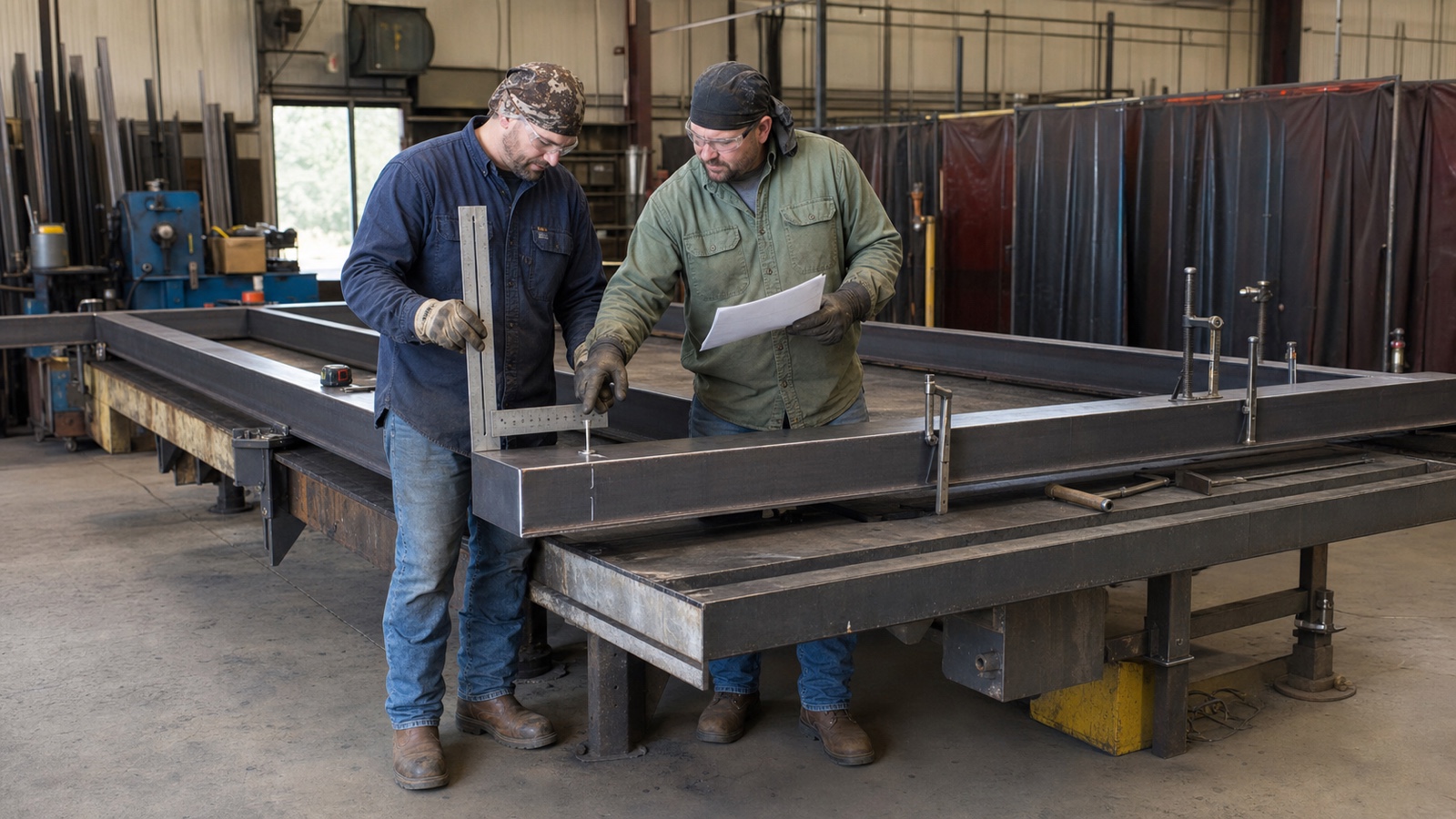
A finished weld can hide the hardest part of a fabrication job: deciding where everything belongs before heat makes the argument permanent.
By the time the hood drops, a reference point has been found. Steel has been measured, marked, cut, moved, checked, adjusted, clamped, and often tacked. Somebody has looked from the drawing to the material and back again until the two tell the same story.
That somebody may be called a fitter, fabricator, fitter-welder, layout hand, or simply the person everyone trusts to start the job. In smaller shops, the same person may fit and weld the entire assembly. In larger operations, fitting and welding may pass between different hands.
Either way, the arc is not the beginning. It is the visible part of work that is already well underway.
A drawing does not arrive as an assembly
The print is clean. The steel is not.
Paper does not show the awkward reach around a fixture, the mill scale under a square, the small variation that appeared after cutting, or the order in which several loose pieces must become one stable unit. A fitter works in that gap between the ideal drawing and the physical material.
The federal O*NET occupation profile for structural metal fabricators and fitters lists the job’s core tasks plainly: study engineering drawings, verify workpieces against specifications, lay out stock, position and align parts, set fixtures, and tack-weld fitted pieces. The Bureau of Labor Statistics gives the shorter version: structural metal fabricators and fitters cut, align, and fit together structural metal parts and may help weld or rivet them.
Those descriptions are accurate, but they do not quite capture the feel of the work. Fitting is a steady sequence of decisions that often disappear once the assembly is complete. A line becomes an edge. An edge becomes a joint. Loose parts become something rigid enough that the next person can trust it.
The fitter is not waiting for the welder
There is an old mental picture of fabrication that divides the job too neatly: the fitter gets pieces close, then the welder arrives to perform the skilled part.
Real shops are rarely that tidy.
O*NET includes welding, layout, inspection, material movement, machine setup, clamping, bracing, and alignment inside the fitter’s work. BLS, meanwhile, lists blueprint reading, measuring, inspecting material, and working to specifications among the welder’s duties. The two roles overlap because the work overlaps. A welder needs to understand the fit. A fitter needs to understand what welding will ask of the assembly.
The strongest crews do not use that overlap to protect territory. They use it to exchange information.
The fitter can explain which reference controls the assembly, where access becomes tight, and what moved during tacking. The welder can flag a joint that is difficult to reach, a sequence concern, or a detail that deserves another look before more heat enters the part. Neither handoff works well when it sounds like an order tossed over a wall.
A tack is small, but the decision is not
Tack welds barely register in the glamour version of welding. In a real fabrication sequence, they mark a commitment. They hold fitted parts together while the assembly is checked, moved through the next stage, or prepared for final welding.
That is one reason an experienced fitter can look unhurried even when production is pushing. Speed does not come from skipping the check. It comes from knowing which references matter, organizing the work so it can be verified, and catching a disagreement while the steel can still be repositioned through the shop’s approved process.
This is not perfectionism for its own sake. Every unresolved mismatch becomes somebody else’s problem. It may reach the welder as poor access, the inspector as a dimensional question, the painter as an awkward seam, or the field crew as holes that do not meet. The fitter works near the front of that chain, where a clear answer still has leverage.
The role also carries a particular kind of humility. When the fit is right, the finished piece does not announce how many adjustments it took. It simply looks inevitable.
Respect lives in the handoff
A shop reveals its culture in what happens when a welder finds a fit-up concern.
In a weak culture, the problem becomes personal. Somebody starts defending a station, a shift, or a name on a traveler. The conversation moves away from steel and toward blame.
In a strong culture, the part becomes shared evidence. The drawing comes back out. The controlling reference is identified. The people responsible for fitting, welding, supervision, engineering, or inspection are brought in according to the shop’s process. Nobody quietly fills a gap, forces a member, changes a detail, or turns an uncertainty into permanent metal merely to keep the job moving.
That response is not soft. It is disciplined. The goal is not to prove which trade is more important. The goal is to send correct work forward.
Fitters and welders earn trust the same way: by making their decisions visible enough for the next person to understand. A mark that can be read. A question raised before the arc. A handoff that includes more than “it’s ready.” A willingness to stop when the material and the drawing disagree.
Give the quiet part of fabrication its due
Welding will always be the part people gather to watch. It has light, sound, smoke, motion, and a finished bead that can be photographed. Fitting usually offers a square, a tape, a drawing, a clamp, and a person staring at steel.
Do not mistake less spectacle for less craft.
The next time an assembly lands in the booth ready to weld, notice what “ready” contains. Somebody translated dimensions into locations, kept track of reference points, handled physical material, and left the joint in a condition another craftsperson could accept. That work deserves more than being described as whatever happened before the real job began.
Who is the fitter your shop trusts, and what do they notice before everyone else? Share the habit, phrase, or quiet check that tells you a job started in capable hands.
Arc Life tells the stories behind the people, habits, and handoffs that make welding culture recognizable. You can also visit the Arc Life collection, but today’s point belongs to the fitters: the weld may finish the joint, yet the work started long before the arc.
Leave a Reply