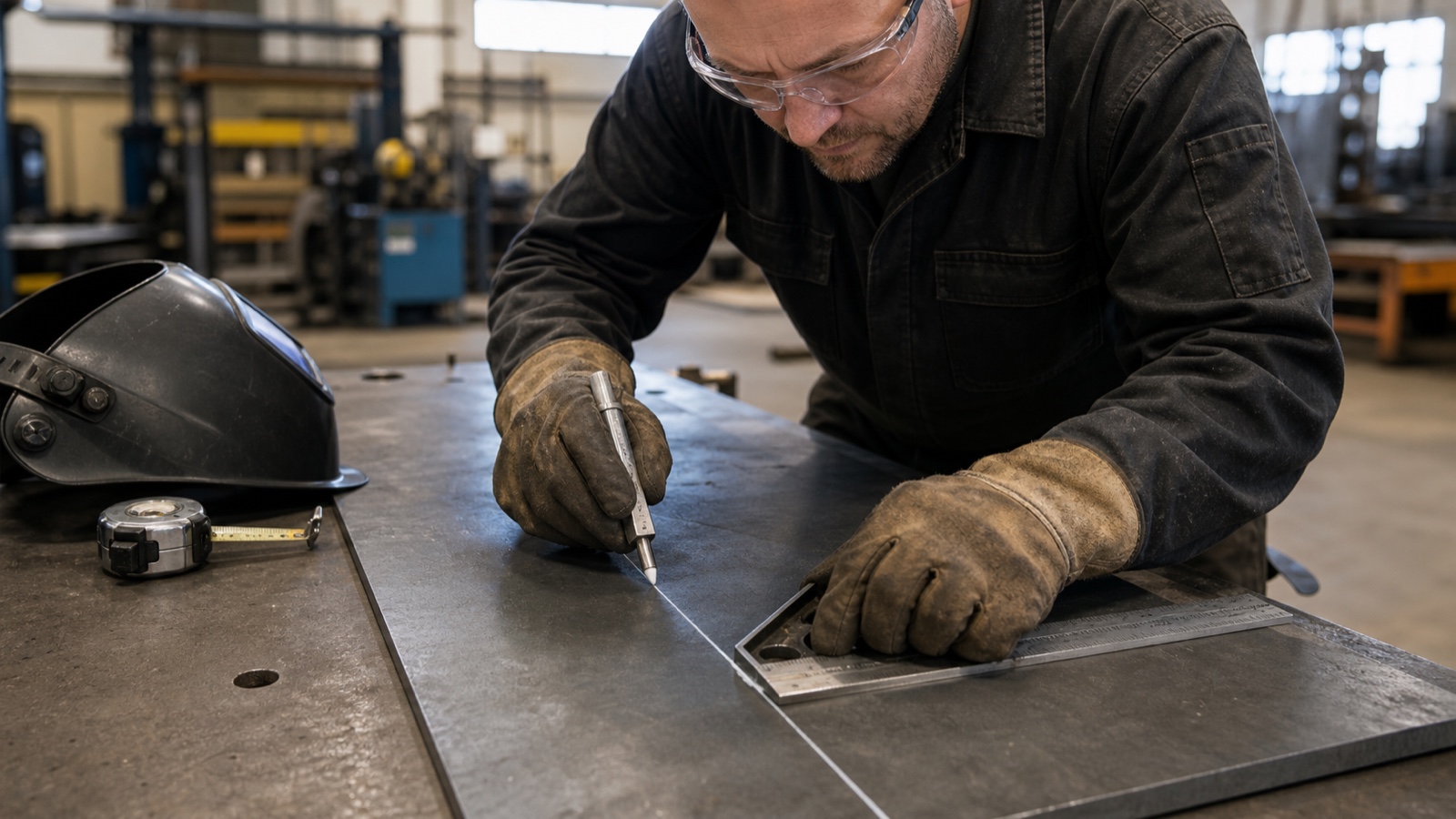
Before the arc, there is usually a line.
It may come from a laser, a scribe, a paint marker, or the edge of a template. In plenty of welding shops, though, it is still a chalky white stroke pulled across dark steel with a flat stick of soapstone. The CAD model can be open on a monitor. The CNC table can be ten feet away. The part may carry a printed traveler and a stack of tolerances. Yet somebody still reaches into a shirt pocket, finds that familiar holder, and puts a human-sized mark exactly where the next decision has to happen.
That is not a contradiction. It is the last three feet of fabrication—the space between a plan and the person making it real.
A rock with a shop job
Soapstone is almost comically simple. The U.S. Geological Survey describes talc as a hydrous magnesium silicate and notes that massive talcose rock is called steatite, with an impure massive variety commonly known as soapstone. On another USGS page, the agency describes soapstone as a talc-rich metamorphic rock that is relatively easy to cut and shape.
Those geological qualities became practical shop qualities: softness, a visible light-colored mark, and a stick that can be shaped into an edge. Markal’s current product information describes its natural soapstone as a temporary marker for welding work, available in flat, round, and square forms. The manufacturer also says the marks are easy to remove and will not contaminate the weld or damage metal. A holder adds almost no sophistication, but it helps protect a brittle stick and gives a gloved hand something solid to control.
Nothing about that sounds futuristic. That is precisely the point.
Digital precision still needs a physical conversation
Modern fabrication can carry astonishing precision from a model to a machine. Nesting software, laser tables, plasma systems, CNC press brakes, and digital measurement tools have removed a great deal of guesswork. They have not removed the need for a person to look at an actual piece of steel and decide what happens next.
A part still has an orientation. A cut still has a keep side and a drop side. A bracket still has to be checked against the assembly in front of it. A fit-up may need one clear reference that a partner can see without opening a file or scrolling through a screen.
Soapstone thrives in that gap. It has no battery, boot sequence, or menu. It can circle a questionable spot, extend an edge, mark a center, carry an arrow, or leave a short note that disappears when the work moves on. It is immediate enough for the bench and temporary enough for the process.
The tool also makes the welder slow down just enough to commit. Putting a line on steel forces a choice: this edge, this side, this direction. The mark is quick, but the thinking behind it should not be casual.
The line carries judgment
Soapstone is humble, not foolproof. A wide, soft mark can introduce uncertainty if somebody treats its center, near edge, and far edge as the same reference. A poorly sharpened stick can turn a precise layout into a fuzzy suggestion. A clear line placed from the wrong datum is still wrong.
Good layout habits do not come free with the marker. Confirm the reference surface. Know which side of the line belongs to the finished part. Check the print, the scale, the cut allowance, and the sequence. Use a scribe, fine marker, or another method when the tolerance and material call for it. Soapstone does not replace a drawing, a square, or a measurement; it makes the next action visible.
That distinction matters because experienced tradespeople rarely worship a tool. They know what it can do, what it cannot do, and when to reach for something else. A silver pencil can offer a finer mark. A paint stick can survive rough handling and weather. A scribe creates a sharper reference. Soapstone survives beside all of them because it is honest about its role: temporary, fast, readable, and easy to carry.
A small piece of shop culture
Every crew develops a visual language on steel. An X can mean scrap. An arrow can settle which way a part turns. A circle can call attention to something that needs another look. Initials, short notes, and quick sketches can turn a blank plate into a conversation that moves faster than a meeting.
The details vary by shop, which is why nobody should assume a mark means the same thing everywhere. But the habit itself is recognizable. Long before a finished weld becomes the visible proof of the job, small marks have already passed information from the print table to the saw, from the fitter to the welder, and from one shift to the next.
That makes soapstone more than an old tool that has escaped retirement. It is one of the quiet ways the trade stays physical. The person making the mark can feel the plate, see the edge, notice mill scale, spot a burr, and compare the drawing to the actual object in the same moment. The white line is not data floating above the work. It is a decision placed directly on it.
The future still has room for a white line
The strongest shops are not divided into digital people and old-school people. They use the method that carries the right information with the least confusion. Sometimes that is a model, a tablet, or a machine coordinate. Sometimes it is a soft white line drawn against a square.
There is dignity in a tool that does one job well and asks for almost nothing. Soapstone will not make a layout accurate by itself. It will not rescue a missed dimension or settle a bad handoff. In practiced hands, though, it connects intention to steel with remarkable efficiency.
So what lives in your pocket or on your layout table: flat soapstone, round soapstone, a silver pencil, a paint marker, or something else? And does your crew have a mark that every regular understands without a word?
Arc Life is built around the people, habits, and objects that give welding culture its character. If that sounds like your corner of the trade, you can also visit the Arc Life collection—but the real story is the line you put down before the hood drops.
Leave a Reply