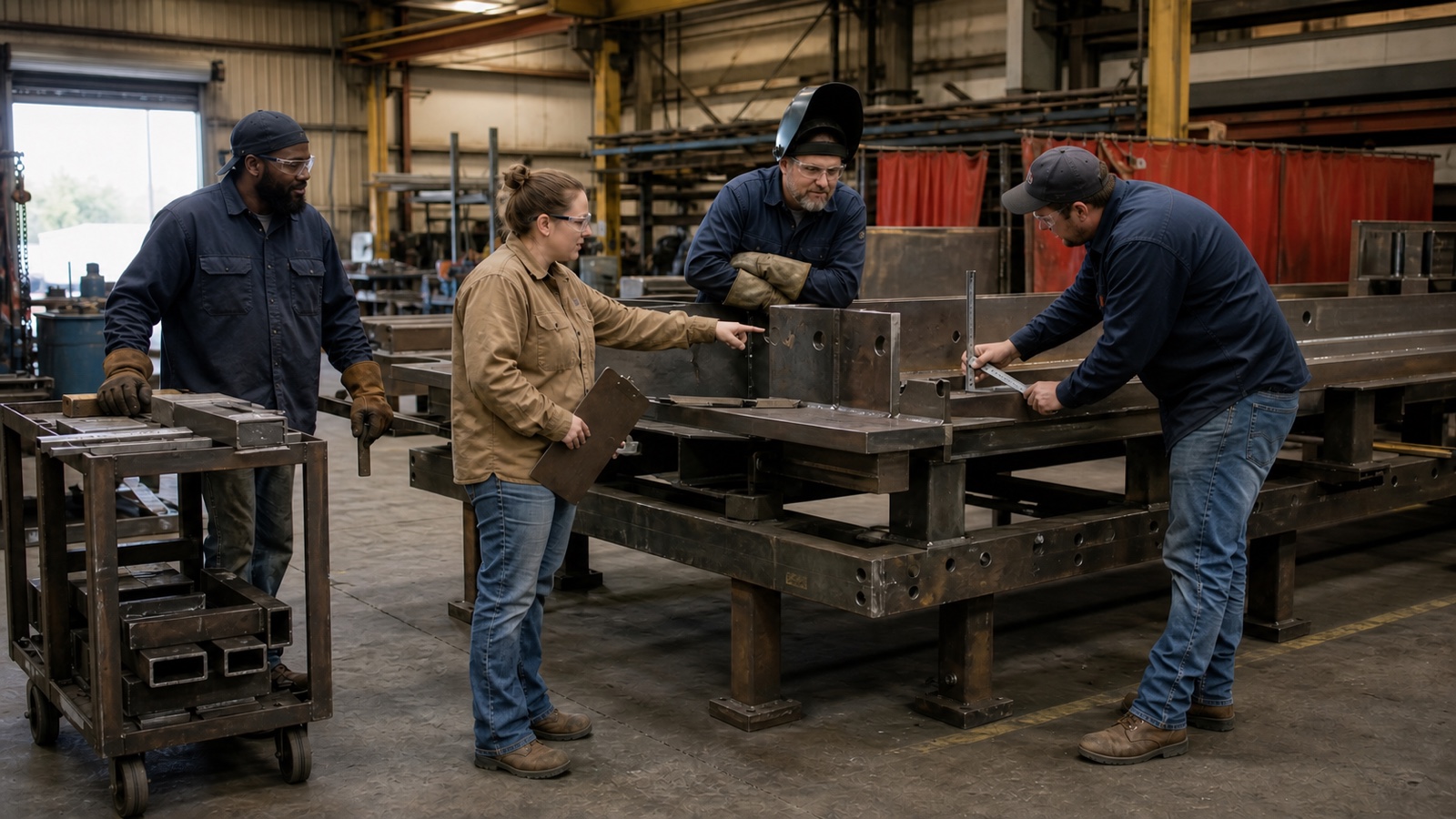
The arc is the easiest part of the job to notice.
It throws light across the shop. It makes the sound people recognize. When somebody takes a photograph, the welder under the hood usually lands in the center of the frame.
Just outside that frame, the rest of the job is still moving.
Somebody found the material and checked the piece marks. Somebody cut, formed, and fitted the parts. Somebody moved the assembly without damaging the work already finished. Somebody will inspect what was built, record what matters, and decide whether the next operation can begin. Depending on the shop, one person may wear several of those hats. On a larger job, each may belong to a different crew.
The bead can belong to one welder. The result rarely belongs to one person.
A Bright Arc Can Hide a Whole Job
Welding culture has good reasons to respect individual skill. The person holding the gun, torch, or stinger has to read the puddle and make the decisions. There is no committee inside the hood.
But individual control is not the same as individual ownership of the entire job.
The U.S. Department of Labor’s 2026 O*NET profile for welders includes much more than depositing metal. The work includes inspecting material, marking parts with job and piece identifiers, preparing surfaces, aligning and clamping work, detecting defective material, and communicating problems. The same profile treats face-to-face discussion and contribution to a work group as ordinary parts of the occupation.
That is closer to the shop most people know. A welder may spend part of the day fitting, moving material, reading a print, helping a coworker hold an awkward piece, or explaining why something needs to stop before the next bead. Job titles create lanes. Work still crosses them.
Fit-Up Is the First Handoff
A good fit-up is not a favor delivered to the welder. It is part of the finished work.
The fitter makes a series of choices the arc will reveal later: alignment, gap, orientation, sequence, access, and the stubborn question of whether the pieces in front of the crew actually match the drawing. The Bureau of Labor Statistics describes structural metal fabricators and fitters as workers who cut, align, and fit structural parts and may help weld or rivet them together. That word “help” can sound smaller than the responsibility feels on the floor.
When fit-up is thoughtful, the welder receives a joint that can be approached with a plan. When it is unclear, the professional move is not to silently weld around the uncertainty. It is to stop and bring the right people back to the work.
That conversation can take thirty seconds or half an hour. Either way, it is cheaper than pretending the handoff was complete when it was not.
The Jobs That Keep the Hood Down
Every experienced welder knows the value of the person who brings the right piece before the machine goes idle.
Material handlers, saw operators, helpers, crane operators, maintenance crews, and leads all influence the rhythm of a welding station. They keep steel arriving in the right order. They clear completed work. They replace what is empty, address what is broken, and make sure a welder is not improvising a lift because the proper support never appeared.
The work changes by industry. A small repair shop may have one person answering the phone, fitting the part, welding it, and cleaning the floor. A production plant may divide those steps across departments. A field crew has its own mix of rigging, access, weather, permits, and watch responsibilities. The titles are less important than the handoffs.
Good crews make those handoffs visible. They say what is ready, what is not, and what changed. They do not make the next person discover a problem through heat and noise.
Inspection Is Part of the Crew, Too
The old shop joke casts the inspector as the person who appears after the hard work and finds fault with it. The joke survives because tension between production and quality is real. It is also incomplete.
An American Welding Society editorial published in 2026 argues that the relationship between production and quality is pivotal and that inspection knowledge can help welders catch potential nonconformances before an inspector is called. Its better point is cultural: inspection is not an outside attack on craft. Done well, it is one of the ways a crew protects the work and the people who depend on it.
A strong inspector asks questions clearly and applies the required criteria. A strong welder does not treat every question as disrespect. A strong lead makes room for both to solve the actual problem instead of staging a contest over who knows more.
Trust is not agreement on every first look. It is confidence that everybody at the table is trying to leave behind work that can be defended.
Credit Should Travel Backward Through the Job
The finished assembly usually moves forward. Credit should be able to move backward.
Back to the person who caught the wrong piece mark. Back to the fitter who asked for a second look. Back to the helper who staged the next joint before the line stopped. Back to maintenance for getting the machine stable. Back to the inspector who explained the requirement instead of only pointing at the failure.
This does not reduce the welder’s skill. It puts that skill in its real setting.
The trade is full of individual tests, individual certifications, individual hoods, and individual names written on toolboxes. The work still becomes useful through cooperation. Even a one-person shop depends on drawings, material suppliers, customers, code requirements, and the next set of hands that will install, operate, repair, or live with what was made.
The arc deserves attention. It is bright, difficult, and worth learning. The crew deserves attention, too, because the bead is only one moment in the longer act of building something right.
Shop question: Who is the person outside the hood who makes your work better—and what do they do that most people never notice?
For more stories about the people and culture that keep the trade moving, visit About Arc Life or explore the Arc Life collection.

Leave a Reply